SEOUL DERMAL FILLERS 2026: TYPES, COSTS, AND CLINIC REALITIES
Everything foreign patients need to know before booking filler treatment in Seoul.
By Editorial
Seoul has become one of the most sought-after destinations for dermal filler treatments, and the reasons come down to three things: board-certified dermatologists and plastic surgeons at high concentration, pricing that undercuts most Western markets, and access to Korean-formulated HA brands not widely available elsewhere. Foreign patients who visit specifically for aesthetics often add filler to a Seoul itinerary alongside bigger procedures, or use it as the standalone reason for the trip.
WHAT TYPES OF DERMAL FILLERS DO SEOUL CLINICS USE?
Seoul clinics work primarily with hyaluronic acid (HA) fillers, and the brand range is wider than most visitors encounter at home. International names like Juvederm and Restylane are available at mid-to-premium clinics in Apgujeong and Cheongdam, but Korean-branded fillers, Yvoire, Neuramis, and Cleviel, dominate the market. These carry CE certification equivalent to their European counterparts and are formulated to the specific rheological preferences of Korean injectors, meaning the consistency and spread behavior suit the techniques commonly used here. Many Gangnam clinics default to Korean brands because the price-to-quality ratio is strong and supply reliability is better than imported alternatives.
Beyond standard HA fillers, clinics offer PLLA-based volumizers such as Sculptra for patients wanting longer-term results, and cannula-based injection has become standard at higher-end practices. When consulting, ask whether the clinic uses a sharp needle or a blunt cannula for the area you are treating. Cannulas carry a lower bruising risk, particularly for cheeks and temples. Clinics in Cheongdam and Apgujeong generally favor premium international brands. Sinnonhyeon and outer Gangnam neighborhoods offer comparable results with Korean brands at lower per-cc costs.
HOW MUCH DO DERMAL FILLERS COST IN SEOUL?
Filler is priced per syringe (1cc) at Seoul clinics, and the range is significant depending on brand, area, and clinic tier. Korean HA brands (Neuramis, Yvoire) run around ₩80,000 to ₩140,000 per cc (about $58 to $100). International brands like Juvederm Voluma or Restylane Lyft sit in the ₩200,000 to ₩380,000 range per cc (about $145 to $275). The Sculptra vial, which covers more volume and requires a series of sessions, is quoted at ₩350,000 to ₩600,000 per vial ($255 to $435). Most lip treatments use 0.5 to 1cc. Cheeks and jawline work can require 2 to 4cc total across both sides.
These prices usually exclude VAT. Clinics in Gangnam proper often add 10% on top of the listed amount, so confirm before booking. A number of clinics serving foreign patients have moved to foreigner-inclusive pricing with VAT absorbed. The simplest check: ask directly at booking whether VAT is included in the price. For a walkthrough of how Korean clinic price menus work and what to verify before you pay, the Seoul clinic booking guide covers the full pre-visit checklist.
WHICH AREAS DO VISITORS MOST COMMONLY TREAT?
Lips and the under-eye (tear trough) area are the two most requested treatment zones for foreign patients in Seoul. Lip filler here typically leans toward a defined, natural result rather than maximum volume, so if you want visible fullness, say so clearly in the consultation and bring reference photos. Tear trough filler is technically demanding and should only be performed by a dermatologist or plastic surgeon. At credible Gangnam and Apgujeong clinics, a licensed doctor handles every injection.
Nose filler (non-surgical rhinoplasty) is popular in Seoul and priced at ₩150,000 to ₩350,000 ($110 to $255) for 0.5 to 1cc, depending on the product. Results last six to twelve months and are reversible with hyaluronidase, making it a low-commitment entry point for patients considering a shape change without surgery. Cheek, temple, and jawline filler follows similar pricing scaled by volume. Some patients combine jawline filler with Botox masseter reduction in the same session for a more defined lower-face result. If structural lift is also a goal, the sagging jawline treatment guide compares how thread lifting and HIFU stack up against filler for that area.
WHAT DOES A FILLER CONSULTATION LOOK LIKE IN SEOUL?
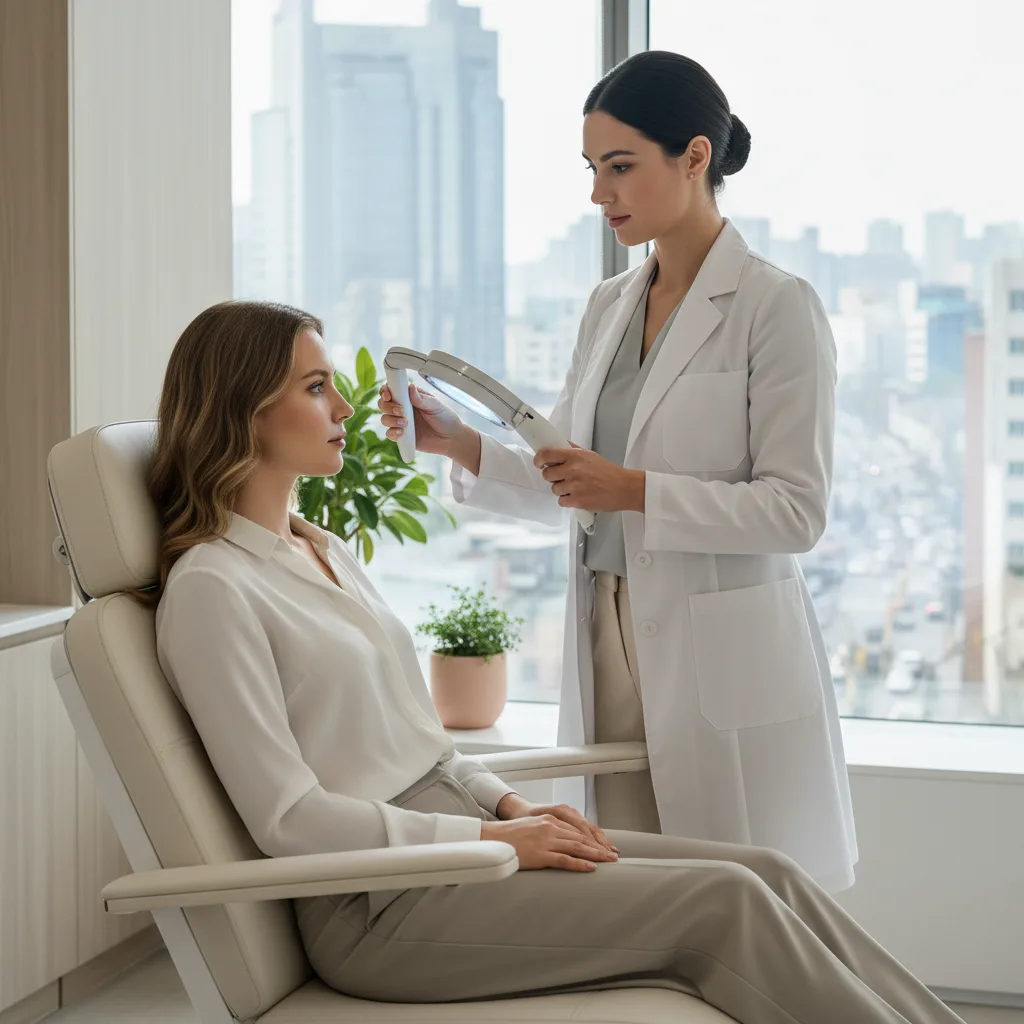
Most Seoul clinics that see foreign patients have an English-speaking coordinator who manages intake. You will complete a health history form covering blood thinners, recent procedures, and allergies, then a doctor will examine the target area under clinic lighting before recommending a product and volume. Good clinics show reference photos and confirm your goals before pricing anything. Some take before-photos as standard practice. Others do it only on request. Ask for one regardless, for your own records.
The treatment moves quickly. Lips take 10 to 20 minutes; cheeks and jawline work take 20 to 30 minutes. Numbing cream is applied 20 to 30 minutes before injection. Expect the treated area to be swollen and possibly bruised for 24 to 72 hours. Lips swell noticeably in the first 48 hours and take about two weeks to fully settle into their final shape. If you have never had lip filler before, build that settling window into your schedule rather than evaluating the result on day one.
ARE THERE RISKS SPECIFIC TO THE SEOUL CONTEXT?
The core risks with HA filler, including vascular occlusion, migration, and overfilling, are universal rather than location-specific. The Seoul-specific exposure is more about clinic selection. Walk-in clinics near tourist zones in Myeongdong and parts of Hongdae sometimes offer filler at unusually low prices, performed by staff who are not licensed medical practitioners. In Korea, filler injection is legally restricted to doctors. A per-cc price below ₩60,000 should be treated as a warning sign.
Hyaluronidase (available as Hirondelle or HRase) is widely stocked at Gangnam-area clinics, so dissolution is accessible if you have concerns post-treatment. Keep the clinic's phone number and the exact product name used at your appointment. If you experience unusual pain, skin blanching, or unexpected color changes after injection, contact the clinic the same day. These responses are rare but require prompt attention from a physician. Patients who want to layer filler with collagen-building treatments like Rejuran generally do so on a separate visit to avoid stacking recovery timelines.
- 01Korean HA brands (Neuramis, Yvoire, Cleviel): ₩80,000 to ₩140,000 per cc / about $58 to $100
- 02International HA brands (Juvederm, Restylane): ₩200,000 to ₩380,000 per cc / about $145 to $275
- 03Sculptra PLLA (per vial): ₩350,000 to ₩600,000 / about $255 to $435
- 04Typical volumes: lips 0.5-1cc, nose 0.5-1cc, cheeks/jawline 2-4cc total
- 05VAT (10%) is often listed separately. Confirm inclusion before you book.
- 06Hyaluronidase reversal is widely available in Gangnam. Keep the product name from your appointment.
Treatment guides · 6 min · May 16, 2026
← all posts
REJURAN VARIANTS EXPLAINED: HEALER, I, S, HB, EYE IN SEOUL
Every Rejuran type does something different. Here is what each variant treats, what it costs in Seoul, and which one your first booking should be.
SKIN BOOSTERS IN SEOUL 2026: JUVELOOK, PROFHILO, SCULPTRA GUIDE
A first-timer's cost, brand and clinic guide to skin boosters and collagen biostimulators in Seoul for 2026.
REVISION RHINOPLASTY IN SEOUL 2026: FIXING A FAILED NOSE JOB
A practical Seoul revision rhinoplasty guide covering cost, timing, cartilage sourcing, top districts, and which surgeons actually take secondary cases.
BREAST LIFT (MASTOPEXY) IN SEOUL 2026: COST, TECHNIQUES, RECOVERY
Everything a first-time medical tourist needs to know about mastopexy in Seoul: incision types, KRW pricing, recovery windows, and how it differs from augmentation.
LATERAL CANTHOPLASTY IN SEOUL: THE CAT EYE SURGERY GUIDE (2026)
How Korean surgeons lift the outer eye corner for a subtle cat-eye look, what it costs, and who it fits.
▶▶▶ stop reading. start matching.
FIND YOURS.
We'll pull five clinics matched to your case. WhatsApp reply within 24h.