HIDDEN COSTS IN SEOUL CLINICS: VAT, PACKAGES, PRICE TRAPS
What Seoul clinic price lists leave out, and how to keep your real bill within 5% of the number you were quoted on the phone.
By Editorial
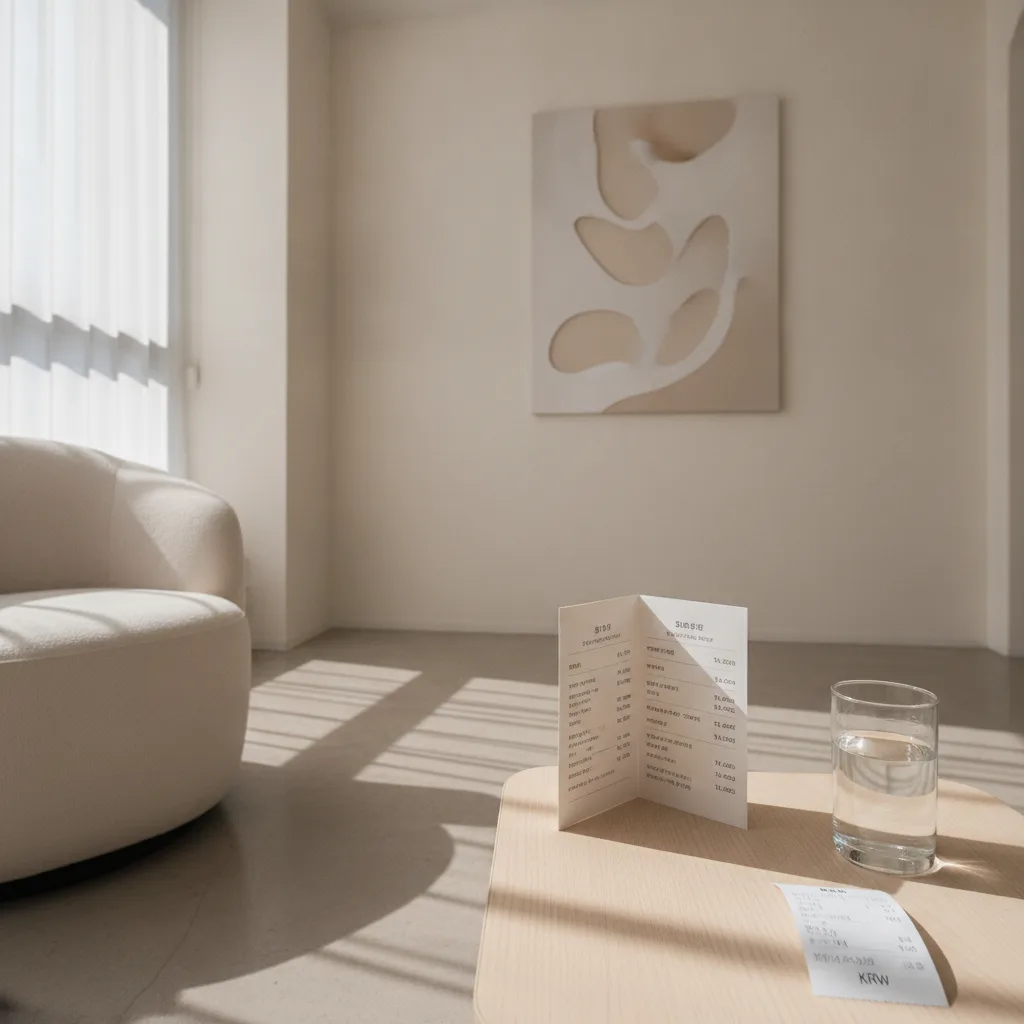
The quote you get on KakaoTalk and the number on the final receipt are almost never the same in a Seoul aesthetic clinic. The gap is rarely fraud. It is a stack of small line items, package mechanics, and VAT conventions that nobody warns you about before you sit down. This guide walks through every one of them so you can land in Seoul, hear a price, and pay something within five percent of it.
WHY THE QUOTED PRICE ALMOST NEVER MATCHES THE RECEIPT
A Seoul aesthetic clinic builds a quote the way an airline builds a fare. There is a base treatment price, a brand or device tier on top, a per-area or per-session multiplier, an upgrade chain for anesthesia or aftercare, and a tax convention that varies clinic by clinic. Foreign-facing clinics in Gangnam and Apgujeong tend to bundle most of these into the headline, while neighborhood clinics in Sinnonhyeon or Seocho usually quote the bare base and add the rest at the counter. Neither approach is dishonest. They are different ways of presenting the same total.
The trick for a first-time visitor is knowing which model the clinic uses before you commit. If you booked through an English-language coordinator at a clinic that markets to medical tourists, expect the headline to be near-final and the menu to read in tidy KRW round numbers. If you walked in cold to a small clinic with a Korean-only price board, expect the base number to be 15 to 30 percent below what you actually pay once add-ons appear. Both can be good value. The mistake is comparing the two headline numbers as if they describe the same thing.
Before any booking, ask one question that resolves most ambiguity: "Is this the all-in price including VAT, anesthesia, aftercare, and any consumables, or is it the base only?" A clinic that hesitates is telling you the headline is the base. A clinic that immediately confirms all-in usually means it. Save that answer in writing. If you want the full menu-decoding logic, the first-consultation walkthrough covers the script word for word.
VAT, LISTED PRICES, AND WHAT "WITHOUT VAT" REALLY MEANS
Korean clinics handle VAT three different ways and your final bill depends entirely on which one you walked into. The first convention is VAT-included pricing, where the menu number is what you pay. Most premium foreign-facing clinics in Apgujeong and Cheongdam use this model because it makes price comparison clean. The second is plus-10-percent pricing, where the menu number is the base and 10 percent VAT is added at the register. This is common at mid-tier Gangnam clinics and almost universal at smaller neighborhood clinics.
The third convention is the awkward one. Some clinics quote the base on the phone, add VAT only when paying by card, and waive it on cash payments. The cash discount is roughly the same 10 percent. This is not a tourist scam, it is how a lot of small Korean businesses handle taxes, and it is legal in practice. It does mean that if you are budgeting in USD, you should assume plus-10 unless told otherwise, and treat anything lower as a happy surprise rather than a baseline. Tax-free shopping schemes for tourists exist for retail goods but generally do not extend to elective medical procedures, so do not plan to recover VAT at the airport.

PACKAGE DEALS, SESSION BUNDLES, AND THE UNIT-COST TRICK
Packages are the single biggest source of confusion at the counter. A clinic will quote you ₩300,000 for one Rejuran session and then offer ₩1,000,000 for four sessions, and on paper that looks like a clean 17 percent discount. The catch is two-fold. The four sessions usually have to be used within 60 to 90 days, which forces you into a treatment cadence that may not suit your schedule, and the per-session refund is rarely clean if you do not finish the course. Some clinics refund unused sessions at the original single-session rate, which can erase the discount entirely.
The other package wrinkle is the unit-cost trick on injectables. Botox is sold by unit, but "unit" can mean a Korean unit, an Allergan unit, or a per-area bucket depending on the clinic. The Korean botox brand tiers post and the Botox cost guide walk through this in detail, but the short version is that you should always ask for the total units administered, the brand, and the per-unit price as three separate numbers. If you cannot get all three, the headline price is not comparable to any other quote you have. Filler is the same. A 1cc syringe of Juvederm and a 1cc syringe of a Korean filler are priced differently and behave differently, and a package that bundles "three areas" without naming the product is hiding more than it reveals.
- 01Ask for per-unit or per-cc pricing on every injectable, never per-area only.
- 02Confirm package validity windows in writing, and the refund rule for unused sessions.
- 03Watch for free add-ons like aftercare masks or LED sessions that get quietly priced back in if you decline them.
- 04Treat 'free consultation' as marketing language. The consultation itself is rarely the cost, but the recommendation that follows usually is.
THE CONSULTATION UPSELL LAYER
The consultation is where most hidden costs are born. A Seoul aesthetic consultation is a sales process, run by a coordinator who often works on a commission tied to what you book that day. This is not unique to Korea, but the pace and confidence with which it happens can catch first-time visitors off guard. You arrive expecting a chat about Ultherapy and leave with a quote that includes Ultherapy, two Rejuran sessions, a skin booster course, and a pico toning add-on, all bundled into a single "glow-up" package at a number that feels reasonable only because you stopped tracking the individual prices.
The defense is procedural rather than emotional. Walk in with a single named treatment, a single named area, and a written budget cap. If the coordinator recommends adjacent treatments, ask for each one quoted separately, not as a bundle. Take the quotes home. If you booked the trip around one specific procedure, the Ultherapy cost guide and the per-procedure cost posts give you the price band you should be hearing, so any number more than 25 percent above the band deserves a second look. Coordinators expect this. The good ones respect it.
PAYMENT, EXCHANGE RATES, AND SMALL BILLS THAT ADD UP
Most Seoul clinics accept foreign credit cards, but the conversion happens at your card network's wholesale rate plus whatever foreign-transaction fee your bank charges. For a ₩2,000,000 treatment, a 3 percent foreign-transaction fee adds about $45 that nobody quoted you. Dynamic currency conversion at the terminal is worse, often 4 to 7 percent above the interbank rate. Always pay in KRW at the terminal, never in your home currency, even if the staff offers.
Cash is still meaningful in Korea for elective treatments. A cash payment can unlock the VAT waive mentioned earlier, and at neighborhood clinics it can quietly knock another 5 to 10 percent off the base. Withdraw from a major bank ATM, not a convenience store kiosk, since the spread on a Citi or KB Kookmin ATM is closer to the mid-market rate. If you booked through an agency that arranged the consultation, ask whether the clinic price has been adjusted upward to cover an agency commission, which is usually 10 to 20 percent invisible to you. The booking-from-abroad guide covers which booking channels carry which markups.
- 01Pay in KRW at the terminal, decline dynamic currency conversion every time.
- 02Use a card with no foreign transaction fee for treatments over $500.
- 03Withdraw cash from a major-bank ATM in Gangnam or Apgujeong, not a hotel or convenience store.
- 04If the clinic was booked through a third-party agency, ask directly whether the price you see is gross or net of commission.
A CLEAN SCRIPT TO LOCK IN YOUR REAL PRICE
Three messages over KakaoTalk before you fly settle almost everything. First: "For [procedure name], can you confirm the all-in price including VAT, anesthesia, aftercare, and any consumables, in KRW?" Second: "If this is a package, what is the per-session refund if I do not complete the course?" Third: "Is the price different for cash versus card?" Save the screenshots. Bring them to the consultation. If the in-clinic number is higher than what you have in writing, the screenshots are your reference point, not an argument.
On the day, ask the coordinator to itemize the receipt before you pay, not after. A clean Korean clinic receipt will show the base, the units or sessions, any add-ons, and the VAT line, in that order. If anything is missing, ask for it to be added. This is normal and does not cause offense. If you want a sense of what the receipt should look like at a premium clinic, the Apgujeong premium district guide walks through what the front-desk experience tends to include at that tier.
Cost & pricing · 7 min · Jun 13, 2026
← all posts
RHINOPLASTY SEOUL: OPEN VS CLOSED COST GUIDE 2026
Open and closed rhinoplasty in Seoul cost different amounts for different reasons. Here is the 2026 price split, by technique.
RHINOPLASTY SEOUL: OPEN VS CLOSED COST GUIDE 2026
Open rhinoplasty, closed rhinoplasty, tip plasty, and revision in Seoul 2026, with KRW price bands per technique and when each one is the right call.
MOMMY MAKEOVER COST IN SEOUL 2026: BREAST, TUMMY, LIPO PACKAGES
What a combined breast, tummy, and liposuction package actually costs in Seoul in 2026, with KRW bands and clinic picks.
V-LINE SURGERY COST IN SEOUL 2026: FULL PRICE BREAKDOWN
A cost-first look at mandible reduction, genioplasty, and cortical shaving for medical tourists booking V-line surgery in Seoul.
RHINOPLASTY COST IN SEOUL 2026: FULL PRICE BREAKDOWN BY TYPE
What rhinoplasty actually costs in Seoul in 2026, broken down by technique, tier, and hidden add-ons.
▶▶▶ stop reading. start matching.
FIND YOURS.
We'll pull five clinics matched to your case. WhatsApp reply within 24h.