FOREHEAD LINES IN SEOUL: WHICH BOTOX BRAND FOR YOUR LINE TYPE
Dynamic creases and static lines need different brands and doses. Here's how Seoul clinics approach forehead Botox.
By Editorial
Forehead Botox is the single most-requested injectable in Seoul clinics, but brand selection and unit count vary more than most guides admit. Korean clinics stock four or five brands with different protein loads, onset speeds, and diffusion profiles. Picking the right one for your specific line pattern determines whether you get a natural result or an over-frozen brow.
DYNAMIC LINES VS. STATIC LINES: WHY THE DISTINCTION MATTERS
Dynamic lines form when you move your forehead. They appear when you raise your brows, then smooth out at rest. In your twenties and early thirties, these are the only lines most people have, and Botox relaxes them cleanly. The treatment targets the frontalis muscle directly, reducing the contraction that causes the crease.
Static lines stay visible even when your face is completely relaxed. They develop as collagen breaks down and the skin loses its ability to spring back. Botox can soften static lines but won't erase them the way it clears dynamic ones. Clinics in Gangnam often pair Botox with a skin booster or Rejuran Healer for patients who have both types, using the Botox to stop the muscle movement and the biostimulator to rebuild the skin structure from below.
This distinction matters because it changes the dose. A frontalis with prominent static lines needs more conservative injection to avoid over-relaxation of a muscle that's already doing less work. Over-treating static lines with the same protocol used for dynamic lines can flatten the brow arch and create a heavy appearance. A well-trained injector assesses both at consultation, ideally with the patient raising and relaxing their brows in sequence.
THE FOUR BOTOX BRANDS SEOUL CLINICS USE MOST
Korean clinics typically stock a mix of domestic and imported brands. Meditoxin (also called Neuronox in some markets) has been a workhorse in the Korean market for over 15 years. It has a clean diffusion profile, moderate onset of around three to four days, and sits at a lower price point than imported options. Most mid-tier Gangnam clinics use it as their standard offering.
Nabota (daxibotulinumtoxinA) is a domestic Korean brand that gained FDA approval in 2023, which boosted its reputation internationally. It tends to have a slightly faster onset than Meditoxin and a duration that many practitioners report as marginally longer, around four to five months versus the usual three to four. Botulax is another domestic option with wide distribution; it's generally positioned at the budget end of the Korean market and is commonly used in volume-oriented clinics near Sinnonhyeon station, where Sinnonhyeon clinics compete aggressively on price.
Allergan (the imported reference product) costs more, around ₩7,000 to ₩12,000 per unit versus ₩3,000 to ₩5,000 for domestic brands, and some patients prefer it because the result profile is familiar from treatments done in their home countries. Clinics in Apgujeong and Cheongdam are more likely to keep it on the shelf, since their clientele skews toward premium options. It is not medically superior to the Korean brands for forehead lines, but brand familiarity affects patient confidence, and that is a real clinical variable.
HOW CLINICS DOSE FOREHEAD BOTOX IN SEOUL
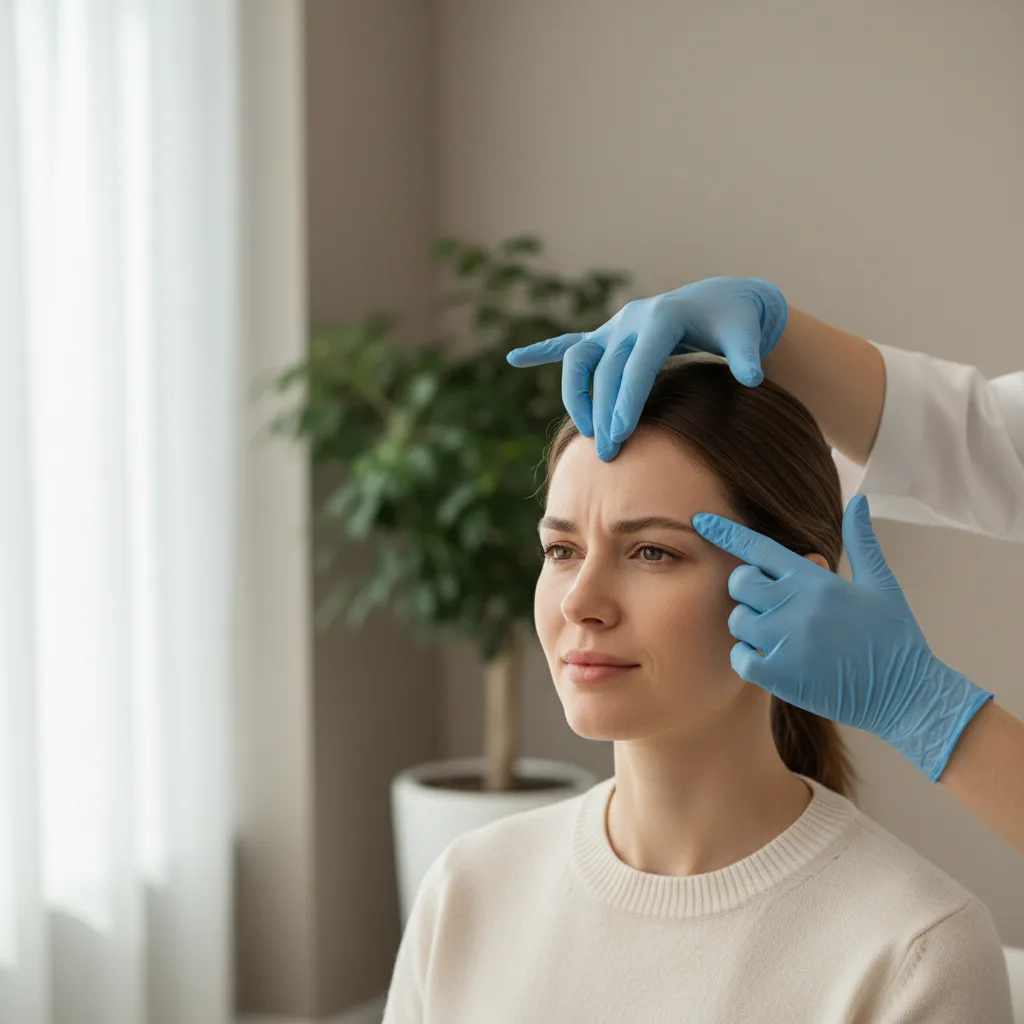
The frontalis is a large muscle that spans the full width of the forehead, but injectors don't treat the entire surface equally. Standard forehead Botox in Seoul typically runs 10 to 20 units total across four to eight injection points. The exact count depends on muscle mass, the strength of the patient's natural brow position, and whether they have a low or high brow arch that could be affected by relaxation.
Most clinics use a conservative first dose for new patients, often starting at 10 to 12 units, then assessing the result at two weeks before offering a top-up. Over-injecting on the first session is far harder to fix than under-injecting. Patients who want a lifted brow rather than a frozen one benefit from keeping the upper frontalis partially active, which requires precise zonal placement. Some clinics offer combination injection with dermal fillers for patients whose brow drop is causing deep horizontal creases that Botox alone won't fully address.
- 01Forehead only (dynamic lines): 10-15 units typical
- 02Forehead with brow lift effect (micro-dose, upper zone only): 6-10 units
- 03Forehead + frown lines (11s) combined session: 20-30 units total
- 04Full upper-face treatment (forehead + frown + crow's feet): 30-50 units
- 05Top-up at 2-week follow-up if underdosed: 2-5 additional units
HOW MUCH DOES FOREHEAD BOTOX COST IN SEOUL?
Forehead Botox pricing in Seoul comes in two forms: per-unit and per-zone. Per-unit pricing gives you clearer cost control. Domestic brands run ₩3,000 to ₩5,000 per unit, so a 15-unit forehead treatment lands at roughly ₩45,000 to ₩75,000, or about $33 to $55 USD. Allergan per-unit pricing runs ₩7,000 to ₩12,000, bringing the same 15-unit dose to ₩105,000 to ₩180,000, or $75 to $130 USD. The full Botox cost breakdown covers package pricing and VAT considerations if you're comparing multiple treatments on the same visit.
Per-zone pricing quotes a flat rate per area rather than per unit. This is more common at clinics that cater to tourists, since it's easier to communicate upfront. Forehead zone pricing typically runs ₩80,000 to ₩150,000 for domestic brands and ₩180,000 to ₩350,000 for Allergan. Per-zone pricing can be a better deal if the injector is generous with units; it can be worse if the clinic sets a low maximum and uses it as a ceiling. Always ask how many units are included in the zone price before confirming the booking.
- 01Domestic brand (Meditoxin / Nabota / Botulax), per unit: ₩3,000-5,000 / ~$2-4
- 02Allergan (imported), per unit: ₩7,000-12,000 / ~$5-9
- 03Forehead zone, domestic brands: ₩80,000-150,000 / ~$58-110
- 04Forehead zone, Allergan: ₩180,000-350,000 / ~$130-255
- 05Combination forehead + frown lines, domestic: ₩120,000-220,000 / ~$87-160

WHAT HAPPENS AT YOUR FOREHEAD BOTOX APPOINTMENT?
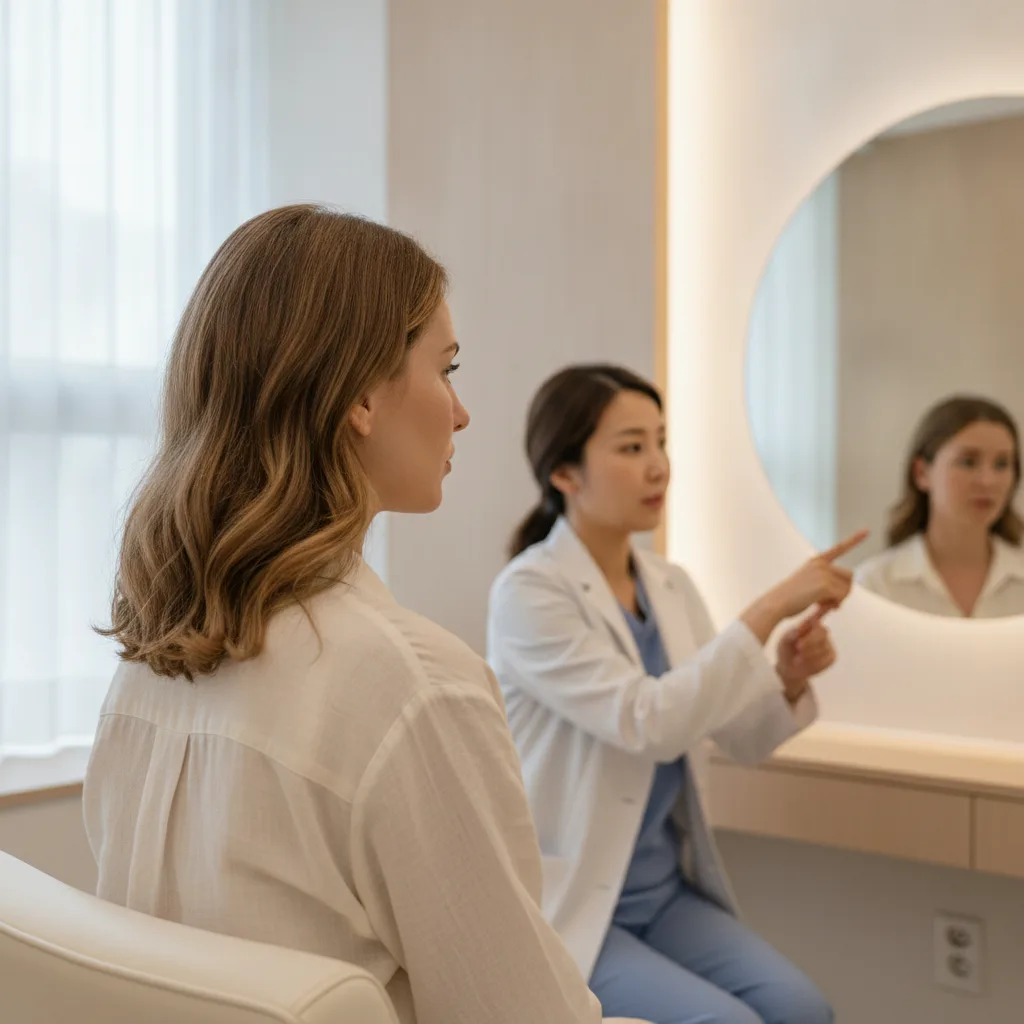
The consultation runs five to fifteen minutes. The doctor will ask you to raise your brows, frown, and relax repeatedly to map the muscle activity. Most clinics apply a topical numbing cream for 10 to 15 minutes before injecting, though experienced patients often skip it, since the injections themselves are quick and the discomfort is minimal. The actual treatment takes three to five minutes.
After treatment, expect small raised dots at each injection point for 15 to 30 minutes. Mild redness typically resolves within an hour. Most clinics ask you to avoid vigorous exercise, saunas, alcohol, and lying flat for four hours post-treatment. Full onset is visible at day three to five, with peak effect around day ten to fourteen. The two-week follow-up is worth keeping if your clinic offers it, since that's when top-ups happen if the initial dose left any movement you wanted erased.
Most clinics in Seoul offer same-day Botox without requiring a prior consultation appointment. Booking from abroad is straightforward: contact the clinic with your treatment interest, confirm which brand they stock (essential if you have a preference), and ask for available slots in your travel window. Payment is typically cash or card on the day, and no deposit is usually required.
HOW LONG DOES FOREHEAD BOTOX LAST?
Domestic Korean brands typically last three to four months for most patients. Nabota and Allergan tend to edge toward four to five months in clinical reports, though individual metabolism, muscle mass, and activity level affect duration significantly. First-time Botox patients sometimes find the first treatment wears off faster, around eight to ten weeks, with subsequent treatments lasting closer to the full four months as the muscle gradually weakens from repeated inhibition.
Static lines respond differently from dynamic ones over time. For patients with established static lines, consistent Botox every three to four months over two to three years often produces a visible improvement in resting line depth. Not because Botox repairs collagen, but because repeatedly preventing the muscle crease from forming lets the skin partially recover. A clinic worth returning to will explain this progression at your first consultation rather than just booking you for each appointment in isolation.
Concerns · 6 min · May 24, 2026
← all posts
BREAST AUGMENTATION RISKS IN SEOUL 2026: A SAFETY GUIDE
Capsular contracture, rupture, hematoma, and the red flags to catch before booking a Seoul clinic.
TWO-JAW SURGERY RISKS IN SEOUL 2026: WHAT TO KNOW BEFORE BOOKING
A candid look at nerve injury, occlusion problems, airway swelling, and revision odds for international patients considering orthognathic surgery in Korea.
BUNNY LINES BOTOX IN SEOUL 2026: NOSE WRINKLE FIX GUIDE
Small dose, big difference. What bunny lines Botox costs in Seoul, which brand to pick, and how to avoid a frozen nose.
LIPOSUCTION RISKS IN SEOUL 2026: RED FLAGS TO AVOID
The real complications from Seoul lipo, the clinic red flags that predict them, and how medical tourists reduce their odds.

HAND REJUVENATION IN SEOUL 2026: AGE SPOTS, VOLUME & VEINS
Non-surgical hand rejuvenation in Seoul: pico toning for age spots, Radiesse and Profhilo for volume loss, sclerotherapy for veins, and honest 2026 pricing.
▶▶▶ stop reading. start matching.
FIND YOURS.
We'll pull five clinics matched to your case. WhatsApp reply within 24h.