SMOKER'S LINES IN SEOUL 2026: BOTOX, FILLER & LASER OPTIONS
Fine vertical lip lines respond to different tools depending on depth, movement and skin quality. Here is how Seoul clinics stack them in 2026.
By Editorial

Vertical lip lines earn the nickname 'smoker's lines' unfairly. Most of the readers we see at Seoul clinics with these creases have never smoked. Sun exposure, decades of pursing during speech and drinking, and the natural thinning of the perioral fat pad and orbicularis oris muscle do most of the damage. Seoul's aesthetic scene treats this concern with an unusually specific ladder of tools, and matching the right rung to your line depth is where clinics separate.
WHAT ACTUALLY CAUSES VERTICAL LIP LINES?
The orbicularis oris is a sphincter muscle that circles the mouth. Every sip, every 'oo' vowel, every straw contracts it inward, and after roughly four decades the overlying skin folds along those same vectors. Layer sun damage on top, which degrades collagen and elastin in the thin perioral skin, and you get static creases that stay visible even when the face is relaxed. Volume loss in the white roll and upper lip vermilion border makes the lines look deeper than they are, because the surrounding scaffold has shrunk.
Seoul clinics grade these lines on a rough three-tier system. Tier one is dynamic only, visible only when you purse or smile. Tier two is static but shallow, faint shadows at rest. Tier three is deep static creases with visible skin thinning. The tool you need depends entirely on which tier applies to you, and a competent injector at a Gangnam clinic will grade this in the first five minutes of consultation.
MICRO-DOSE BOTOX AND THE LIP FLIP
For tier one and light tier two lines, the first tool most Seoul clinics reach for is not filler. It is a very small dose of botulinum toxin placed superficially along the vermilion border. The dose sits between 2 and 4 units total across four points, which is roughly a tenth of what goes into the glabella. The relaxation is subtle. Lips move normally, drinking through a straw still works, and the vertical pursing action softens enough to stop reinforcing the creases.
The technique is called a lip flip when the injector wants the upper lip to roll slightly outward for a fuller appearance, or micro-dose Botox when the goal is purely line softening. Korean toxin brands like Botulax and Nabota dominate this application because clinics can dose in single-unit increments. Expect around ₩50,000 to ₩120,000 for the perioral micro-dose at a mid-tier Sinnonhyeon or Sinsa clinic, roughly to . Results appear at day 5 to 7 and last around three months, shorter than glabella dosing because the muscle is thinner and the dose smaller. If you want a fuller comparison of brands, the Korean vs Allergan Botox breakdown covers it.
Botox alone will not fill a static crease. If the line still shows when your face is completely relaxed, muscle relaxation gets you maybe 30 percent improvement, not the 80 percent people hope for. That is the ceiling. Injectors who over-promise on this point are usually the ones who then upsell filler at the same appointment to make up the gap.
FILLERS: WHICH PRODUCT, WHICH PLANE?
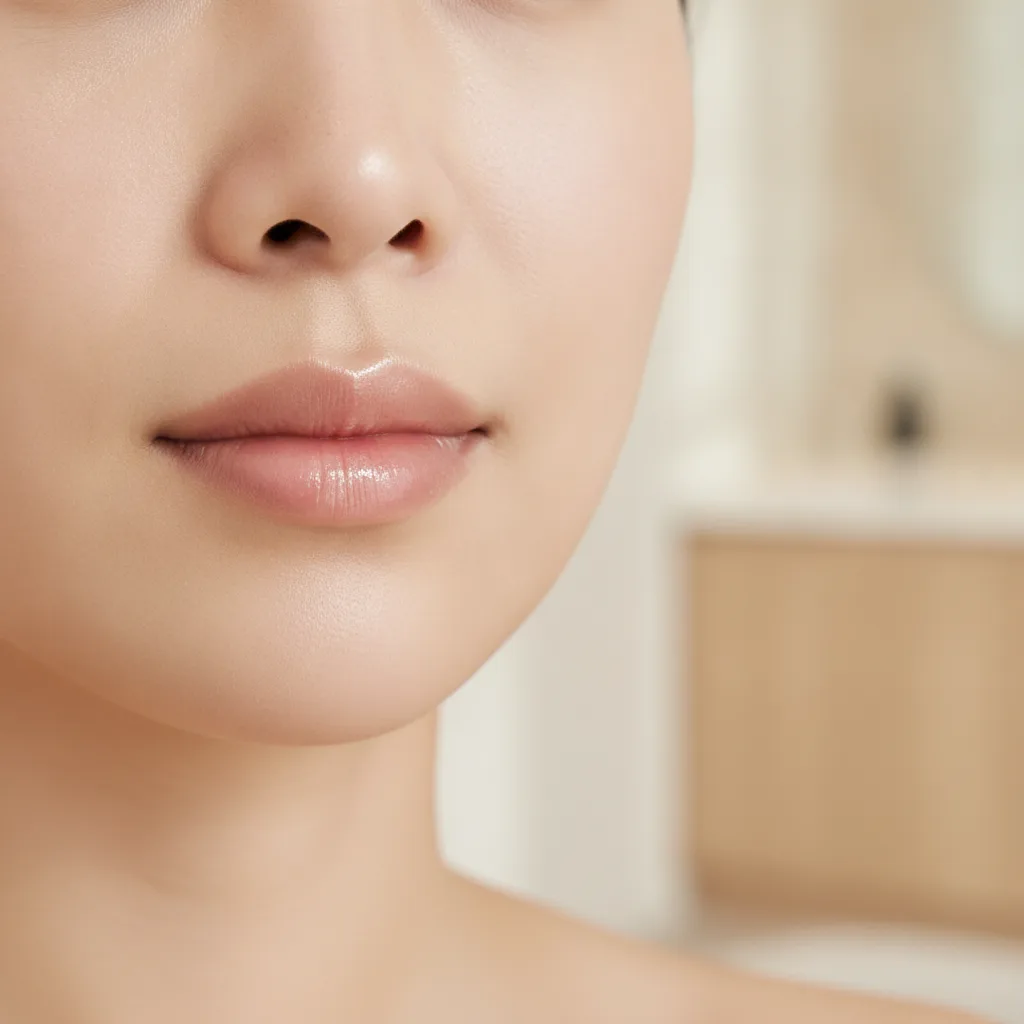
For tier two and tier three creases, hyaluronic acid filler placed in the correct plane is the workhorse. Seoul clinics use two main approaches. The first is direct intradermal fill of the line itself with a very soft, low-crosslink HA like Juvederm Volbella or Restylane Kysse. The needle rides just under the crease, deposits a hair of product, and lifts the depression flush with surrounding skin. The second approach volumizes the white roll and upper lip body with a slightly more structural HA, which restores the scaffold and makes the lines fade by proxy.
Which one you need depends on how much lip volume you have to start with. A patient in her mid-fifties with thin lips and deep tier three lines typically needs both, delivered in a single session, at around ₩450,000 to ₩700,000 for one syringe, roughly 0 to 0. A patient in her early forties with plump natural lips and shallow tier two creases often only needs 0.3 to 0.5ml of soft HA directly in the lines, priced by fraction of syringe at some clinics or as a full syringe at others. The dermal filler cost guide walks through the per-syringe menu in detail.
WHERE DOES LASER RESURFACING FIT IN?
For tier three deep static lines, especially when the perioral skin also shows crepey texture and sun damage, injectables alone leave a ceiling of improvement around 60 percent. Seoul clinics push the last 30 percent with fractional laser resurfacing, either CO2 or erbium, and the perioral zone is one of the classic treatment areas because the skin heals well and the results photograph dramatically.
The standard protocol is one to three sessions spaced eight to twelve weeks apart. Downtime runs four to seven days of visible redness and micro-crusting, and you cannot wear makeup for the first three days. Pricing sits around ₩350,000 to ₩600,000 per session for the perioral zone alone, or ₩900,000 and up if you bundle full lower face. Full picosecond and fractional pricing is in the laser treatments cost guide. Clinics in Apgujeong tend to run the newest devices.
One clinical detail that matters. Laser resurfacing directly on lines without addressing underlying muscle activity and volume loss produces short-lived improvement, because the same forces that created the lines are still working. Sequencing matters. Most Seoul clinics run the ladder as micro-dose Botox first to quiet the muscle, HA filler second to rebuild the scaffold, laser third to smooth residual texture. Skipping steps or reversing the order wastes money.
SKIN BOOSTERS AND REJURAN FOR THE MAINTENANCE LAYER
The final rung is not corrective. It is preventive and cumulative. Skin boosters and polynucleotides do not fill lines and do not paralyze muscles. They improve skin hydration, elasticity and dermal thickness over a course of three to four sessions. In the perioral zone this means the treated skin holds up better against pursing forces, and future lines form slower. Rejuran Healer is the standard for this area at around ₩250,000 to ₩350,000 per session, and Profhilo or Juvelook run ₩350,000 to ₩500,000. See the Rejuran vs skin boosters comparison for how they differ.
- 01Tier 1 (dynamic only): micro-dose Botox, ₩50k-₩120k, 3-month cycle
- 02Tier 2 (shallow static): soft HA filler in line + micro-Botox, ₩500k-₩800k combined
- 03Tier 3 (deep static): HA filler for scaffold + fractional laser 1-3 sessions, ₩1.2M-₩2.5M total
- 04Maintenance: Rejuran or Profhilo, 3-session course, ₩750k-₩1.5M annually
HOW LONG DOES PERIORAL TREATMENT RECOVERY TAKE?
Micro-dose Botox has effectively zero downtime. Tiny pinpricks at the injection sites vanish inside an hour, and you can eat normally the same day. Avoid pursing your lips through a straw or heavy exercise for the first four hours so the toxin sets where it was placed. Filler has moderate downtime. Expect swelling for 24 to 48 hours and a small chance of bruising that lasts three to five days. Sensitive lipwork can swell visibly enough that most patients schedule three clear days before any important social event.
Laser resurfacing has the longest recovery. Days one and two show redness and swelling comparable to a bad sunburn. Days three through five show micro-crusting that flakes off with gentle cleansing. Days five through seven the skin is pink and needs SPF 50 discipline for at least eight weeks after. If you are flying home to a beach holiday, read the flying home after Seoul treatments guide before booking.
“Sequencing matters. Botox first to quiet the muscle, filler second to rebuild the scaffold, laser third to smooth residual texture. Skip steps and you waste money.”
WHAT DOES A FULL PERIORAL PROTOCOL COST END-TO-END?
A realistic 2026 budget for a first-time medical tourist treating tier two lines in Seoul lands between ₩1,200,000 and ₩1,800,000, or roughly 0 to ,350 depending on district and injector seniority. That covers a micro-dose Botox session, one syringe of soft HA filler placed by an experienced injector, and a follow-up review at week two to touch up any settling. Add ₩900,000 to ₩1,500,000 for a two-session laser resurfacing course if lines are tier three. Compare this against London, New York or Sydney and you are typically at 40 to 55 percent of home-country pricing for equivalent injector experience.
The maintenance schedule after the initial correction runs around ₩1,500,000 to ₩2,500,000 per year at Seoul rates. That covers three Botox cycles, one filler top-up around month 10, and a Rejuran course of three sessions. Most patients time this to a single annual Seoul trip and stack a few other concerns like under-eye hollows or a Ultherapy touch-up into the same visit.
Concerns · 7 min · Jul 11, 2026
← all posts
BREAST AUGMENTATION RISKS IN SEOUL 2026: A SAFETY GUIDE
Capsular contracture, rupture, hematoma, and the red flags to catch before booking a Seoul clinic.
TWO-JAW SURGERY RISKS IN SEOUL 2026: WHAT TO KNOW BEFORE BOOKING
A candid look at nerve injury, occlusion problems, airway swelling, and revision odds for international patients considering orthognathic surgery in Korea.
BUNNY LINES BOTOX IN SEOUL 2026: NOSE WRINKLE FIX GUIDE
Small dose, big difference. What bunny lines Botox costs in Seoul, which brand to pick, and how to avoid a frozen nose.
LIPOSUCTION RISKS IN SEOUL 2026: RED FLAGS TO AVOID
The real complications from Seoul lipo, the clinic red flags that predict them, and how medical tourists reduce their odds.
HAND REJUVENATION IN SEOUL 2026: AGE SPOTS, VOLUME & VEINS
Non-surgical hand rejuvenation in Seoul: pico toning for age spots, Radiesse and Profhilo for volume loss, sclerotherapy for veins, and honest 2026 pricing.
▶▶▶ stop reading. start matching.
FIND YOURS.
We'll pull five clinics matched to your case. WhatsApp reply within 24h.