FIRST-TIME BREAST AUGMENTATION IN SEOUL: WHAT TO EXPECT (2026)
A first-timer's walkthrough of breast augmentation in Seoul in 2026: consultation, implant choices, hospital stay, recovery timeline, and the exact fees to expect.
By Editorial
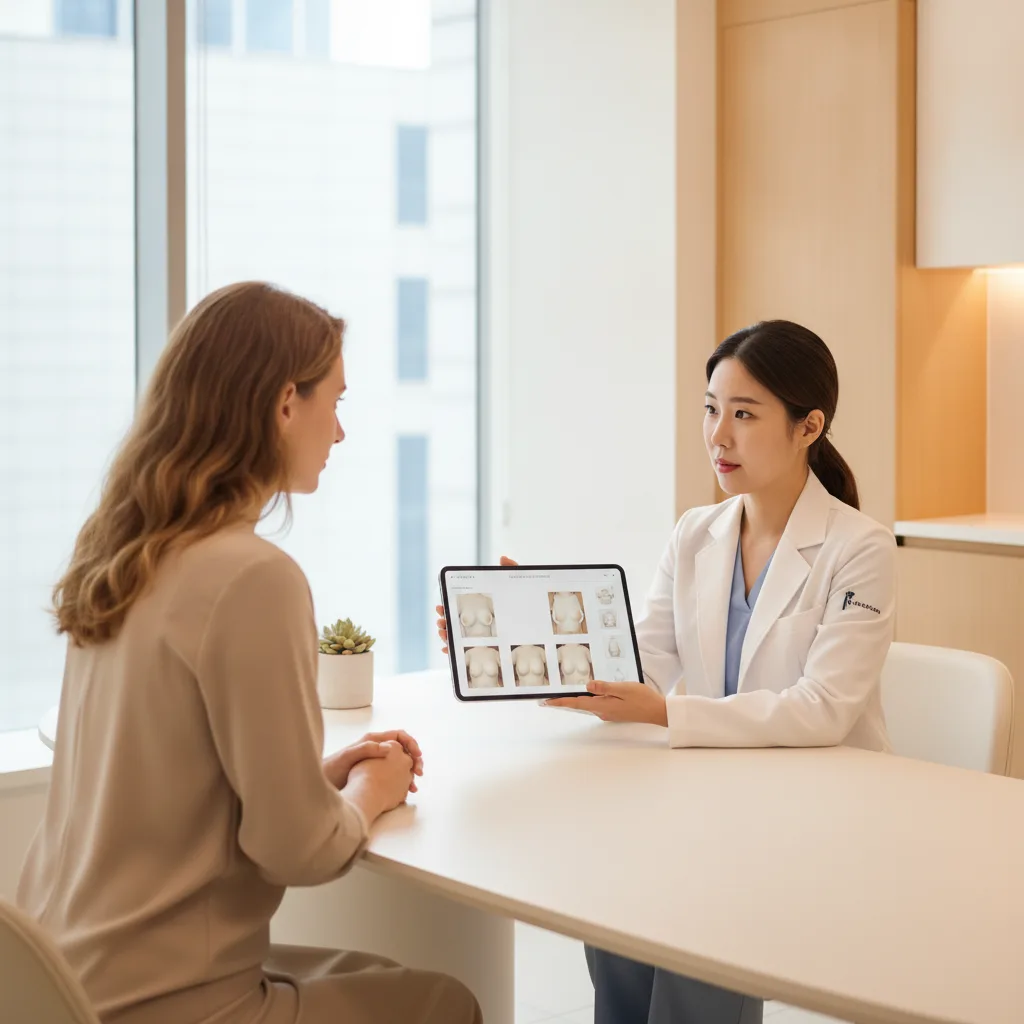
A first breast augmentation in Seoul in 2026 typically involves two consultation visits, one operating day, one or two hospital nights, and about ten to fourteen days in the city before flying home. The all-in price sits between ₩8,500,000 and ₩22,000,000, or roughly $6,300 to $16,300 USD, depending on implant brand, plane, incision, and whether fat transfer is combined. This guide walks the trip from your first inquiry email to the compression bra you'll live in for six weeks.
BOOKING THE CONSULTATION FROM ABROAD
Most Seoul plastic surgery clinics still confirm surgical bookings through KakaoTalk rather than email, so download it before you start reaching out. Send frontal, three-quarter, and side photos from the shoulders up plus a topless mirror shot with arms relaxed at your sides. Include your height, weight, band and cup size, whether you have kids or plan to breastfeed, any prior chest surgery, and your target look in one sentence, for example 'natural teardrop, one cup larger, still fits button shirts.' Serious surgery clinics reply within 24 to 48 hours with a preliminary quote range and a suggested surgery date. If you get an immediate hard number or a discount before video consultation, treat it as marketing rather than a medical opinion. For the mechanics of the wider booking process, the walkthrough in how to book a Seoul aesthetic clinic from abroad applies here too.
Ask for a live video consultation with the operating surgeon, not only the coordinator. A ten-minute video call tells you whether the surgeon actually assesses your tissue thickness, chest width, and skin envelope, or whether they push a preset package. Clinics that route international first-timers through Saero Plastic Surgery, Wonjin Plastic Surgery, or MINE Plastic Surgery generally offer the video step by default because they run high international volume and know serious patients pre-screen. Confirm in writing which surgeon operates on your day, the implant brand and profile they recommend, and whether a fellow or junior assists. Every plastic surgery clinic in Seoul has a lead surgeon and a bench; you want to know which one is holding the scalpel.
THE TWO-VISIT CONSULTATION MODEL
Almost every reputable Seoul clinic runs a two-visit model for foreign breast augmentation patients. Visit one is the in-person consultation, blood work, EKG, chest measurement, 3D simulation with Vectra or Crisalix, and implant sizing with rice bags or the Motiva JOY test kit. This visit takes two to three hours and usually happens on day one or day two of your trip. Visit two is the pre-op check the morning of surgery: fasting confirmation, anesthesia briefing, marking on your chest with a surgical pen while you stand, and payment settlement. In between you have 24 to 72 hours to sit with the recommendation, walk around Apgujeong or Gangnam, and change your mind about size without feeling rushed.
Bring your recent blood panel, EKG, and any prior imaging if you have them. Korean clinics will run their own tests regardless because the anesthesiologist needs same-week values, but showing that you arrived prepared changes how the medical team reads you. The 3D simulation is not a promise, it is a shape reference. Focus on whether the surgeon adjusts implant profile based on your natural upper-pole slope, your intermammary distance, and the pinch test at your inframammary fold. If the answer to every question is 'Motiva Ergonomix 300cc,' you are being handed a template. A good surgeon will explain why a moderate-plus profile fits your chest width instead of a full profile, or why 275cc reads bigger on your frame than 325cc on a wider chest.
CHOOSING IMPLANT, PLANE, AND INCISION
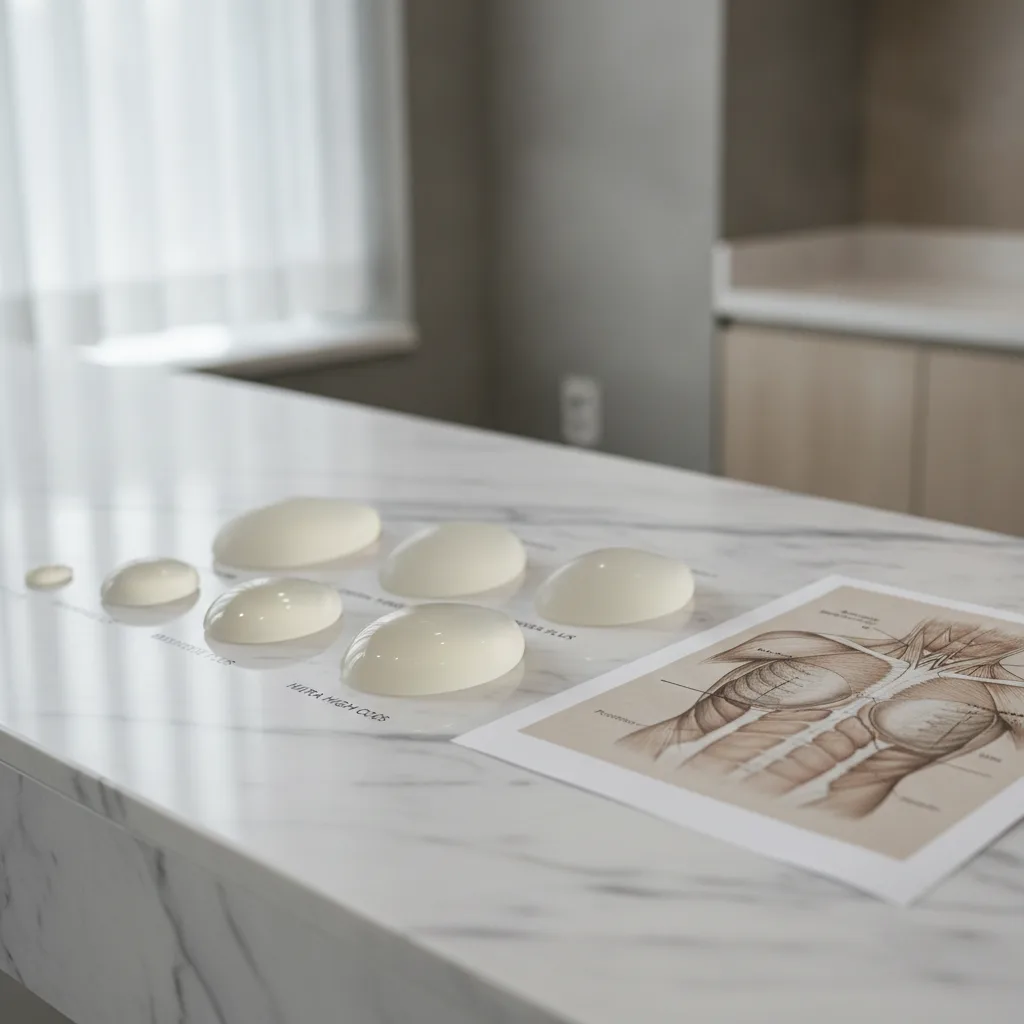
Three decisions determine most of your result. Implant type: Motiva Ergonomix SmoothSilk and Mentor MemoryGel are the two most common in Seoul first-timer cases, with Motiva slightly more popular in Gangnam clinics because the ergonomix gel shifts under gravity in a way that mimics natural tissue. Round textured implants are used less often in 2026 following the global BIA-ALCL guidance, and most Korean surgeons now default to smooth or nano-textured. Fat transfer to the breast is offered as a hybrid option when the surgeon can harvest 400 to 800 ml from your flanks or thighs, and it adds ₩3,000,000 to ₩5,000,000 to the base implant quote.
Plane: dual-plane subpectoral is the default for thin patients with less than 2 cm of pinch tissue at the upper pole, because muscle coverage hides the implant edge and reduces rippling. Subfascial or subglandular sits above the muscle, gives faster recovery, and works when you have adequate soft tissue. Incision: inframammary in the crease is the workhorse, gives direct access, hides in the fold, and is the choice for most first-time augmentations. Periareolar sits at the lower half of the areola and works when you also want an areola reduction. Transaxillary through the armpit is more common in Korean patients because it leaves no scar on the breast itself, but it is technically harder and not every surgeon does it well. The cost differences by technique are broken down further in the breast augmentation cost guide.
- 01Base implant surgery, dual plane, Motiva or Mentor: ₩8,500,000 to ₩13,000,000
- 02Fat transfer added to implant: +₩3,000,000 to ₩5,000,000
- 03Deep-plane or complex revision by senior surgeon in Apgujeong: ₩16,000,000 to ₩22,000,000
- 04One night hospital stay, standard post-op meds, three to five follow-ups, compression bra: usually included
- 05VAT (10%): sometimes included, sometimes added, always ask in writing
HOW LONG SHOULD I STAY IN SEOUL?
Plan for ten to fourteen days in the city. Day one and two: consultation, blood work, sizing. Day three: surgery, one night in the clinic's inpatient room. Day four: discharge, back to your hotel, first shower usually cleared. Day five to seven: two drain-check visits if drains were placed, otherwise one wound check. Day eight to ten: stitch removal for periareolar or transaxillary incisions, inframammary sutures are dissolvable. Day eleven to fourteen: final check, clearance to fly, prescription refills for the flight. Book a hotel with an elevator, a bathtub-free shower, and a bed you can climb out of by rolling to your side. Serviced apartments in Apgujeong, Cheongdam, or Sinsa run ₩150,000 to ₩350,000 per night and put you within a ten-minute taxi of every major surgery clinic. The Apgujeong district guide covers the walkable clinic cluster in more detail.
THE RECOVERY TIMELINE, WEEK BY WEEK
Day zero to three is the hardest window. Chest feels tight, breathing is shallow, sleep must be on your back at a 30 degree incline with pillows under your knees. Pain sits at 6 or 7 out of 10 on day one, drops to 3 or 4 by day three. Ice packs 20 minutes on, 40 off. No lifting your arms above shoulder height. Day four to seven: swelling peaks around day five, implants sit high and feel tight, this is normal and not a size problem. You can walk gently around your neighborhood by day four. Week two: swelling starts dropping, implants begin descending, sleeping is still back-only. Week three to four: allowed to sleep on your side with a pillow between the breasts, cleared for light desk work and gentle walking.
Week five to six: implants have dropped into the lower pole, upper pole slope softens, cleared for lower body strength training and yoga excluding chest and shoulders. Week eight: chest workouts back on with light weight, no heavy pressing until week twelve. Final shape settles somewhere between month three and month six as the capsule matures. Scars go through a red raised phase for the first three months, then flatten and lighten over 12 to 18 months. Silicone tape or sheeting starting week three is the standard scar protocol most Seoul clinics send you home with. If you smoke, stop four weeks before surgery and stay off for six weeks after; nicotine strangles the blood supply to the incision and the capsule, and it is the single fastest way to turn a clean case into a wound-healing problem.
LANGUAGE, TRANSLATORS, AND HOW SURGEONS ACTUALLY COMMUNICATE
Surgical clinics running foreign volume assign you a coordinator who speaks English, Chinese, Japanese, or Thai depending on their patient base. The coordinator handles scheduling, quotes, and hand-holding, but the operating surgeon usually consults in Korean through the same coordinator translating. This is fine for measurements and medical history, but you should insist on a slow, repeated read-back for the surgical plan: implant brand, exact cc, profile, plane, incision, and expected downtime. Ask the surgeon to write it in English on the consent form, not only in Korean. The mechanics of how translation actually plays out inside the room, and what to watch for, are covered in the translator services guide.
WHAT TO BRING, WHAT TO SKIP
- 01Two front-close soft bras (button or zip), one to wear home, one spare
- 02Loose button-front tops and cardigans; nothing pulls over your head for 3 weeks
- 03Slip-on shoes; you cannot bend down to tie laces comfortably for 10 days
- 04Wedge pillow or two firm pillows to prop your torso at 30 degrees
- 05Silicone scar tape or sheets (clinic will suggest a brand; buy after surgery, not before)
- 06Electrolyte packets, straws (drinking from a cup while reclined is awkward), and stool softener for the codeine week
- 07Skip: underwire bras, tight sports bras, pull-over hoodies, gym clothes, high heels
A clean breast augmentation booking carries aftercare in writing on day one: compression bra protocol, drain check schedule, specific scar tape brand, lifting restrictions by week, and the emergency number that reaches a nurse at 2 AM. Walk the clinic through the 15-question consultation checklist and get those five aftercare lines on your file alongside the implant brand and plane decision. Patients who leave Seoul with the aftercare schedule in a WhatsApp screenshot run into the capsular contracture conversation at month eighteen with no written protocol to reference.
HOW MUCH DOES BREAST AUGMENTATION COST IN SEOUL FOR A FIRST-TIMER?
A first-time patient choosing a mid-tier Gangnam clinic, dual-plane subpectoral, Motiva Ergonomix 275 to 325cc, inframammary incision, one night stay, five follow-ups, and standard compression bra usually pays ₩10,500,000 to ₩14,500,000, or about $7,800 to $10,700 USD. Add ₩1,000,000 to ₩2,000,000 for VAT if not included. Add ₩3,000,000 to ₩5,000,000 for a hybrid fat transfer. Add ₩1,500,000 to ₩4,000,000 for a senior-surgeon uplift in Apgujeong. Excluded from every quote: your flight, accommodation for 10 to 14 nights, meals, taxis to check-ins, and travel insurance that specifically covers elective surgery abroad (many standard policies exclude it, buy a specialist policy).
HOW SOON CAN I FLY HOME AFTER BREAST AUGMENTATION IN SEOUL?
Most Seoul surgeons clear international patients to fly home between day 10 and day 14 after uncomplicated primary augmentation. Under 10 days raises risk of DVT and pressure changes on fresh implants, over 14 is more comfortable but often overkill. Wear the compression bra, walk the aisle every 90 minutes on long-haul, drink water constantly, and choose an aisle seat you can slip out of without leaning across a neighbor. Skip carry-on for the return leg; you cannot lift a bag into an overhead bin for four weeks. The flying-home recovery rules guide breaks the cabin protocol down further.
WHAT IF I NEED REVISION OR SOMETHING GOES WRONG?
Every reputable Seoul plastic surgery clinic offers a revision policy on primary augmentation, typically covering size change, capsular contracture, or implant malposition for 12 to 24 months at no additional surgical fee, with the patient paying only for hospital stay and implants. Read the exact clause in your consent form before signing. Motiva implants carry a lifetime warranty on rupture and a limited warranty covering Baker grade III to IV capsular contracture within ten years. Ask specifically what happens if you develop capsular contracture 18 months out at home in Sydney or Los Angeles: does the Seoul clinic reimburse a local revision, cover flights back, or only re-operate in Seoul at their cost. The answer varies clinic to clinic and matters more than any 3D simulation.
First-timer · 11 min · Sep 3, 2026
← all posts
SEOUL CLINIC CONSULTATION CHECKLIST: 15 QUESTIONS TO ASK BEFORE YOU PAY A DEPOSIT (2026)
A deposit-blocking checklist of the exact device, dose, credentials, and aftercare questions every Seoul clinic should answer on the first consult.
LIENJANG HONGDAE REVIEW: HONEST 2026 GUIDE & WHAT TO EXPECT
What Lienjang Hongdae actually feels like for foreign patients: real prices, English and Chinese support, popular treatments, and whether it earns its 4.9 rating.
NEST SKIN CLINIC GANGNAM REVIEWS: HONEST 2026 GUIDE
Real KRW prices, native English support, and a reviewer-voice look at whether Nest Skin Clinic Gangnam is worth a flight.
NBOM CLINIC HONGDAE REVIEWS: THE COMPLETE 2026 GUIDE
A reviewer's walkthrough of nBOM Clinic Hongdae: signature treatments, honest price bands, English support, and what repeat patients actually say.
SHINEBEAM GANGNAM: HONEST 2026 GUIDE & WHAT TO EXPECT
An honest reviewer's take on Shinebeam Gangnam in 2026, with real KRW prices, English support notes, and how a visit actually flows.
▶▶▶ stop reading. start matching.
FIND YOURS.
We'll pull five clinics matched to your case. WhatsApp reply within 24h.