INCISIONAL VS NON-INCISIONAL DOUBLE EYELID SURGERY SEOUL 2026
Three methods, three recovery timelines, three price bands. Here is which one actually matches your eyelid, with Seoul clinic prices in KRW and USD.
By Editorial
Three incisions decide the result. Full incisional cuts a 25 to 30 millimetre line along the pretarsal crease, non-incisional (also called buried suture or DST) threads two or three permanent loops through four tiny punctures, and partial incisional splits the difference with an 8 to 12 millimetre opening in the middle third. Which one your surgeon recommends depends more on tarsal plate thickness, lid fat volume, and skin elasticity than on budget. This comparison breaks down the three methods with Seoul 2026 price bands, recovery timelines, and the specific clinics that specialise in each.
HOW THE THREE METHODS ACTUALLY DIFFER
Full incisional removes a strip of upper lid skin, trims orbicularis muscle and preseptal fat if the lid is heavy, and anchors the new crease by suturing the levator aponeurosis to the dermis. The scar sits inside the fold and fades to a hairline within 6 to 9 months. Non-incisional makes no cut at all. The surgeon marks the planned crease, passes a 7-0 or 8-0 permanent suture through the tarsal plate and the subcutaneous layer at three or four points, then ties the knots under the skin so the lid folds along that line every time you open the eye. Partial incisional is a hybrid: a small central opening lets the surgeon debulk fat and anchor one suture to the tarsus, while the lateral and medial segments stay closed.
Mechanically, the full method creates a crease by removing tissue and building a permanent scar-tether. The buried method creates a crease by holding the skin against the tarsus with thread tension alone. That difference drives every downstream variable: how long the swelling lasts, how visible the scar is, how often the fold loosens, and how much the clinic can charge.
WHICH EYELID MATCHES WHICH METHOD?
Non-incisional works best on thin lids with little fat, taut skin, and no ptosis. A patient in her early twenties with a mono-lid and no excess upper-lid skin is the textbook candidate. The method fails when the lid is thick with pretarsal fat, when the skin has stretched past 35 or 40, or when the levator muscle is weak and lifts the lid poorly. On a fatty or heavy lid, buried stitches cut through the soft tissue within 12 to 24 months and the fold vanishes.
Full incisional is the only option when the surgeon needs to remove skin, debulk fat, correct ptosis, or revise a prior surgery. It is also preferred for patients over 35, for anyone with asymmetric lid heights of more than 1 millimetre, and for Western or mixed-ethnicity eyes where the aponeurosis attaches lower on the tarsus. Partial incisional covers the middle ground: moderate fat volume, borderline skin laxity, or a patient in her late twenties who wants a lower revision risk than buried stitches but less downtime than full incisional. For readers debating a non-surgical starting point, non-surgical lifts for hooded eyelids sometimes delay the decision by two or three years.
RECOVERY TIMELINES AND SCAR VISIBILITY
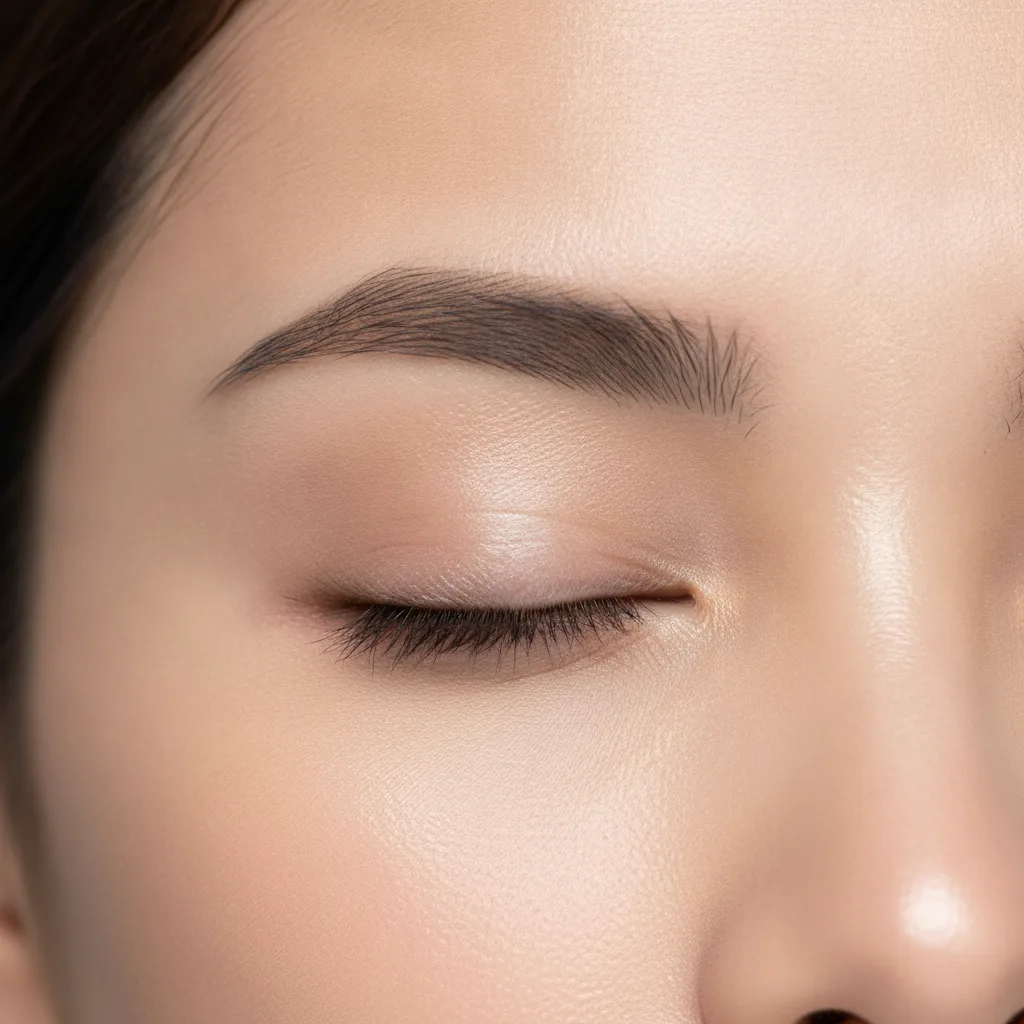
Non-incisional patients hit a social-presentable baseline at 5 to 7 days. Visible swelling resolves inside two weeks and the final shape settles at 2 to 3 months. There is no scar to monitor. Partial incisional sits in the middle: moderate bruising for 10 to 14 days, a 2 to 3 millimetre central mark that is pink for 6 weeks and faded by month four. Full incisional runs the longest. Swelling and bruising are prominent for 10 to 14 days, the full 25 to 30 millimetre line is pink to red for 2 to 3 months, and the final crease height sits a half-millimetre higher than planned until month six when the aponeurosis finishes contracting.
- 01Non-incisional: stitches out at day 5, back at work in 7 days, flight-safe at 7 to 10 days, final result at 3 months
- 02Partial incisional: stitches out at day 7, back at work in 10 days, flight-safe at 10 to 14 days, final result at 4 to 5 months
- 03Full incisional: stitches out at day 7, back at work in 10 to 14 days, flight-safe at 14 days, final result at 6 months
- 04All three: sleep elevated for 7 nights, cold compress for 48 hours, no contact lenses for 2 weeks, no mascara for 3 weeks
COST IN SEOUL 2026: REAL KRW BANDS
Pricing has stayed flat since late 2024 because competition in Gangnam and Apgujeong keeps clinics within a tight band. The numbers below are the surgeon-director fee at mid to high-tier clinics with English coordinators and foreign-patient aftercare. Trainee-run clinics on the margins of Sinnonhyeon advertise lower numbers, but revision rates there run two to three times higher. See the double eyelid surgery cost breakdown for the full fee anatomy including consultation, anaesthesia, and aftercare charges.
- 01Non-incisional (buried suture / DST): ₩1,200,000 to ₩2,500,000 ($900 to $1,850)
- 02Partial incisional: ₩1,800,000 to ₩3,200,000 ($1,350 to $2,400)
- 03Full incisional with fat removal: ₩2,500,000 to ₩4,500,000 ($1,850 to $3,350)
- 04Full incisional with ptosis correction: ₩3,500,000 to ₩6,000,000 ($2,600 to $4,450)
- 05Revision eyelid surgery: ₩4,000,000 to ₩8,000,000 ($3,000 to $5,950) depending on how much scar tissue the surgeon has to release

WHICH SEOUL CLINICS SPECIALISE IN EACH METHOD?
Only Eye Plastic Surgery in Sinsa is the clearest specialist case: the clinic runs eye-only cases and the director performs double eyelid, canthoplasty, and ptosis correction on roughly 30 patients per week, which keeps the surgical learning curve tight. Only Eye is the standard non-incisional and partial-incisional pick for thin-lid first-timers in their twenties, with a 4.9 Google rating across more than 400 reviews.
For full incisional with ptosis or revision work, JW Plastic Surgery in Apgujeong and ID Hospital in Gangnam carry the heavier case loads. Both have surgeons who publish on upper blepharoplasty technique in Korean plastic surgery journals, and both run dedicated foreign-patient coordinators in English, Chinese, and Japanese. VG Plastic Surgery and Item Plastic Surgery, both in Gangnam, sit in the mid-tier and quote the lower end of the full-incisional band for standard cases without ptosis. Compare their price depth on the best value Seoul double eyelid clinics 2026 ranked guide.
COMMON COMPLICATIONS AND REVISION RISK
Non-incisional revision rates sit at 15 to 20 percent inside the first two years. The dominant failure mode is suture loosening on heavier lids, followed by asymmetric fold heights when one stitch slips but the other holds. Full incisional carries a lower revision rate, around 5 to 8 percent, with the common failures being too-high crease placement, visible scar hypertrophy in patients prone to keloids, and under-corrected ptosis when the surgeon treated the fold without addressing the levator. Partial incisional lands between the two at roughly 10 to 12 percent.
HOW LONG BEFORE I CAN FLY HOME?
Non-incisional patients fly safely at day 7 to 10. Full incisional patients should wait 14 days so the stitches are out, the crease is set, and cabin pressure does not aggravate residual lid oedema. Partial incisional sits at 10 to 14. The flying home after Seoul plastic surgery guide has the day-by-day rules for every surgery type, including which clinics will write an in-flight medical letter for business-class recline requests.
CAN NON-INCISIONAL CONVERT TO INCISIONAL LATER?
Yes, and it is a routine conversion. If the buried stitches loosen at 18 months, the same clinic can remove the sutures and perform a full-incisional procedure in the same operative session. The second surgery is priced as a primary case, not a revision, because there is no scar tissue to release. Many surgeons at Only Eye and JW openly recommend starting with non-incisional in your twenties and converting to full incisional in your mid-thirties when skin laxity catches up, rather than committing to the longer scar early.
Comparisons · 9 min · Oct 6, 2026
← all posts
BREAST IMPLANT REMOVAL SEOUL 2026: EN BLOC VS CAPSULECTOMY VS EXPLANT
The three protocols Seoul surgeons use to take breast implants out, how they pick between them, and what each one costs and recovers like for foreign patients in 2026.
JUVEDERM VS RESTYLANE VS BELOTERO: SEOUL FILLER BRANDS 2026
The three Western HA filler families Seoul injectors actually stock, where each one wins on the face, and what foreign patients pay per syringe in 2026.
SUBGLANDULAR VS SUBMUSCULAR VS DUAL PLANE BREAST AUGMENTATION SEOUL 2026
The three pocket planes behind every Seoul boob job, how surgeons pick between them, and what each one means for recovery, feel, and ten-year results.
MINT PDO VS WONDERLIFT VS SILHOUETTE SOFT THREADS SEOUL 2026
The three thread brands Seoul clinics argue about, how surgeons actually pick between them, and what each costs for foreign patients in 2026.

FAT TRANSFER VS IMPLANTS BREAST AUGMENTATION SEOUL 2026
Head-to-head verdict on fat grafting and silicone implants in Seoul, with KRW price bands, revision rates, and the clinic types that run each procedure well.
▶▶▶ stop reading. start matching.
FIND YOURS.
We'll pull five clinics matched to your case. WhatsApp reply within 24h.