FUE VS DHI VS ROBOTIC HAIR TRANSPLANT SEOUL 2026
Head-to-head on graft survival, downtime, cost per graft, and which Seoul clinics actually run each platform in 2026.
By Editorial
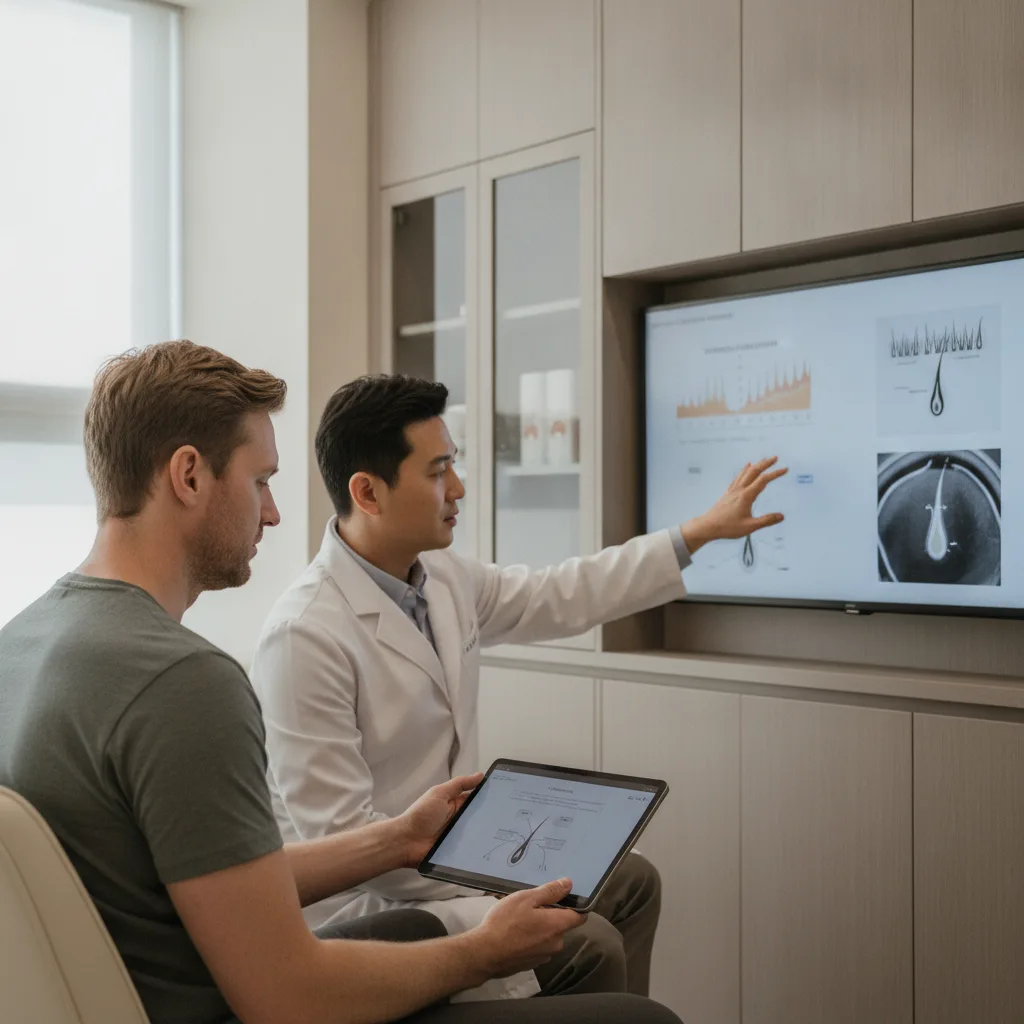
Picking between FUE, DHI, and robotic hair transplant in Seoul is a clinical decision, not a marketing one, and the three platforms separate on three measurable axes: graft survival, implantation precision, and donor density preservation. For international patients the Seoul picture in 2026 is clear. FUE is the volume workhorse that every credible clinic runs. DHI with the Choi pen is slower and pricier, but better for density work and female diffuse thinning. Robotic FUE under the ARTAS platform exists in a handful of Seoul programs but has not replaced manual and motorized FUE in the mainstream Korean market. This comparison runs each technique on cost, downtime, best-fit case profile, and the specific Seoul clinics that credibly offer it.
THE CORE CLINICAL DIFFERENCE IN ONE PARAGRAPH
FUE extracts follicular units one at a time with a 0.8-0.9 mm punch, hands the grafts off to a technician team for trimming, and the surgeon then creates recipient sites with a slit blade or custom needle before implantation. DHI compresses the implantation step by loading each graft into a Choi pen that creates the recipient site and places the follicle in a single motion, which cuts out-of-body time for the graft and lets the surgeon control angle and depth directly. Robotic FUE, almost exclusively the ARTAS system in Korea, uses a vision-guided robotic arm to select and extract follicles under algorithm supervision, then still passes the grafts to a human team for implantation. The headline is that DHI differs most on the implantation side, robotic differs most on the extraction side, and FUE sits in the middle as the baseline both are measured against.
GRAFT SURVIVAL RATE AND DENSITY OUTCOMES
Across published Korean plastic surgery society data from 2022 to 2025, in-clinic graft survival at 12 months lands at roughly 85 to 92 percent for competent manual or motorized FUE, 88 to 95 percent for Choi-pen DHI performed by a trained surgeon, and 83 to 90 percent for ARTAS robotic FUE. The DHI edge is real but conditional. It only shows up when the surgeon is Choi-pen experienced beyond 300 cases, otherwise the technique penalty erases the survival margin. Robotic FUE's extraction consistency is a scientific plus but graft handling after extraction still happens by hand, so the final outcome tracks the human team's trimming and holding solution protocol more than the robot's selection accuracy. For a technique primer before this comparison, read the FUE vs DHI Seoul guide, and for the destination logic the Seoul vs Turkey breakdown covers why Korea beats Istanbul on surgeon involvement.
Density outcomes diverge most clearly on female cases and on hairline refinement work. Choi-pen DHI gives the surgeon direct angle and depth control at the point of implantation, which matters when you are placing 40-50 grafts per square centimeter into a zone that already has native hair without transecting what is already there. For a Norwood 4 or 5 coverage case where you are placing 2,500-3,000 grafts across a mostly bald scalp, FUE's efficiency advantage swamps DHI's angle control gain. Robotic FUE's density outcome is roughly indistinguishable from manual FUE at the same clinic, because the implantation step is identical, and the robot's advantage only shows in extraction uniformity, not in placed-graft angle.
COST PER GRAFT AT SEOUL CLINICS IN 2026
The 2026 Seoul price band separates cleanly by technique. Manual or motorized FUE at a foreigner-designated clinic runs ₩2,500-₩4,500 per graft, roughly $1.80-$3.25 USD at a mid-year KRW rate. Choi-pen DHI at the same clinics adds ₩800-₩1,500 per graft on top of the FUE base, which pushes a 2,500-graft DHI session into the ₩8,250,000-₩15,000,000 range before VAT. Robotic FUE on ARTAS, where offered, prices between manual FUE and DHI at ₩3,500-₩5,000 per graft, reflecting the capital cost of the robot and the smaller operator pool. All three qualify for the 10 percent VAT refund at foreigner-designated clinics against a Ministry of Health designated receipt. For the full value-ranked list across techniques see the best value Seoul hair transplant clinics ranking and for the broader cost picture the hair transplant cost in Seoul breakdown.
DOWNTIME AND RECOVERY DIFFERENCES
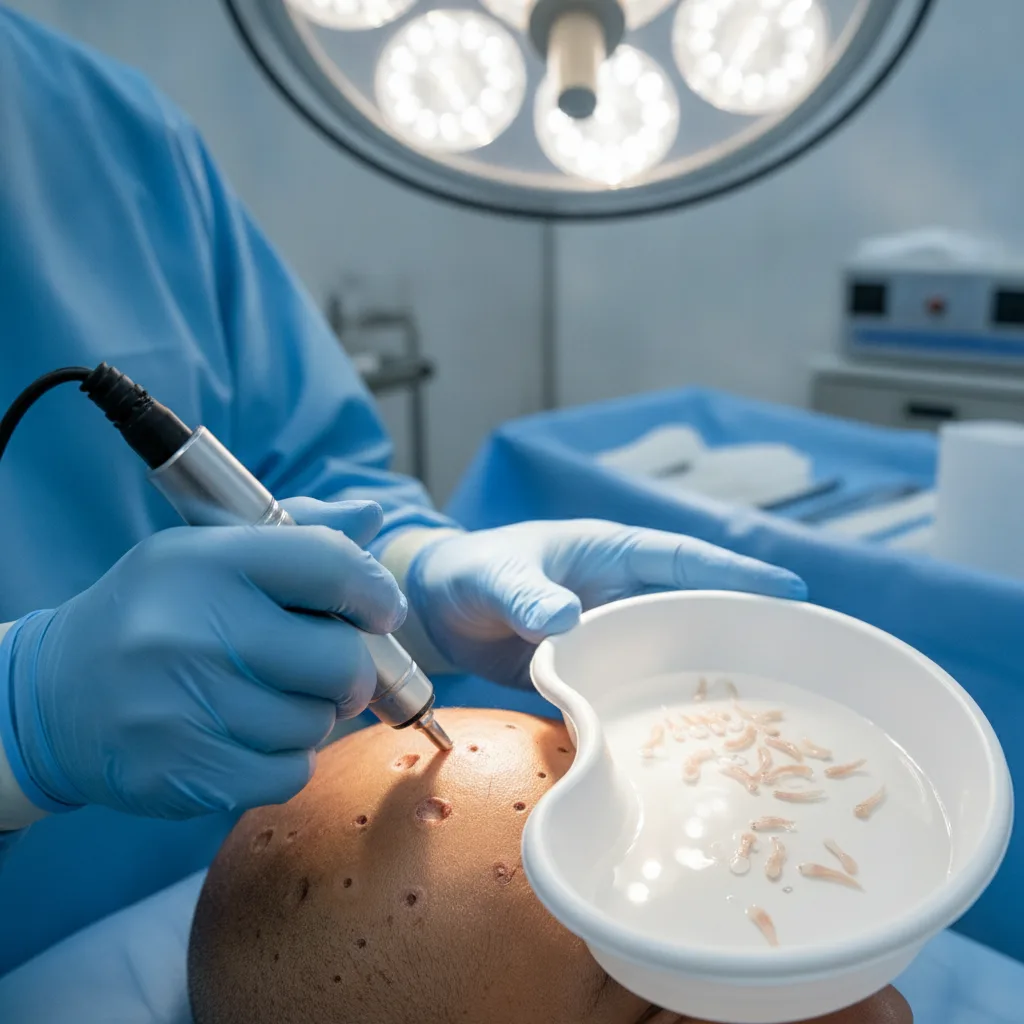
The three techniques diverge less on recovery than on operative experience. FUE and robotic FUE leave the donor zone with small round punch sites 0.8-0.9 mm wide that scab within 3-4 days and fade over two to three weeks. DHI's donor extraction is identical to FUE, so donor recovery is the same. The recipient zone recovers differently. DHI's slit-and-place-in-one-motion technique minimises crust formation and tends to let patients return to a hat or a loose scarf after day 7, roughly 2 days earlier than slit-blade FUE recipient sites. Shedding at week three and regrowth onset at month three are platform-independent, driven by the follicle cycle not the extraction method. Flying rules follow the same curve across all three. Most Seoul clinics clear international patients to fly after 7 days, though cabin pressure can mildly worsen scalp swelling for an extra 48 hours. The flying home after Seoul plastic surgery guide covers the full timing matrix.
WHICH SEOUL CLINICS ACTUALLY OFFER EACH TECHNIQUE?
Technique availability in Seoul is lopsided. Every foreigner-designated clinic running a credible hair program offers manual or motorized FUE. The practical operators for Choi-pen DHI at scale in 2026 are a smaller set, with Grand Plastic Surgery in Apgujeong, April31 Aesthetics in Gangnam, Braun Plastic Surgery in Seocho, VG Plastic Surgery in Gangnam, and Wonjin in Gangnam running established DHI programs with surgeons past the 300-case Choi-pen learning curve. Girin Plastic Surgery in Seocho offers DHI alongside its FUE service with a one-year post-op guarantee that is unusual for the Seoul market. ID Hospital in Gangnam runs hair as part of its multi-specialty hospital program and defaults to FUE with DHI available for frontal line work. Robotic ARTAS is the shortest list in Seoul, limited to a handful of hair-specialty clinics that invested in the capital kit, and is a question to ask the clinic directly before booking, not an assumption.
- 01FUE pricing at foreigner-designated clinics: ₩2,500-₩4,500 per graft
- 02DHI upcharge above FUE at the same clinic: ₩800-₩1,500 per graft
- 03Robotic ARTAS FUE pricing where offered: ₩3,500-₩5,000 per graft
- 042,500-graft FUE total band in 2026: ₩6,250,000-₩11,250,000 before VAT
- 052,500-graft DHI total band in 2026: ₩8,250,000-₩15,000,000 before VAT
- 06Session cap at most Seoul hair programs: 3,000 grafts per day for donor preservation
- 07VAT refund for international patients: 10 percent of base at foreigner-designated clinics
BEST-FIT CASE PROFILE FOR EACH TECHNIQUE
Match the technique to the case, not to the marketing. A Norwood 3 to 5 male with clear bald zones and healthy donor density is a FUE case first, because the per-graft efficiency and the 3,000-graft daily cap favour volume throughput and manual or motorized FUE will deliver a clinically identical result at a lower price than DHI. A female with diffuse frontal thinning, or a male wanting hairline refinement with existing hair in the recipient zone, is a DHI case because angle control at the implantation point protects the native follicles you are not replacing. A patient who prioritises extraction-step uniformity, has a well-defined donor, and does not mind paying the robotic premium is an ARTAS candidate, provided the clinic's human implantation team is competent, because the robot never implants.
VERDICT: WHICH SEOUL TECHNIQUE WINS IN 2026?
For most international patients booking a Seoul hair transplant in 2026, manual or motorized FUE at a foreigner-designated clinic is the right default. It is cheaper per graft, every credible clinic runs it, graft survival at a competent operator is clinically indistinguishable from DHI on bald-zone coverage work, and session caps are identical. Choi-pen DHI is the correct choice when the recipient zone has native hair worth preserving, which usually means female diffuse thinning, hairline refinement, and crown densification work rather than mass coverage. Robotic ARTAS FUE is a narrow pick for patients who specifically value extraction-side uniformity and are willing to pay the premium at the small Seoul operator pool offering it. The technique matters less than the surgeon of record, the bound graft count on the written quote, and the revision policy if 12-month regrowth lands below 60-70 percent.
IS DHI REALLY BETTER THAN FUE IN SEOUL?
Only on specific case profiles. For a Norwood 4 male coverage case, FUE and DHI produce clinically indistinguishable results at 12-month regrowth, and FUE costs ₩2,000,000-₩3,750,000 less at the same clinic. For a female diffuse thinning case or a hairline refinement where native hair is already present, DHI's Choi-pen angle control at implantation is a real advantage and justifies the per-graft premium. The 'DHI is always better' claim common in Seoul clinic marketing does not survive the published survival data.
IS ROBOTIC HAIR TRANSPLANT WORTH THE EXTRA COST IN SEOUL?
For most patients, no. Robotic FUE on ARTAS automates extraction consistency but graft handling and implantation remain fully manual, which means final survival tracks the human team's protocol regardless of the robot's selection accuracy. In Seoul's labor market, where experienced hair transplant technicians are deep and relatively cheap, the robotic premium does not translate into a measurable outcome gain. Patients with specific extraction concerns, or who are comparing Seoul to a Western market where technician labor is scarcer, may still value the robot.
HOW LONG IS RECOVERY FOR EACH TECHNIQUE?
Donor zone recovery is identical across FUE, DHI, and robotic FUE at around 3-4 days to scab shedding and 2-3 weeks to full fade. Recipient zone recovery is faster for DHI by roughly 2 days because the slit-and-place motion creates less crust. All three techniques follow the same regrowth cycle: shedding at week three, early regrowth onset at month three, 60-70 percent of final density at month six, and final result at month 12.
CAN I FLY HOME 7 DAYS AFTER ANY OF THESE TECHNIQUES?
Yes. Seven days post-op is the standard Seoul clinical clearance across FUE, DHI, and robotic FUE for international patients. Cabin pressure can mildly worsen scalp swelling for 24-48 hours after the flight. Wear a loose hat, hydrate, and avoid tight headgear. Stitch-removal does not apply because none of these techniques requires sutures in the donor or recipient zone.
DO ALL THREE QUALIFY FOR THE VAT REFUND IN SEOUL?
Yes, provided the clinic is Ministry of Health foreigner-designated. The 10 percent VAT refund applies to the base surgical fee on hair transplant regardless of extraction or implantation technique. Robotic ARTAS cases qualify on the same basis as FUE and DHI. Pharmacy spend, hotel costs, and non-medical ancillaries fall outside the refund.
WHICH SEOUL CLINICS HAVE THE MOST CHOI-PEN DHI EXPERIENCE?
Grand Plastic Surgery in Apgujeong, April31 Aesthetics and VG Plastic Surgery in Gangnam, and Braun Plastic Surgery in Seocho all run established DHI programs with surgeons past the 300-case Choi-pen learning curve. Girin Plastic Surgery in Seocho pairs DHI with a one-year revision guarantee that is unusual for the Seoul market. Wonjin's large-group DHI program caps at the 3,000-graft Korean industry norm with efficient multi-language intake. ID Hospital in Gangnam offers DHI primarily for frontal-line work alongside its FUE service.
Comparisons · 11 min · Oct 19, 2026
← all posts
BEST VALUE APGUJEONG RHINOPLASTY CLINICS 2026: 7 PICKS RANKED
A reviewer-ranked shortlist of seven Apgujeong plastic surgery clinics worth the premium postcode, with KRW price bands and what each room does well.
BREAST IMPLANT REMOVAL SEOUL 2026: EN BLOC VS CAPSULECTOMY VS EXPLANT
The three protocols Seoul surgeons use to take breast implants out, how they pick between them, and what each one costs and recovers like for foreign patients in 2026.
JUVEDERM VS RESTYLANE VS BELOTERO: SEOUL FILLER BRANDS 2026
The three Western HA filler families Seoul injectors actually stock, where each one wins on the face, and what foreign patients pay per syringe in 2026.
SUBGLANDULAR VS SUBMUSCULAR VS DUAL PLANE BREAST AUGMENTATION SEOUL 2026
The three pocket planes behind every Seoul boob job, how surgeons pick between them, and what each one means for recovery, feel, and ten-year results.
MINT PDO VS WONDERLIFT VS SILHOUETTE SOFT THREADS SEOUL 2026
The three thread brands Seoul clinics argue about, how surgeons actually pick between them, and what each costs for foreign patients in 2026.
▶▶▶ stop reading. start matching.
FIND YOURS.
We'll pull five clinics matched to your case. WhatsApp reply within 24h.