SEOUL RHINOPLASTY PRICE MENU 2026: COSTS BY TECHNIQUE AND DISTRICT
Line-item KRW and USD bands for osteotomy, tip plasty, alar base, deviated septum, and revision rhinoplasty in Seoul, with district averages.
By Editorial
Rhinoplasty in Seoul is sold as a single package on most clinic websites, but the real invoice is a stack of line items. A primary nose job is one price. Adding osteotomy, alar base reduction, deviated septum correction, tip refinement, or revision work each shifts the total by millions of won. This 2026 price menu breaks the quote into the components Seoul surgeons actually bill, with KRW and USD bands sourced from published clinic pricing and medical-tourist coordinator quotes across Gangnam, Apgujeong, Cheongdam, Sinsa, and Seocho.
HOW SEOUL CLINICS STRUCTURE A RHINOPLASTY QUOTE
A Seoul rhinoplasty quote starts with a base surgical fee that covers the surgeon, standard implants or cartilage, anesthesia, operating room, one post-op visit, and the first week of dressings. The base price assumes a closed technique, silicone bridge augmentation, and no osteotomy. Everything beyond that is added as a component line: open approach, septal cartilage harvest, costal (rib) cartilage harvest, osteotomy, alar base reduction, tip plasty subtypes, and adjunct work like hump reduction or short-nose lengthening. A Korean-language companion to this breakdown covers the same math in Hangul for domestic patients at our Korean rhinoplasty cost guide. For the full bird's-eye overview of nose surgery pricing by broad category, our rhinoplasty cost in Seoul guide is the sister resource to this line-item menu.
Medical tourists almost never pay the quoted base alone. Bulbous tips need tip plasty. Wide nostrils need alar base reduction. Dorsal humps need osteotomy. Noses with prior surgery need revision work with rib. Expect the real total to land 40 to 90 percent above the headline base once components are added. Seoul clinics rarely bundle revision work into a flat package because scar tissue, prior implants, and donor-site complications change the operating time. The honest read of a quote is to ask the coordinator to itemize every component with its own KRW line before you wire a deposit.
PRIMARY RHINOPLASTY BASE PRICE BANDS BY DISTRICT
Base price for a primary closed rhinoplasty with silicone augmentation in Seoul runs ₩3,500,000 to ₩7,500,000, roughly $2,500 to $5,400 at a ₩1,390 to the dollar rate. Gangnam and Apgujeong anchor the higher end because of brand pricing and foreign-patient coordinators, while Seocho and Sinsa average 15 to 25 percent lower for equivalent clinical capability. A consolidated view of the clinics behind these numbers lives in our best value Seoul rhinoplasty clinics post, which ranks seven foreign-patient-ready picks across the map.
- 01Apgujeong primary base: ₩5,500,000–₩7,500,000 ($3,950–$5,400). Flagship brands, fluent English coordinators, revision warranty language on contracts.
- 02Cheongdam primary base: ₩5,000,000–₩7,000,000 ($3,600–$5,000). Boutique surgeon-owned studios, lower volume, premium interiors.
- 03Gangnam / Yeoksam primary base: ₩4,500,000–₩6,500,000 ($3,240–$4,680). High-volume hospitals like ID and Wonjin, broad surgical teams.
- 04Sinsa / Seocho primary base: ₩3,500,000–₩5,500,000 ($2,520–$3,950). Surgeon-led mid-market clinics, less marketing overhead, often the price-to-skill sweet spot.
These bands assume closed technique, silicone bridge, no osteotomy, no tip cartilage grafting, no alar base work. A quote at ₩3,500,000 that looks cheaper than every peer usually excludes anesthesia, excludes the surgeon's fee (packaged as a chief surgeon upgrade), or uses a junior associate. Ask whether the chief surgeon performs the full case or hands off the closing. The answer changes the real value of the price.
COMPONENT-BY-COMPONENT PRICE ADDITIONS
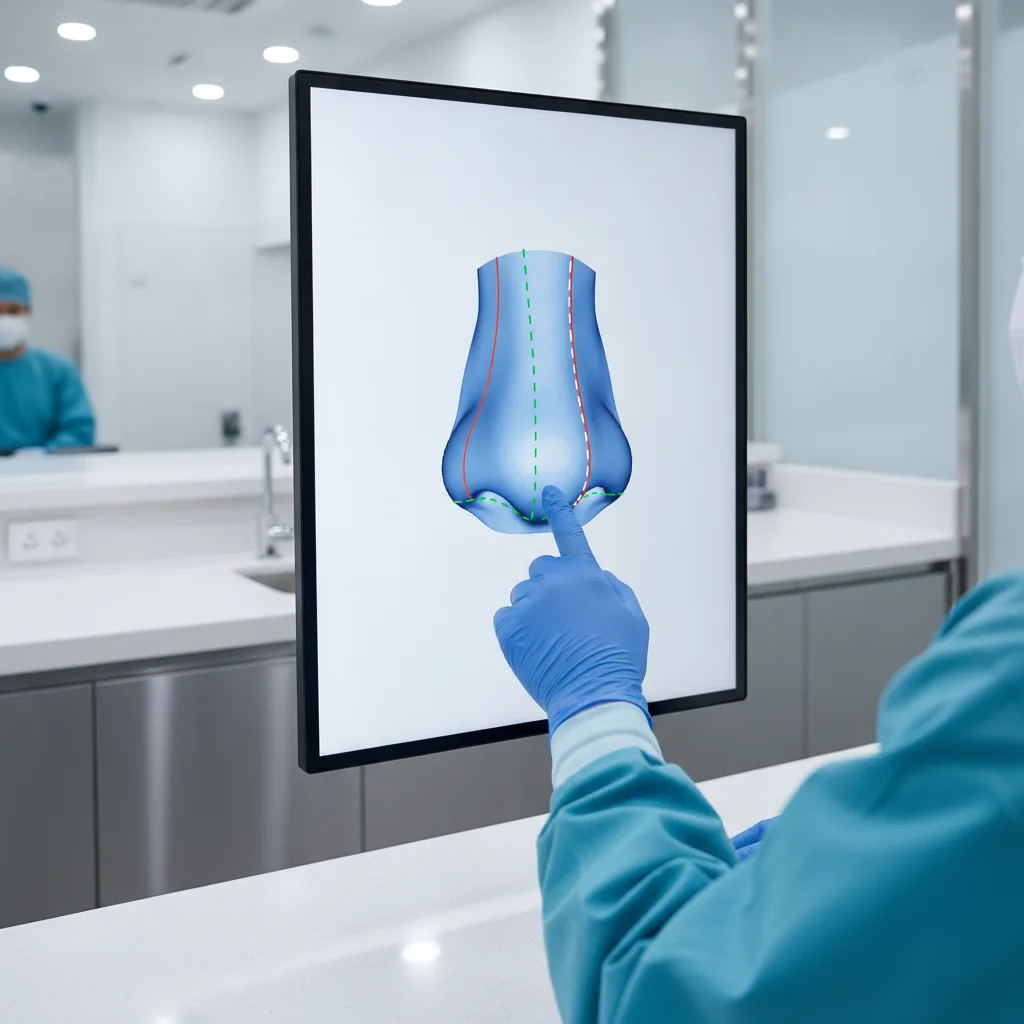
Osteotomy, the controlled breaking of the nasal bones to narrow a wide bridge or correct a deviation, adds ₩1,200,000 to ₩2,500,000 ($860 to $1,800) to the base. The range reflects whether the surgeon uses traditional chisel osteotomy or ultrasonic piezo osteotomy, which costs more but produces less bruising. Alar base reduction, which narrows wide nostrils by excising small wedges at the nostril sill, adds ₩800,000 to ₩1,800,000 ($575 to $1,290) and is billed separately because it requires its own incisions and closure. Tip plasty ranges wider than any other component because it covers a spectrum from simple suture refinement to full tip rebuild with septal or costal cartilage grafts.
- 01Osteotomy (bone work): +₩1,200,000–₩2,500,000 ($860–$1,800). Piezo adds ₩500,000–₩1,000,000 on top of chisel.
- 02Alar base reduction: +₩800,000–₩1,800,000 ($575–$1,290). Weir incision, often requested for Southeast-Asian and mixed-ethnicity noses.
- 03Tip plasty (suture refinement only): +₩800,000–₩1,500,000 ($575–$1,080). Reshapes alar cartilages, no graft.
- 04Tip plasty with septal cartilage graft: +₩1,500,000–₩3,000,000 ($1,080–$2,160). Harvests from inside the nose, no second site.
- 05Tip plasty with ear (conchal) cartilage: +₩1,800,000–₩3,500,000 ($1,290–$2,520). Adds ear donor site, mild post-op discomfort.
- 06Tip plasty with rib (costal) cartilage: +₩3,500,000–₩6,000,000 ($2,520–$4,320). Chest donor site, longer surgery, standard for revision.
- 07Deviated septum correction (septoplasty): +₩1,000,000–₩2,000,000 ($720–$1,440). Functional component, sometimes reimbursable if symptomatic at home.
- 08Hump (dorsal) reduction: +₩800,000–₩1,500,000 ($575–$1,080). Often paired with osteotomy to close the open roof.
- 09Bulbous tip (defat and suture): +₩500,000–₩1,200,000 ($360–$865). Thins the subcutaneous fat pad, refines projection.
- 10Short-nose lengthening (columellar strut + spreader grafts): +₩2,500,000–₩5,000,000 ($1,800–$3,600). Common for Asian primary cases.
- 11Open approach surcharge: +₩300,000–₩800,000 ($215–$575). Trans-columellar incision, scar fades at 6 to 12 months.
Add the base to the components that match your face and the quote becomes concrete. A primary open rhinoplasty with silicone bridge, osteotomy, tip plasty with septal cartilage, and alar base reduction in Apgujeong lands at roughly ₩9,800,000 to ₩15,100,000 ($7,050 to $10,860). The same case in Sinsa or Seocho runs ₩7,100,000 to ₩12,100,000 ($5,110 to $8,700). That 25 to 30 percent spread is why coordinators push brand clinics on first contact. The clinical difference is often smaller than the price gap suggests. The open vs closed rhinoplasty cost guide walks through where the open surcharge actually buys you something versus where it is a markup.
REVISION RHINOPLASTY: A DIFFERENT PRICING ENGINE
Revision rhinoplasty is priced on operating-room hours and rib harvest, not on a component menu. Seoul revision cases run ₩8,000,000 to ₩20,000,000 ($5,760 to $14,390) with typical cases clustering ₩12,000,000 to ₩16,000,000 ($8,630 to $11,510). The spread is driven by three variables: whether prior silicone or Gore-Tex needs explant, whether rib cartilage is required to rebuild bridge and tip, and whether the prior surgery damaged skin or septum. A clinic quoting ₩6,000,000 for revision almost always means a secondary touch-up on a scarred tip, not a full revision with rib. Our revision rhinoplasty in Seoul deep dive covers which clinics take complex revision cases and which route them out to specialist hospitals.
Rib harvest alone adds ₩2,500,000 to ₩4,500,000 ($1,800 to $3,240) to a revision quote because of the chest incision, longer anesthesia, and donor-site aftercare. Expect an extra two days of visible chest tape and a six-month scar fade on the donor site. Surgeons who do heavy revision volume prefer costal rib for predictable grafts in scarred tissue, and the premium is clinical not cosmetic. If a revision quote excludes rib while promising to lengthen a contracted short nose, ask what graft material is replacing it. Conchal ear cartilage alone is usually insufficient for revision lengthening.
MATERIAL CHOICE: SILICONE, GORE-TEX, AND CARTILAGE PRICING
Bridge material is a line item on the invoice. Silicone implants add ₩200,000 to ₩500,000 ($145 to $360) over the base and are standard in Korean primary rhinoplasty. Gore-Tex (ePTFE) adds ₩500,000 to ₩1,000,000 ($360 to $720) and is marketed as softer and more natural but carries a slightly higher long-term extrusion risk documented in Korean literature. The silicone vs Gore-Tex vs rib cartilage comparison covers the trade-offs in clinical detail. Rib cartilage is the most expensive material because it requires harvest surgery, but it is also the only material that does not count as an implant for revision risk calculations.
- 01Silicone bridge implant: +₩200,000–₩500,000 ($145–$360). Standard, 15 to 20 year track record in Korea.
- 02Gore-Tex (ePTFE) bridge: +₩500,000–₩1,000,000 ($360–$720). Softer feel, slightly higher extrusion risk at 10+ years.
- 03Septal cartilage graft: included in tip plasty line, no separate implant fee, limited supply from own septum.
- 04Ear (conchal) cartilage graft: +₩300,000–₩800,000 ($215–$575) for donor-site surgery.
- 05Rib (costal) cartilage graft: +₩2,500,000–₩4,500,000 ($1,800–$3,240) including chest harvest and closure.
ANESTHESIA, HOSPITAL STAY, AND POST-OP
Primary rhinoplasty in Seoul is day surgery under IV sedation or general anesthesia. IV sedation is bundled into the base price at most clinics. General anesthesia adds ₩300,000 to ₩600,000 ($215 to $430) when the case involves rib harvest, long operating times, or patient preference. Overnight hospital stay is rarely included and runs ₩300,000 to ₩600,000 per night at the clinic's partner facility. Revision cases often require one overnight for monitoring. Post-op visits during week one (splint removal, suture removal) are bundled. Follow-up at three and six months is bundled. Any follow-up after twelve months is billed per visit at ₩50,000 to ₩150,000. Flying rules after rhinoplasty are stricter than most patients expect, and the Seoul rhinoplasty splint week guide covers the day-by-day timeline before you book the return leg.

FOREIGN-PATIENT LINE ITEMS YOUR QUOTE SHOULD INCLUDE
VAT treatment varies by clinic. Some include the 10 percent inside the quoted number, others add it at checkout. Always ask whether the KRW figure on the written quote is VAT-included. Medical-tourist VAT refund is available on surgical spend above ₩300,000 per transaction if you process the refund at Incheon on the return flight, which recovers around 7 to 8 percent after the agency fee. English-speaking coordinators are standard in Gangnam, Apgujeong, and Cheongdam flagships and bundled into the price. Mid-market Sinsa and Seocho surgeon-led clinics often provide translator services only on request at ₩100,000 to ₩200,000 per consultation session. Our VAT and KRW pricing guide for foreigners covers the refund flow end to end.
- 01VAT: ₩0 or +10 percent of base, depending on clinic. Confirm before deposit.
- 02Medical-tourist tax refund: ~7 to 8 percent recoverable at Incheon, surgical spend qualifies.
- 03English coordinator: bundled at Apgujeong and Cheongdam flagships, add-on elsewhere.
- 04Overnight stay (if required): ₩300,000–₩600,000 per night at partner facility.
- 05Deposit: typically 20 to 30 percent to confirm surgery date, refundable per clinic policy.
- 06Return revision window: 6 to 12 months post-op at most clinics, coverage varies by contract.
NAMED RHINOPLASTY CLINICS AND WHERE THEY SIT ON THIS MENU
SHIMMIAN Rhinoplasty Clinic in Seocho is a dedicated rhinoplasty-only practice with a 5.0 Google rating and sits in the premium component band, roughly ₩8,000,000 to ₩13,000,000 for a complex primary with osteotomy and tip graft. JW Plastic Surgery in Apgujeong carries a 4.6 rating and a coordinator-English operation, with complex primary quotes in the ₩9,000,000 to ₩14,000,000 range and heavy revision volume. ID Hospital in Gangnam operates at hospital scale with a 4.8 rating, coordinator English, and base primary bands at ₩5,500,000 to ₩8,000,000 before components. Braun Plastic Surgery (Seocho, 4.9) and Girin Plastic Surgery (Seocho, 4.9) both sit in the mid-premium sweet spot that medical-tourist coordinators recommend most often, typically landing complex primary cases at ₩6,500,000 to ₩11,000,000. Teuim Plastic Surgery in Gangnam (5.0) rounds out the surgeon-led boutique tier.
HOW MUCH SHOULD I ACTUALLY BUDGET FOR RHINOPLASTY IN SEOUL?
A realistic all-in budget for a medical tourist booking primary rhinoplasty with osteotomy, tip plasty, and alar base in Seoul is ₩9,000,000 to ₩15,000,000 ($6,470 to $10,790) for surgery, plus ₩2,000,000 to ₩4,000,000 ($1,440 to $2,880) for 10 days of hotel, meals, and ground transport in Gangnam or Apgujeong. Revision rhinoplasty with rib adds ₩4,000,000 to ₩8,000,000 to the surgical figure. Factor another ₩500,000 for a VAT refund that will not arrive until the return flight, and plan the trip around the splint-removal date at day 7.
CAN I GET A CHEAPER QUOTE THAN ₩3,500,000 FOR PRIMARY RHINOPLASTY?
Yes, there are clinics quoting ₩2,500,000 to ₩3,200,000 for primary rhinoplasty. The honest reads are that the chief surgeon is not performing the case, anesthesia is not bundled, implant material is the lowest-cost silicone, or the clinic is a high-volume operation using junior associates on routine primaries. None of these are automatic disqualifiers, but the quote stops being comparable to the ₩4,500,000 baseline. If budget forces a quote under ₩3,500,000, demand a written statement naming the operating surgeon and confirming anesthesia inclusion.
WHY DO APGUJEONG CLINICS COST 25 PERCENT MORE THAN SINSA FOR THE SAME SURGERY?
Apgujeong carries brand premium, higher real estate costs, and heavier marketing spend, which pushes list prices up. The clinical operation is often equivalent to a surgeon-led Sinsa or Seocho clinic one or two subway stops away. The Apgujeong premium pays for bilingual coordinators, faster scheduling, more polished patient logistics, and a more conservative revision-warranty contract. Whether that is worth 25 percent depends on how much friction you can absorb as a solo medical tourist. First-time rhinoplasty patients tend to overpay for logistics comfort, which is often the correct call.
IS REVISION RHINOPLASTY IN SEOUL CHEAPER THAN IN THE US OR EUROPE?
Yes, by a wide margin. A complex revision rhinoplasty with rib cartilage runs $25,000 to $40,000 in New York or London and $8,000 to $14,000 in Seoul for equivalent surgical complexity. Seoul has higher revision case volume than any other city because primary rhinoplasty volume is so large, which means surgeons see more of the complications. The clinical argument for revision in Seoul is not just cost, it is case volume at specific revision-heavy practices like JW, SHIMMIAN, and a handful of Apgujeong boutiques.
HOW LONG SHOULD MY SEOUL TRIP BE FOR PRIMARY RHINOPLASTY?
Plan for 10 to 14 days. Day 1 to 2 is consultation and pre-op blood work. Surgery is day 3 to 4. Splint removal is day 7. Suture removal for open cases is day 7 to 10. Most surgeons clear patients to fly at day 8 to 10, but the clinical recommendation is day 14 to avoid cabin-pressure-related swelling complications. Rib harvest or revision adds 2 to 4 days to the recovery window. The day-by-day timeline for the splint week is covered in our rhinoplasty splint week in Seoul 2026 guide.
DOES MEDICAL INSURANCE COVER ANY OF THIS?
Cosmetic rhinoplasty is not covered by Korean national insurance or by most foreign private plans. Functional components, specifically septoplasty for a documented deviated septum causing breathing symptoms, may be reimbursable by your home insurance if you obtain a Korean clinical note describing the functional indication, the septoplasty component, and the itemized fee. Ask the clinic for an English-language medical report and an itemized invoice separating functional and cosmetic components. Reimbursement is case-by-case, and recovery is rarely more than 20 to 30 percent of the total bill even when approved.
Cost & pricing · 10 min · Nov 12, 2026
← all posts
FACIAL CONTOURING SEOUL 2026: WHAT THE PRICE COVERS
Line-by-line on what a Seoul V-line, zygoma, or combo contouring quote actually includes, and the add-ons that catch foreign patients at the balance payment.
TUMMY TUCK COST IN SEOUL 2026: MINI, FULL & EXTENDED ABDOMINOPLASTY
KRW and USD price bands for mini, full, and extended abdominoplasty in Seoul, with lipo-combo pricing, foreign-patient add-ons, and the five vetting questions that keep you in-budget.
OCEAN CLINIC GANGNAM PRICES 2026: ₩9,900 BOTOX TO ₩990K THERMAGE
Full price menu for Ocean Clinic Gangnam in 2026, from the ₩9,900 wrinkle botox entry tier through fillers, Shurink, Ultherapy Prime, and Thermage FLX.

BODY CONTOURING IN SEOUL: REALISTIC TRIP BUDGET FOR 2026
What lipo, fat-dissolving injections, tummy tuck, and non-surgical body work actually cost as a complete Seoul trip — from surgery to discharge, in real KRW and USD.

KOREAN SKINCARE TREATMENTS IN SEOUL: WHAT THEY COST IN 2026
A first-timer's cost overview of Seoul's most requested skin treatments — Rejuran, skin boosters, exosomes, laser toning, and medical facials — with realistic per-trip budgets.
▶▶▶ stop reading. start matching.
FIND YOURS.
We'll pull five clinics matched to your case. WhatsApp reply within 24h.