REVISION RHINOPLASTY IN SEOUL 2026: FIXING A FAILED NOSE JOB
A practical Seoul revision rhinoplasty guide covering cost, timing, cartilage sourcing, top districts, and which surgeons actually take secondary cases.
By Editorial
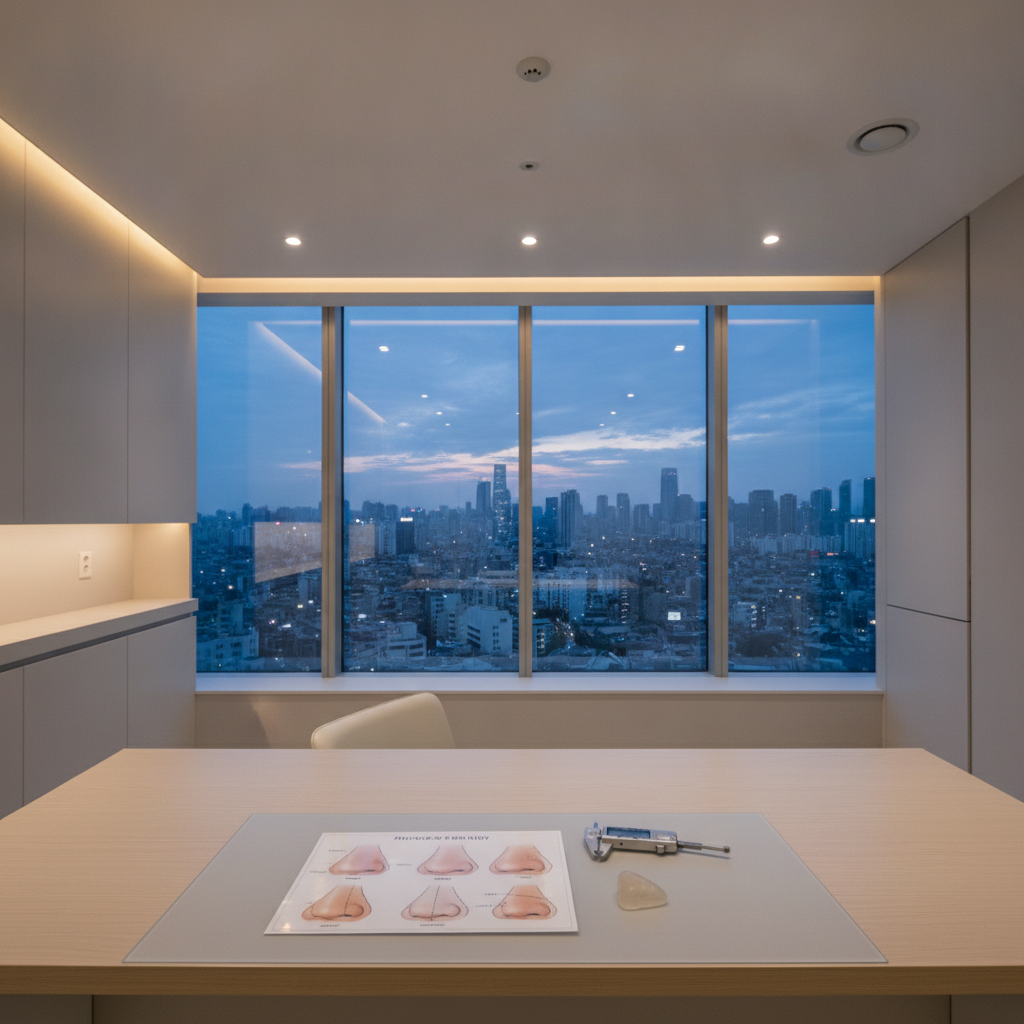
A revision rhinoplasty is not a second first surgery. The tissue is scarred, the cartilage supply is depleted, and the margin for error is a fraction of what a primary case allows. Seoul has become the global capital for these cases because the top Cheongdam and Apgujeong surgeons see more revisions in a month than most Western surgeons see in a year.
WHY SO MANY PATIENTS FLY TO SEOUL FOR REVISION
Korea produced the modern silicone-and-cartilage hybrid technique that swept Asia in the 2010s, and it produced the wave of patients who now need those results corrected. Bridge implants that shifted, tips that dropped, and short noses that contracted after healing are the three most common cases walking into revision clinics along Apgujeong-ro. Because volume is high, the top specialists refined a specific playbook for secondary work: remove the previous implant, rebuild the framework with rib or septal cartilage, and only then reshape the tip. Foreign patients get access to the same operating rooms locals use, at prices that still undercut equivalent revision work in London, Sydney, or Los Angeles by around 40 to 60 percent. The catch is that not every clinic listed for primary rhinoplasty actually accepts revision cases. Many will politely decline anything beyond a first surgery. Expect a shorter list of candidate clinics and longer consultation queues once you land.
There is also a technical reason Seoul dominates: rib cartilage harvest is treated as routine here. Korean revision surgeons perform costal cartilage grafting several times a week, so anesthesia teams, chest closure protocols, and post-op donor-site care are standardized. In markets where rib grafts are rare, the harvest itself becomes the risk. In Seoul, it is the base case.
HOW MUCH DOES REVISION RHINOPLASTY COST IN SEOUL?
A straightforward second surgery using septal cartilage runs around ₩8,000,000 to ₩12,000,000, or roughly $5,700 to $8,600 USD. Cases requiring rib cartilage push the range to ₩12,000,000 to ₩18,000,000, about $8,600 to $12,900. Complex third or fourth revisions with severe contracture or exposed implants can reach ₩20,000,000 or higher. Compare against the numbers in the full rhinoplasty cost guide for Seoul and you will see revision typically costs 60 to 100 percent more than a primary case at the same clinic.
The premium reflects three real inputs. Operating time roughly doubles, since dissection through scar tissue is slower and unpredictable. Cartilage sourcing beyond the septum adds harvest time, donor-site care, and extra consumables. And the surgeon fee itself is higher because revision volume is concentrated among a small number of specialists whose books stay full. Any clinic quoting revision at primary-surgery prices is a signal to walk away.
- 01Simple correction (asymmetry, minor tip revision): ₩8M-12M ($5,700-$8,600)
- 02Full rebuild with septal or ear cartilage: ₩12M-16M ($8,600-$11,400)
- 03Rib cartilage revision (contracted nose, exposed implant): ₩14M-18M ($10,000-$12,900)
- 04Complex third or fourth revision: ₩18M-25M+ ($12,900-$17,900+)
- 05Add roughly ₩1M-2M for extended recovery hotel stay and post-op splint changes

WHEN IS IT SAFE TO HAVE A REVISION?
The consensus among Seoul revision surgeons is a minimum of 12 months after the previous surgery, and 18 months for complex or contracted cases. Tissue needs to soften fully before it can be redissected safely. Operating through fresh scar tissue increases bleeding, ruins the surgeon's ability to identify anatomic planes, and dramatically raises the risk of skin necrosis in thin-skinned patients. If you had your first surgery less than a year ago and a clinic offers to revise you next week, that is a red flag.
There are two exceptions where earlier intervention is warranted. First, if an implant is visibly extruding through the skin, or infection is active, removal happens immediately and reconstruction is delayed for six to twelve months afterward. Second, severe airway obstruction from a collapsed valve may need functional repair sooner. Cosmetic revision on healed tissue almost always benefits from waiting the full year.
WHERE IN SEOUL DO THE REVISION SPECIALISTS CLUSTER?
Two districts dominate: Cheongdam and Apgujeong. The addresses within a five-minute walk of Apgujeong Rodeo Station Exit 5 house the highest concentration of surgeons who publicly list revision as their main practice. Cheongdam clinics along Dosan-daero tend to skew toward luxury pricing and celebrity clientele but include several of the best rib-cartilage specialists. Gangnam proper has volume but a smaller share of true revision specialists. Avoid clinics in Myeongdong or Hongdae for revision work. Those areas market heavily to first-time medical tourists and rarely take on the technical complexity of a secondary case.
A useful screening question during consultation: ask how many revisions the surgeon personally performs per month. A genuine revision specialist does 15 or more. A generalist doing occasional revisions does two or three. The volume gap directly correlates with outcomes on scar-tissue dissection and cartilage sourcing decisions.
WHAT SHOULD THE CONSULTATION ACTUALLY COVER?
A good revision consultation runs 45 to 60 minutes, not the 10-minute pitch common at high-volume primary clinics. Bring your original surgical records if you can get them, plus any photos from before your first surgery. The surgeon should physically palpate the nose, use an endoscope or intranasal exam to check the septum, and only then discuss aesthetic goals. If cartilage sourcing is not discussed by minute 20, the consultation is too shallow. Ask directly: septal, ear, or rib? Each has different implications for donor-site pain, graft strength, and how long the correction will hold.
Photo simulations are useful but oversold. Korean clinics run some of the best simulation software in the industry, and the images look convincing. Remember they show an ideal outcome, not a probability distribution. A responsible revision surgeon will tell you which aspects of the simulation are realistic and which are aspirational. If everything looks equally achievable, treat that as marketing rather than clinical honesty. For a broader read on avoiding oversell during the visit, the consultation upsell guide applies especially hard to revision cases.
RECOVERY AND FLYING HOME
Plan for a minimum 14 days in Seoul after surgery. The external splint comes off around day 7, stitches at day 8 to 10, and most swelling that would embarrass you in an airport queue subsides by day 12 to 14. Bruising under the eyes is common with revision work because the dissection is more aggressive, and it takes longer to fade than after a primary. If rib cartilage was harvested, chest-wall soreness limits sleep position for about two weeks. Follow the Seoul post-treatment recovery timeline closely, especially the section on cabin pressure and swelling.
Final shape settles slowly. Expect three months for 60 percent of the final result, six months for 80 percent, and 12 to 18 months for full definition, especially at the tip. Revision skin is thicker due to prior surgery, so contour reveal takes longer than a primary. Patience is part of the deal. If your surgeon offers a touch-up option, most clinics honor it at reduced cost within the first year, but the same 12-month tissue-maturation rule applies before any additional surgical intervention.
Treatment guides · 7 min · Sep 16, 2026
← all posts
REJURAN VARIANTS EXPLAINED: HEALER, I, S, HB, EYE IN SEOUL
Every Rejuran type does something different. Here is what each variant treats, what it costs in Seoul, and which one your first booking should be.
SKIN BOOSTERS IN SEOUL 2026: JUVELOOK, PROFHILO, SCULPTRA GUIDE
A first-timer's cost, brand and clinic guide to skin boosters and collagen biostimulators in Seoul for 2026.
BREAST LIFT (MASTOPEXY) IN SEOUL 2026: COST, TECHNIQUES, RECOVERY
Everything a first-time medical tourist needs to know about mastopexy in Seoul: incision types, KRW pricing, recovery windows, and how it differs from augmentation.
LATERAL CANTHOPLASTY IN SEOUL: THE CAT EYE SURGERY GUIDE (2026)
How Korean surgeons lift the outer eye corner for a subtle cat-eye look, what it costs, and who it fits.
ZYGOMA REDUCTION IN SEOUL 2026: CHEEKBONE SURGERY GUIDE
What zygoma reduction actually involves in Korea, who it suits, and what it costs at real Seoul clinics in 2026.
▶▶▶ stop reading. start matching.
FIND YOURS.
We'll pull five clinics matched to your case. WhatsApp reply within 24h.