BUNNY LINES BOTOX IN SEOUL 2026: NOSE WRINKLE FIX GUIDE
Small dose, big difference. What bunny lines Botox costs in Seoul, which brand to pick, and how to avoid a frozen nose.
By Editorial
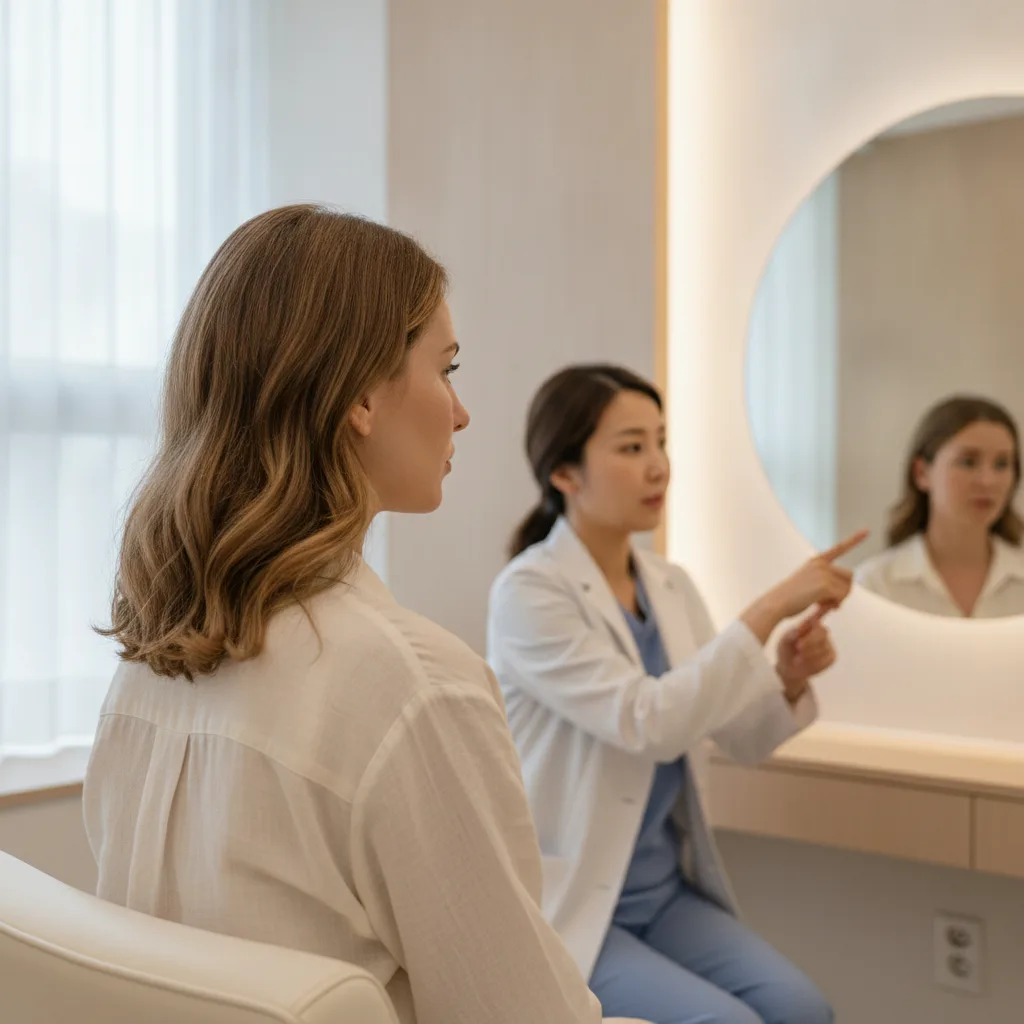
Bunny lines are the diagonal creases that appear across the bridge of the nose when you smile or scrunch. They are not caused by aging, they are caused by the nasalis muscle firing under animated expression, and in Seoul they are one of the most common walk-in add-ons at the end of a Botox or crow's feet appointment. A tiny dose fixes them. A wrong dose flattens your smile.
WHAT BUNNY LINES ACTUALLY ARE
Look in the mirror and scrunch your nose like you smell something odd. The diagonal wrinkles that appear on the side walls of the bridge, running from the inner corner of each eye down toward the nostril, are bunny lines. They sit on top of the nasalis muscle, a fan-shaped muscle that pulls the nose skin upward and inward every time you laugh, squint, or take a strong photo. In people with expressive faces, and especially in patients who have already had crow's feet Botox, the nasalis quietly compensates. Softening the crow's feet forces the nose muscle to do more work, and the bunny lines get more visible over weeks. This is why Seoul injectors often flag bunny lines during a follow-up visit rather than the first one.
Static bunny lines, the ones you can see when your face is at rest, are a different story. Those need a combination of Botox to stop the muscle and a small amount of skin resurfacing to soften the etched line itself. Injectors in Gangnam usually pair a 2 to 4 unit Botox dose with a single-pass fractional laser or a light chemical peel at a later session. The Botox alone will not erase a wrinkle that has already carved into the skin.
HOW MUCH BOTOX GOES INTO THE NOSE
The dose is small. Most Seoul injectors use 2 to 4 units of a Korean brand like Botulax or Nabota per side, so 4 to 8 units total. That is roughly a fifth of a masseter dose and less than half of what most clinics use for a full glabella. The injection sits shallow, in the belly of the nasalis on the upper side of the nose bridge, and the needle stays away from the medial canthal area where a stray dose can drift into the levator labii and drop your upper lip. Clinics that dose 10 units or more per side are overtreating and risking a stiff, flared look when you laugh. Push back if a coordinator quotes you a larger amount.
Expect the price to sit between ₩50,000 and ₩120,000 per session, or roughly $35 to $85 USD, when done as an add-on to a larger Botox appointment. Standalone bunny lines Botox as a first visit is rare, since most patients notice bunny lines after starting other Botox work. If your clinic charges more than ₩150,000 for a bunny lines only treatment, it is a package upsell rather than a fair per-unit rate. Ask what the per-unit rate is for the brand you are getting, then multiply by 4 to 8 units to check the math.

WHICH KOREAN BOTOX BRAND WORKS BEST HERE?
For a small, precise area like the nose bridge, the brand matters less than the injector, but the brand still matters. Nabota (Daewoong) and Botulax (Hugel) are the two most commonly used Korean brands in Gangnam and both perform reliably at low doses on the nasalis. Meditoxin (Medytox) is used less often here because its onset is slightly faster and the diffusion pattern can feel a hair less predictable in a tiny area near the mid-face. If you already had a good result with a specific brand on your crow's feet or forehead, ask for the same one on your nose. Consistency in brand across the mid-face reduces the risk of asymmetric offset when doses start wearing off at different rates. For a deeper look at the differences, see the Korean Botox brands compared guide.
If you are visiting Seoul from abroad and want the closest match to what you get at home, some Apgujeong clinics also stock Allergan Botox (the American original) at a premium. Expect to pay roughly double per unit compared to the Korean brands, so 8 units of Allergan on the nose bridge can push the session past ₩200,000. For most patients this is not worth the markup on such a small area, since Nabota and Botulax perform on par at this dose. Save the imported brand for larger targets like the masseter or forehead if you want it at all.
WHAT CAN GO WRONG IF THE INJECTOR RUSHES?
The nose sits above two muscles that you do not want to touch. The levator labii superioris alaeque nasi, on the outer edge of the nose base, controls your upper lip lift. Get Botox into it by accident and your smile turns crooked or flat for 8 to 12 weeks. The zygomaticus minor, further out on the cheek, controls the corner of your mouth lifting up. Diffusion in that direction gives you a droopy smile on one side. Both errors are recoverable, since Botox is temporary, but they are miserable to wait out. A rushed injector who does not palpate the bridge first, or who places the needle too low on the nose, is the main risk factor here.
The other issue is overtreatment. If the injector uses 8 to 10 units per side to flatten every possible movement, the nose stops moving during animated expressions and the face reads as stiff. Bunny lines Botox should soften the crease when you scrunch, not eliminate it. A residual 20 to 30 percent movement is the target, since a completely still nasalis looks unnatural during laughing and eating. Ask the injector directly what dose they are using, and if they cannot tell you the number of units without checking the chart, that is a signal to reconsider.
- 01Ask for the exact unit count per side before the needle touches skin
- 02Confirm the brand name (Botulax, Nabota, Meditoxin, or Allergan)
- 03Watch the injector palpate the bridge with a gloved finger to map the muscle
- 04Skip the treatment if the injector suggests more than 5 units per side for a first pass
- 05Book a 2-week follow-up so an under-treated side can be topped up safely
WHERE TO GET IT DONE IN SEOUL
Bunny lines Botox is a routine add-on at virtually every dermatology clinic in Gangnam, Apgujeong, Cheongdam, and Sinnonhyeon, so location matters less than the injector. For medical tourists who want English-speaking staff and clear per-unit pricing, the walkable stretch of Sinnonhyeon between exits 4 and 6 has a dense cluster of mid-priced clinics that quote in KRW without hidden VAT. For a more premium experience with senior injectors and quieter waiting rooms, Apgujeong is the standard pick, though prices run 20 to 40 percent higher than Sinnonhyeon for the same brand and dose. Cheongdam sits at the top end and is usually only worth it if you are stacking bunny lines with a surgical consultation on the same day.
If this is your first Botox appointment of any kind, do not book bunny lines as a standalone visit. Book a full first-time Botox consultation and let the injector assess whether you actually need nasalis treatment, or whether softening your crow's feet and glabella first will make the bunny lines less obvious on their own. Many first-timers find that once the upper face relaxes, the nasal scrunch tones down enough that a separate nose dose becomes unnecessary.

HOW LONG DOES IT LAST?
Bunny lines Botox lasts 3 to 4 months in most patients, which is on the shorter end of the Botox duration range. This is because the nasalis is a small, thin muscle that metabolizes the toxin faster than the larger masseter or frontalis. Expect to rebook every 12 to 16 weeks if you want the effect maintained, and plan the touch-up to coincide with your next crow's feet or forehead session so you consolidate travel and consultation fees into one visit. Patients who animate a lot, either from smiling constantly or from expressive work like acting and public speaking, may find the effect wears at the 10-week mark.
There is no cumulative benefit to over-frequent dosing. Injecting every 6 to 8 weeks does not extend duration, it just increases the risk of building antibodies to the toxin over years of use, which can eventually reduce your response to Botox altogether. Stick to the 3 to 4 month cadence, keep the dose low, and rotate brands only if your injector recommends it. For a broader look at how Botox longevity works across areas, the Botox in Seoul guide covers the full picture.
Concerns · 7 min · Aug 31, 2026
← all posts
BREAST AUGMENTATION RISKS IN SEOUL 2026: A SAFETY GUIDE
Capsular contracture, rupture, hematoma, and the red flags to catch before booking a Seoul clinic.
TWO-JAW SURGERY RISKS IN SEOUL 2026: WHAT TO KNOW BEFORE BOOKING
A candid look at nerve injury, occlusion problems, airway swelling, and revision odds for international patients considering orthognathic surgery in Korea.
LIPOSUCTION RISKS IN SEOUL 2026: RED FLAGS TO AVOID
The real complications from Seoul lipo, the clinic red flags that predict them, and how medical tourists reduce their odds.

HAND REJUVENATION IN SEOUL 2026: AGE SPOTS, VOLUME & VEINS
Non-surgical hand rejuvenation in Seoul: pico toning for age spots, Radiesse and Profhilo for volume loss, sclerotherapy for veins, and honest 2026 pricing.
HAIR LOSS INJECTIONS IN SEOUL 2026: EXOSOMES, PDRN & SCALP MESOTHERAPY
Non-surgical scalp injections for thinning hair in Seoul: exosomes, PDRN and mesotherapy protocols, costs, and where foreigners actually book.
▶▶▶ stop reading. start matching.
FIND YOURS.
We'll pull five clinics matched to your case. WhatsApp reply within 24h.