FACELIFT VS THREAD LIFTING IN SEOUL: WHICH LIFT IN 2026?
A surgical SMAS facelift and a Korean PDO/PCL thread lift solve different problems at very different price points. Here is how Seoul clinics actually decide between them.
By Editorial
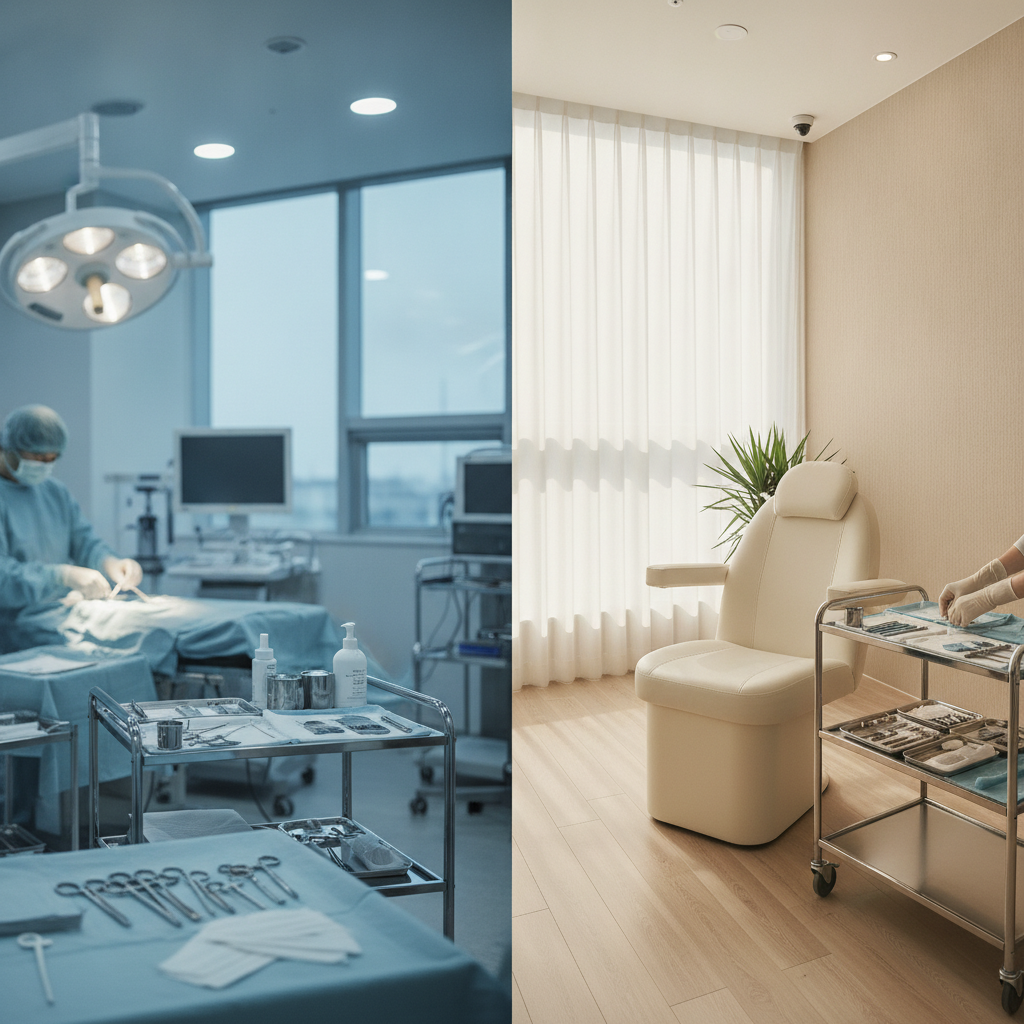
A SMAS facelift and a Korean thread lift look like solutions to the same problem, but they are not. One repositions deep tissue for a decade. The other tacks up soft tissue for a season or two. Seoul clinics work with both because most patients need one, not both, and the wrong choice wastes either years or money. This guide walks through how surgeons in Gangnam and Apgujeong actually decide between them in 2026.
WHAT EACH PROCEDURE ACTUALLY DOES
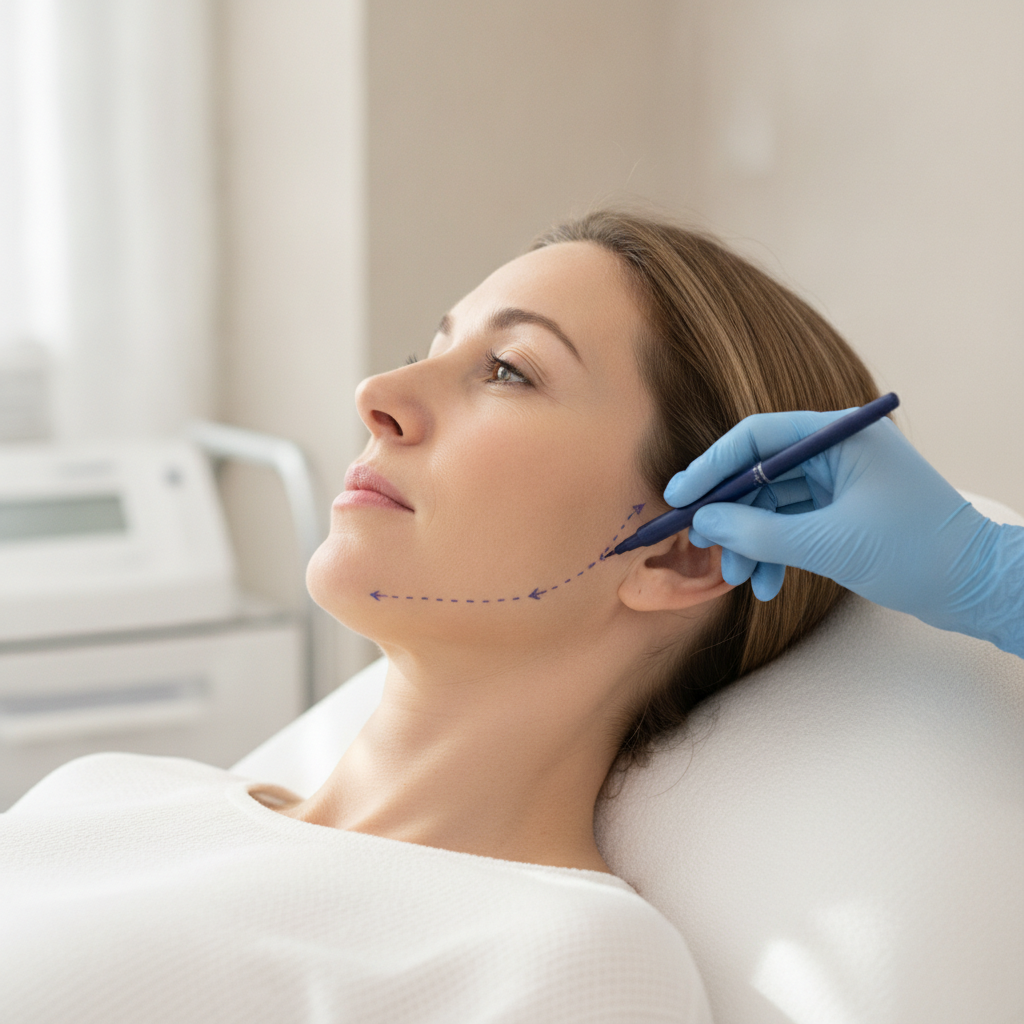
A facelift in Seoul in 2026 almost always refers to a SMAS-plication or deep-plane technique. The surgeon lifts and tightens the superficial musculo-aponeurotic system, the layer of connective tissue that carries the jowl, mid-cheek fat pad, and platysma. Incisions run in front of and behind the ear, sometimes into the hairline for a temporal lift. Duration is around three to four hours under general anesthesia, and the correction sits at the deep tissue level, not the skin surface. Results hold for eight to twelve years in most patients.
A thread lift uses absorbable barbed sutures, usually PDO (polydioxanone), PCL (polycaprolactone), or PLLA (poly-L-lactic acid), inserted through fine needles from the temple, cheek, or preauricular area. The barbs anchor into subcutaneous tissue and mechanically pull sagging soft tissue upward. There is no incision and no general anesthesia. Once inserted, the threads slowly dissolve over six to twenty-four months while stimulating a mild collagen response along the thread tract. The lift itself lasts nine to eighteen months, depending on the material and how much tissue is being asked to move.
The core difference is structural versus superficial. Facelift surgery restructures the scaffold that holds the face up. Threads pin the fabric of the face to that scaffold without changing the scaffold itself. If the scaffold has already dropped, threads will pull briefly and fail early. That single fact drives almost every recommendation a Seoul surgeon will make.
WHO GETS WHICH IN SEOUL IN 2026
Patients in their late twenties to early forties with mild mid-cheek descent, early jowls, or a softening jawline are typical thread-lift candidates. Skin still has elasticity, the fat pads have not migrated deeply, and the goal is prevention plus a subtle refresh. The Korean market has leaned hard into this age bracket for a decade, and clinics along Sinnonhyeon and Gangnam Station stack thread lifts with Ultherapy or Shurink to combine mechanical lift with a collagen-stimulating tightening layer.
Patients in their late forties, fifties, and sixties with true jowl formation, deep nasolabial folds, and neck banding are surgical candidates. In this group, threads underdeliver visibly within three to six months because the tissue weight exceeds what an absorbable suture can hold. Seoul surgeons in Apgujeong and Cheongdam will often decline to thread this patient at all, since the result damages the clinic's reputation more than it helps the patient. See the full facelift guide for candidacy detail.
The grey zone sits between forty-two and forty-eight. Skin is still cooperating, jowls are early, but the mid-face has started to look tired in photographs. Here the decision turns on budget, downtime tolerance, and whether the patient wants a definitive answer or a delaying tactic. A well-placed thread lift with PCL cog threads plus a Shurink cycle can bridge four to six years before surgery becomes the honest recommendation.
COST AND DOWNTIME, HONESTLY
A SMAS facelift in Seoul in 2026 runs ₩12,000,000 to ₩22,000,000, or roughly USD 8,600 to USD 16,000, depending on whether the neck and temporal areas are included. Deep-plane facelifts at senior surgeon tier in Apgujeong touch ₩25,000,000 (about USD 18,000). VAT is usually plus 10% and often waived for foreign passports under the med-tourism refund scheme. Downtime is ten to fourteen days visible bruising, three weeks before makeup covers everything cleanly, and six weeks before workouts return. See the facelift cost breakdown for line-item pricing.
A Korean thread lift with eight to twelve PDO cog threads sits between ₩600,000 and ₩1,800,000 (about USD 430 to USD 1,300), while premium PCL or MINT/Wonderlift branded protocols with twelve to twenty threads reach ₩2,500,000 to ₩4,500,000 (roughly USD 1,800 to USD 3,200). Downtime is one to three days of mild swelling and pinpoint bruising at insertion points, and normal activity resumes the next morning. See the detailed thread lift pricing guide for material-by-material figures.
- 01SMAS facelift Seoul 2026: ₩12M to ₩22M (USD 8,600 to USD 16,000), 10 to 14 days downtime, 8 to 12 year hold
- 02Deep-plane facelift, senior surgeon: ₩18M to ₩25M (USD 13,000 to USD 18,000)
- 03PDO cog thread lift, 8 to 12 threads: ₩600K to ₩1.8M (USD 430 to USD 1,300), 1 to 3 days downtime, 9 to 12 month hold
- 04PCL or MINT or Wonderlift thread lift, 12 to 20 threads: ₩2.5M to ₩4.5M (USD 1,800 to USD 3,200), 12 to 18 month hold
- 05Foreign patient VAT refund typically 8 to 10 percent when clinic is med-tourism registered
HOW SEOUL SURGEONS FRAME THE DECISION
Most Seoul consultations start with a pinch test at the mid-cheek and along the mandible. If the surgeon can pull the tissue upward and it holds a natural angle for a few seconds without cartoonish tension, the patient is a thread candidate. If the tissue snaps back immediately or the pinched skin creates a sharp fold rather than a lift, the patient needs surgery. It is a two-second physical exam and it decides the entire treatment path.
The second filter is photographic. Clinics use ten-year progression photos when available, or side-by-side comparisons against the patient's own driver's license. If the mid-cheek fat pad has migrated below the nasolabial fold, threads cannot walk it back up. Surgery repositions that fat pad and re-anchors it, which is why the ten-year hold is not marketing but geometry.
A third factor rarely discussed in English-language sources is the neck. Neck laxity and platysmal banding respond only to surgery or, in modest cases, to a Nefertiti lift with Botox. Threads placed along the mandible without addressing the neck create a floating jawline that looks worse in profile than before treatment. Any clinic pitching neck threads to a patient with real platysmal banding is oversimplifying, and this is where a second opinion pays.
COMMON SEOUL PACKAGING TRAPS
Thread lifts are the single most upsold treatment in Sinnonhyeon and Gangnam Station because margin per session is high and clinics can bundle them with laser, HIFU, or filler. A common trap is a low-priced thread quote (around ₩390,000) that turns into ₩1,600,000 at the treatment room once the actual number of threads is disclosed. The published price is often for a preview or half-face count of three to four threads, which is not a treatment. Always confirm the thread count before agreeing to any listed number.
Facelift packaging is the opposite kind of trap. Bundled quotes that combine a mini-facelift with fat grafting, blepharoplasty, and neck contouring can look reasonable line-by-line and then arrive at ₩35,000,000 total. Some patients need all of that. Many do not. A senior surgeon will happily separate a jowl-focused SMAS lift from an unnecessary upper blepharoplasty if asked directly. See the avoiding consultation upsell guide for the questions that cut through combined quotes.
RECOVERY EXPECTATIONS FOR INTERNATIONAL PATIENTS
For patients flying in for a facelift, plan a fourteen-day stay. Surgery day plus one night in the clinic, four to seven days of visible bruising, drain and suture removal around day seven, and a final check on day ten to twelve. Flights are cleared from day fourteen for short-haul and day twenty-one for long-haul, since cabin pressure and forced immobility raise seroma and swelling risk. Full detail sits in the flying home after aesthetic procedures guide.
For thread lifts the calculus is different. Most international patients arrive Monday, treat Tuesday, and fly home Thursday or Friday looking essentially normal, with only mild swelling under makeup. This is the honest appeal of threads for a med-tourism itinerary. The catch is that the result peaks at week four to six and starts fading by month eight to ten, so patients rebooking annually spend as much over four years as one facelift would have cost.
“Threads pin the fabric of the face to a scaffold that has not been repaired. Surgery repairs the scaffold. Ten years apart, the difference is not subtle.”
WHAT THE RIGHT ANSWER LOOKS LIKE
For a patient under forty-two with early laxity and no visible jowl, a PDO or PCL thread lift stacked with Ultherapy or Shurink is a defensible choice, and the total spend of ₩3M to ₩5M every eighteen months is reasonable. For a patient over forty-eight with true jowl and mid-face descent, a SMAS facelift is not just the better result, it is the cheaper result over a decade. The middle group should weigh a Seoul thread lift as a considered four-year bridge, then plan surgery when the honest signal arrives.
A second opinion in Apgujeong or Cheongdam after a thread-heavy quote in Sinnonhyeon is a five-minute investment that saves years of chasing diminishing returns. The reverse also holds: a surgical quote at USD 52,000 for a mini-lift deserves a sanity check against three senior-surgeon consultations before signing.
Comparisons · 9 min · Sep 9, 2026
← all posts
HAIR TRANSPLANT SEOUL VS TURKEY 2026: COST, QUALITY, RECOVERY
Seoul or Istanbul for your hair transplant in 2026? A direct comparison of price, technique, graft count, recovery time, and who each destination actually suits.
MOTIVA VS MENTOR VS NAGOR IMPLANTS IN SEOUL 2026
The three implant brands Korean surgeons actually offer, and how the choice changes the price, the scar, and the ten-year plan.
SYLFIRM X VS POTENZA IN SEOUL: WHICH RF MICRONEEDLING IN 2026?
A side-by-side of Sylfirm X and Potenza in Seoul clinics: what each device does best, real KRW pricing, downtime, and how to pick for melasma, acne scars, or a lifting protocol.
LIPOSUCTION SEOUL VS BANGKOK VS ISTANBUL: WHERE TO FLY IN 2026
A working comparison of liposuction 360 in Seoul, Bangkok, and Istanbul for international patients weighing cost, technique, safety, and recovery in 2026.
HYDRAFACIAL VS AQUAPEEL SEOUL 2026: WHICH MEDICAL FACIAL WINS
Two of the most-booked medical facials in Seoul, compared on protocol, price, downtime, and which one actually fits your trip.
▶▶▶ stop reading. start matching.
FIND YOURS.
We'll pull five clinics matched to your case. WhatsApp reply within 24h.