MICRO BOTOX IN SEOUL: PORE-SHRINK & OIL-CONTROL GUIDE 2026
How intradermal micro-dose Botox tightens pores and calms oil in Seoul clinics, with dose maps, KRW and USD pricing, and what to expect at your first session.
By Editorial
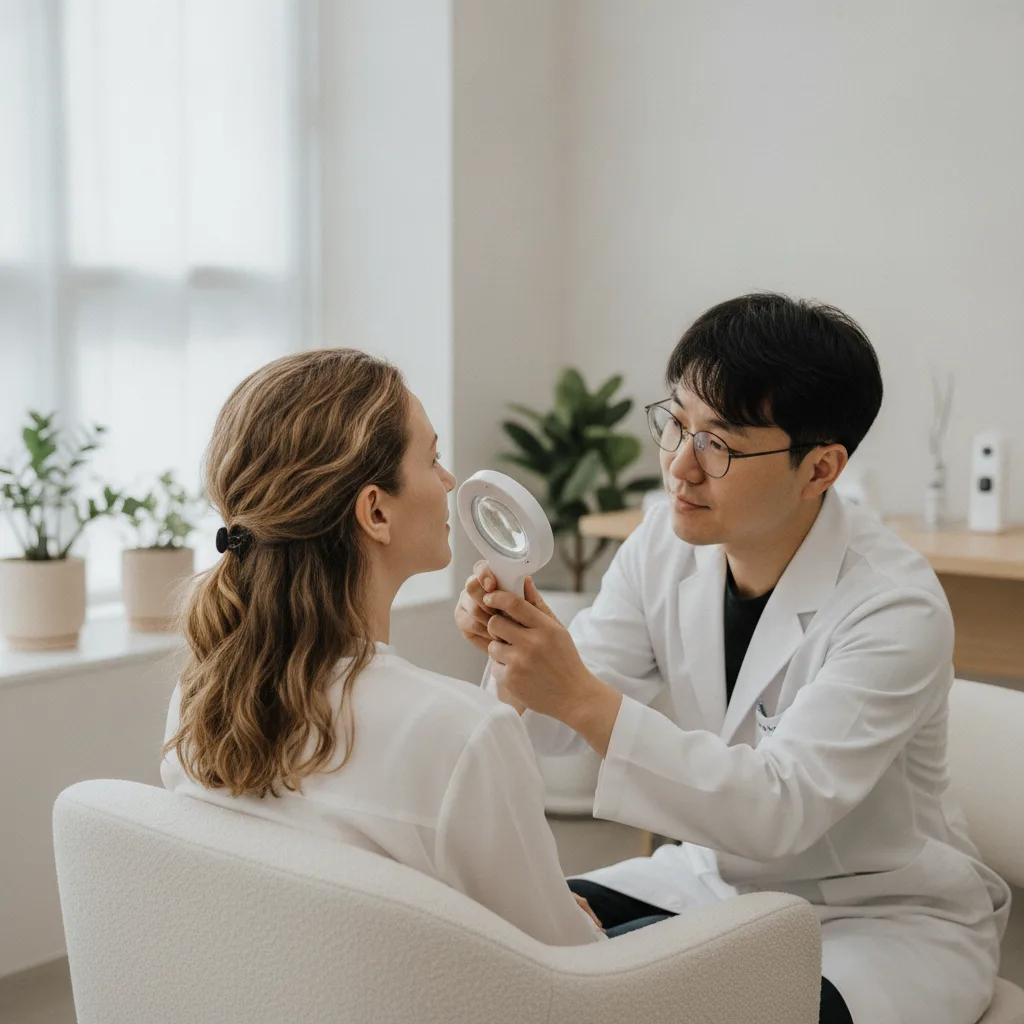
Walk into any Gangnam skin clinic in 2026 and there is a menu item that does not fit the usual Botox story. It is called micro Botox, or skin Botox, and it does almost nothing for wrinkles. What it does instead is quiet down oil glands, refine pore openings, and give the mid-face that flat matte finish Korean actresses seem to wear at 3pm in July. This guide walks through what the treatment actually is, how Seoul clinics dose it, what it costs at real 2026 prices, and where it fits next to the standard Botox protocol.
WHAT MICRO BOTOX ACTUALLY IS (AND WHY SEOUL BUILT A PROTOCOL AROUND IT)
Standard Botox is injected deep into the muscle to stop it from contracting. Micro Botox flips the geography. The toxin is heavily diluted with saline, sometimes mixed with a small amount of hyaluronic acid or exosomes, and placed just under the surface of the skin in a fine grid of tiny blebs. The dose never reaches the underlying muscle in a meaningful way, so expression is preserved. What gets affected is a different target entirely: the erector pili muscles around each pore, the sebaceous glands feeding oil to the surface, and the fine sweat glands on the T-zone.
The result is smaller-looking pores, less afternoon shine, and a subtle skin-tightening effect on the cheeks and jawline. Seoul clinics started refining the protocol around 2018, mostly on humid-summer patients and TV talent who needed a matte camera face without visible product. By 2024 it had spread across mid-tier Gangnam clinics as an add-on to facials, and by 2026 it sits on the price menu as a standalone treatment. It is not a replacement for baby Botox, which still targets fine expression lines. The two protocols share a needle brand and a bottle. They do not share a purpose.
The key point for a first-time visitor: micro Botox is a skin-quality treatment dressed in a Botox uniform. If you booked it expecting your forehead lines to soften, you booked the wrong menu item.
HOW THE INJECTION WORKS, DOSE BY DOSE
A typical Seoul micro Botox session uses 20 to 50 units of a Korean-brand toxin, diluted into 4 to 6 milliliters of saline. Compare that to a standard forehead treatment, which lands 20 units of undiluted product into three or four muscle bellies. The micro protocol spreads the same unit count across 100 to 300 shallow injection points, each about 3 to 5 millimeters apart, across the forehead, temples, cheeks, nose and sometimes the neckline.
Doctors use one of two tools. The traditional method is a 32-gauge insulin needle, injected by hand across a marked grid. The newer method is a mesotherapy gun such as the Vital Injector 2, which fires calibrated micro-doses at set depths and grid spacing. Both work. Hand injection gives finer control at the mid-cheek and jawline. The gun is faster and more even across the forehead. In the top-tier Apgujeong clinics you will often see both, gun for the T-zone, hand for the border areas.
- 01Forehead T-zone: 8 to 15 units across 40 to 70 points
- 02Nose and mid-cheek pores: 6 to 12 units across 40 to 60 points
- 03Lower cheek and jawline lift-and-matte effect: 8 to 15 units across 50 to 100 points
- 04Total session dose: usually 20 to 40 units for face-only, up to 50 with neck
The dilution matters more than the raw unit count. A 4:1 saline dilution gives a stronger pore effect. A 6:1 dilution is gentler and safer for a first-time patient, which is what most reputable Seoul clinics default to unless the client is a returning regular. Ask the injector what dilution ratio they use. A clinic that cannot answer that question is a clinic to leave.
WHAT IT COSTS IN SEOUL IN 2026
Micro Botox is priced by area, not by unit, in most Seoul clinics. That distinction saves money for T-zone-only patients and costs more for full-face requests. The base menu item usually reads as a single-session package including toxin, saline dilution, topical anesthetic and one follow-up review. Prices below reflect Gangnam and Sinnonhyeon mid-tier clinics as of mid-2026, VAT included.
- 01Forehead-only micro Botox: ₩150,000 to ₩220,000 (about USD 115 to 170)
- 02Full face (forehead, nose, cheeks): ₩280,000 to ₩420,000 (about USD 210 to 315)
- 03Face plus neck: ₩380,000 to ₩550,000 (about USD 285 to 415)
- 04Apgujeong premium clinics with Meditoxin or Nabota: expect 30 to 60 percent above the ranges above
- 05Package of 3 sessions (recommended for pore effect): usually 15 to 20 percent off single-session price
Most clinics default to a Korean toxin brand such as Botulax, Nabota or Meditoxin. Allergan Botox costs roughly double per session and is rarely worth it for micro protocols because the dilution flattens brand differences. If you want the full brand argument the Korean vs Allergan Botox comparison covers what actually changes at low dose. For skin-Botox purposes, brand matters less than injector technique.
“Micro Botox is priced by area, not by unit. Ask for the area map before you ask for the price.”
WHO BENEFITS, WHO SHOULD SKIP
The strongest candidates are patients with oily or combination skin, visible pore texture on the nose and mid-cheek, and afternoon shine that survives good skincare. Humid-climate visitors from Bangkok, Singapore, Hong Kong and Manila often see a bigger effect than dry-climate visitors from London or Melbourne, because there is simply more oil for the treatment to calm. If enlarged pores are your primary concern, this treatment slots naturally into a wider pore-focused Seoul plan that pairs it with a chemical peel and a fractional laser.
It is a poor fit for patients with dry or dehydrated skin, active rosacea or eczema, and anyone whose main issue is texture from acne scarring rather than pore visibility. It also does not build collagen, so it is not a substitute for Rejuran, Juvelook or other skin boosters if the underlying goal is a plumper, younger-looking dermis. Some Gangnam injectors will combine micro Botox with a light skin booster in the same session, which is a legitimate protocol but pushes the price above ₩500,000 (about USD 375).
Skip micro Botox entirely if you are pregnant or breastfeeding, running a fever, on high-dose antibiotics such as aminoglycosides, or planning a beach day within 48 hours. The injection points are shallow enough that sun exposure the same afternoon can cause pinpoint hyperpigmentation that lingers for weeks.
BOOKING, AFTERCARE AND WEEK-BY-WEEK TIMELINE
Most Seoul clinics book micro Botox as a 45-minute slot: 15 minutes for numbing with lidocaine cream, 20 minutes for the grid injection, and 10 minutes for cold compress and photography. Bring a hair tie and a clean face. Do not wear foundation to the appointment because it needs to come off anyway. If this is your first injectable in Korea, the first-time Botox walkthrough covers the paperwork, consent and translator options in more detail.
For 24 hours after the session, skip the gym, sauna, jjimjilbang, hot yoga and alcohol. Sleep on your back the first night. Do not massage or scrub the face for three days. The pinpoint welts fade within 6 to 12 hours, though a few patients see faint marks lasting into day two. Makeup is fine after 8 hours. Sun exposure needs SPF 50 and a hat for the first week.
The visible effect builds slowly. Days 1 to 3 you will see calmer oil production. Days 5 to 10 pore openings look tighter, especially on the nose. Weeks 3 to 6 give the peak effect. The result then fades gradually over 3 to 4 months. That is why most Seoul clinics recommend a 3-session package spaced 4 weeks apart to lock in a longer effect, then a maintenance session twice a year.
DOES MICRO BOTOX ACTUALLY SHRINK PORES FOR GOOD?
No, and any clinic that promises otherwise is overselling. Micro Botox temporarily calms the erector pili and sebaceous activity around each pore, which makes openings look smaller because there is less oil filling them and less muscle tone pulling them open. Once the toxin metabolizes over 3 to 4 months, pores return to baseline. Repeat sessions build a longer-lasting quieter baseline over time, but the underlying pore anatomy does not permanently change. For structural pore reduction you need collagen-building treatments such as RF microneedling.
CAN I FLY HOME THE DAY AFTER MICRO BOTOX?
Yes, flying 24 hours after a micro Botox session is generally safe. The injection depth is shallow, the total toxin dose is low, and cabin pressure does not affect intradermal placement the way it can with certain filler protocols. That said, a same-day flight is not recommended because pinpoint welts and residual redness look worse under dry cabin air and immigration lighting. Book the session at least one full night before departure and use a hydrating sheet mask on the plane.
Treatment guides · 8 min · Aug 10, 2026
← all posts
REJURAN VARIANTS EXPLAINED: HEALER, I, S, HB, EYE IN SEOUL
Every Rejuran type does something different. Here is what each variant treats, what it costs in Seoul, and which one your first booking should be.
SKIN BOOSTERS IN SEOUL 2026: JUVELOOK, PROFHILO, SCULPTRA GUIDE
A first-timer's cost, brand and clinic guide to skin boosters and collagen biostimulators in Seoul for 2026.
REVISION RHINOPLASTY IN SEOUL 2026: FIXING A FAILED NOSE JOB
A practical Seoul revision rhinoplasty guide covering cost, timing, cartilage sourcing, top districts, and which surgeons actually take secondary cases.
BREAST LIFT (MASTOPEXY) IN SEOUL 2026: COST, TECHNIQUES, RECOVERY
Everything a first-time medical tourist needs to know about mastopexy in Seoul: incision types, KRW pricing, recovery windows, and how it differs from augmentation.
LATERAL CANTHOPLASTY IN SEOUL: THE CAT EYE SURGERY GUIDE (2026)
How Korean surgeons lift the outer eye corner for a subtle cat-eye look, what it costs, and who it fits.
▶▶▶ stop reading. start matching.
FIND YOURS.
We'll pull five clinics matched to your case. WhatsApp reply within 24h.