SMAS VS DEEP PLANE VS MINI FACELIFT SEOUL 2026
A head-to-head on Seoul's three main facelift techniques: who each one actually fits, what they cost, and how long you'll be in Korea.
By Editorial
Three facelift techniques dominate Seoul's plastic surgery consults in 2026: SMAS, deep plane, and mini-lift. They are not interchangeable, and the clinic that shows you a brochure with all three usually has a strong opinion about which one fits your face. Choosing wrong wastes 10 to 14 days of recovery and a lot of money, so understanding the clinical difference before you fly matters more than picking a famous name.
THE ONE-LINE VERDICT
SMAS is the Seoul workhorse facelift for patients in their late forties to early sixties with moderate jowling and loose neck skin. Deep plane is the right choice when the mid-face has dropped and the nasolabial folds are deep, because the technique releases the retaining ligaments one layer below SMAS and repositions the cheek fat pad as a unit. Mini facelift is a smaller incision in front of the ear only, aimed at jawline and lower-cheek laxity in patients in their late thirties to mid-forties who do not yet need neck work. Pick the technique that matches your anatomy, not the brand name on the brochure.
Pricing in Seoul splits predictably by depth of dissection and operating-room time. A SMAS lift lands around ₩13,000,000 to ₩22,000,000 (roughly $9,300 to $15,700) at mid-tier Apgujeong and Gangnam clinics in 2026. Deep plane runs ₩20,000,000 to ₩35,000,000 (about $14,300 to $25,000) because the surgical plane is tighter and the operating time averages 5 to 7 hours. Mini facelift sits at ₩6,500,000 to ₩11,000,000 (about $4,650 to $7,850) and is often marketed as a lunchtime lift, which is misleading. For the full fee ladder across all three, read our facelift cost in Seoul 2026 breakdown.
SMAS FACELIFT: THE SEOUL DEFAULT
SMAS stands for superficial musculoaponeurotic system, the fibrous layer under the skin that holds facial muscles in place. A SMAS facelift lifts and tightens this layer independently of the skin, which is why the result looks pulled from the structure outward rather than the surface alone. Seoul surgeons have been performing SMAS for over two decades, so technique and consistency are high across the big plastic surgery hospitals. Expect two drains for 48 hours, a compression garment for 5 to 7 days, and sutures out at day 7.
Candidates are typically 48 to 62, with visible jowls, early neck banding, and skin that still has reasonable elasticity. Patients with heavy mid-face descent or deep marionette lines will not get the result they want from SMAS alone, which is why many Seoul clinics add fat grafting at the same time to restore cheek volume. UE Plastic Surgery in Apgujeong and April31 Aesthetics in Gangnam both publish SMAS packages that bundle 15 to 25 cc of autologous fat grafting into the fee, which usually saves ₩2,000,000 to ₩3,500,000 versus doing fat transfer as a second procedure.
DEEP PLANE FACELIFT: WHEN SMAS IS NOT ENOUGH
The deep plane technique dissects below the SMAS layer, releasing four key retaining ligaments: the zygomatic, masseteric, mandibular, and the orbital septum. By freeing these ligaments, the cheek fat pad, SMAS, and skin lift together as one block instead of as separate layers. The practical effect is a result that corrects the mid-face and the nasolabial fold, which SMAS struggles to touch without being over-tightened. The tradeoff is longer surgery, deeper anesthesia, and a higher demand for surgical experience, which is why only a handful of Seoul clinics market this technique honestly.
Lydian Plastic Surgery in Apgujeong, Returning Plastic Surgery in Gangnam, and HERSHE Plastic Surgery in Cheongdam are three Seoul clinics that publish deep plane as a distinct procedure rather than relabeling SMAS. Recovery runs longer than SMAS, with facial swelling that stays visible for 10 to 14 days and residual puffiness in the cheek fat pad for 6 to 8 weeks. Patients fly home at day 12 to 14 after suture removal, not earlier. Expect to budget 14 nights in Seoul minimum for a deep plane procedure, which pushes the total trip cost higher than the surgery fee alone suggests.
MINI FACELIFT: SMALLER CASE, SMALLER PROMISE
The mini facelift uses an incision that runs only in front of the ear, sometimes extending slightly into the hairline at the temple. The surgeon lifts a short SMAS flap and tightens the jawline and lower cheek. There is no neck work, no earlobe repositioning, and no mid-face correction. For a 38 to 46 year old with early jowling and a tight neck, the result is appropriate and the downtime is genuinely shorter than a full lift. For anyone with a loose platysma band or heavy jowls, a mini lift is the wrong operation and the result looks disappointing within 18 months.
Seoul clinics commonly package mini facelift with Ultherapy or a thread lift as a maintenance pairing, which keeps the price band tight at ₩6,500,000 to ₩11,000,000. If your consultation framed a mini facelift as a substitute for a full lift, get a second opinion. For non-surgical lifting alternatives before committing to any cut, compare the energy-device options in our HIFU vs RF microneedling guide and the ultrasound-tightening breakdown in our Ultherapy Seoul complete guide.
SIDE-BY-SIDE AT A GLANCE
- 01SMAS facelift: ₩13M to ₩22M, 7 nights post-op in Seoul, swelling fades at 2 to 3 weeks, best for ages 48 to 62 with jawline and early neck laxity.
- 02Deep plane facelift: ₩20M to ₩35M, 14 nights post-op in Seoul, swelling fades at 6 to 8 weeks, best for mid-face descent and deep nasolabial folds.
- 03Mini facelift: ₩6.5M to ₩11M, 5 nights post-op in Seoul, swelling fades at 10 to 14 days, best for ages 38 to 46 with early jowling and no neck work needed.
- 04All three can be stacked with fat grafting at the same surgery; this is standard in Seoul and worth negotiating into the package fee.

HOW TO CHOOSE WHICH ONE FITS YOUR FACE?
Book consultations at three clinics before you commit, and insist each consult photograph your face at rest and in animation. If two of three surgeons recommend the same technique for the same anatomical reason, that is a strong signal. If one clinic pushes mini and another pushes deep plane for the same face, you are not getting objective reads, and a third opinion resolves it. Patients who skip the three-consult discipline often default to the first clinic's recommendation, which usually tracks the clinic's commercial preference, not the anatomy.
Ask each surgeon which retaining ligaments they release and in what order. SMAS surgeons will name the SMAS flap only. Deep plane surgeons will name the zygomatic, masseteric, mandibular, and orbital ligaments specifically. Mini facelift surgeons will describe a short SMAS flap in front of the ear and no neck component. A surgeon who cannot answer the ligament question in clinical terms is not the right surgeon for a deep plane procedure, regardless of the clinic's marketing. For the full fly-in logistics after any facelift, read our facelift recovery timeline.
HOW LONG SHOULD I STAY IN SEOUL AFTER A FACELIFT?
Minimum stays are set by suture removal, not by swelling. SMAS and mini facelift sutures come out at day 7, so plan 10 nights minimum to allow a buffer and the day of surgery. Deep plane sutures come out at day 10 to 12, pushing the stay to 14 nights. Flying earlier is physically possible but increases facial swelling because of cabin pressure, which can set the final result back by weeks and risks hematoma in the first 72 hours. Business-class recline is worth the money if the flight home is longer than 6 hours, because sleeping flat helps lymphatic drainage.
CAN I COMBINE FACELIFT WITH OTHER PROCEDURES?
Yes, and most Seoul patients do. Fat grafting is the near-universal pairing because it addresses volume loss that lifting alone cannot fix. Upper blepharoplasty is often added for patients over 55, because the brow and upper lid drop in parallel with the lower face. Deep plane patients sometimes add a neck lift as a separate but same-session procedure. Combining procedures saves anesthesia fees and recovery time, but it extends the operating window to 6 to 9 hours, which raises anesthesia risk for patients over 65 or anyone with cardiovascular history.
HOW LONG WILL THE RESULT LAST?
Deep plane results last 10 to 12 years before patients start noticing re-descent of the mid-face. SMAS results last 8 to 10 years. Mini facelift results last 4 to 6 years because the technique addresses less tissue, which is why repeat clients often graduate from mini to SMAS or deep plane in their fifties. The longevity numbers assume the patient maintains stable weight; weight fluctuations of more than 5 to 7 kg accelerate re-descent regardless of technique.
WHAT ARE THE REAL RISKS?
Hematoma, infection, temporary facial nerve weakness, hairline distortion, and visible scarring are the five risks every Seoul surgeon lists on their consent form. Hematoma risk is highest in the first 48 hours and is the main reason you stay in-country for a week. Temporary nerve weakness resolves in 3 to 6 months in most cases but can be permanent in roughly 1 percent of deep plane cases. Scarring is technique-dependent; a well-placed incision in the pre-tragal crease is nearly invisible by month 6. For a comparison of surgical versus non-surgical options, see our facelift vs thread lifting breakdown.
Comparisons · 10 min · Sep 30, 2026
← all posts
BREAST IMPLANT REMOVAL SEOUL 2026: EN BLOC VS CAPSULECTOMY VS EXPLANT
The three protocols Seoul surgeons use to take breast implants out, how they pick between them, and what each one costs and recovers like for foreign patients in 2026.
JUVEDERM VS RESTYLANE VS BELOTERO: SEOUL FILLER BRANDS 2026
The three Western HA filler families Seoul injectors actually stock, where each one wins on the face, and what foreign patients pay per syringe in 2026.
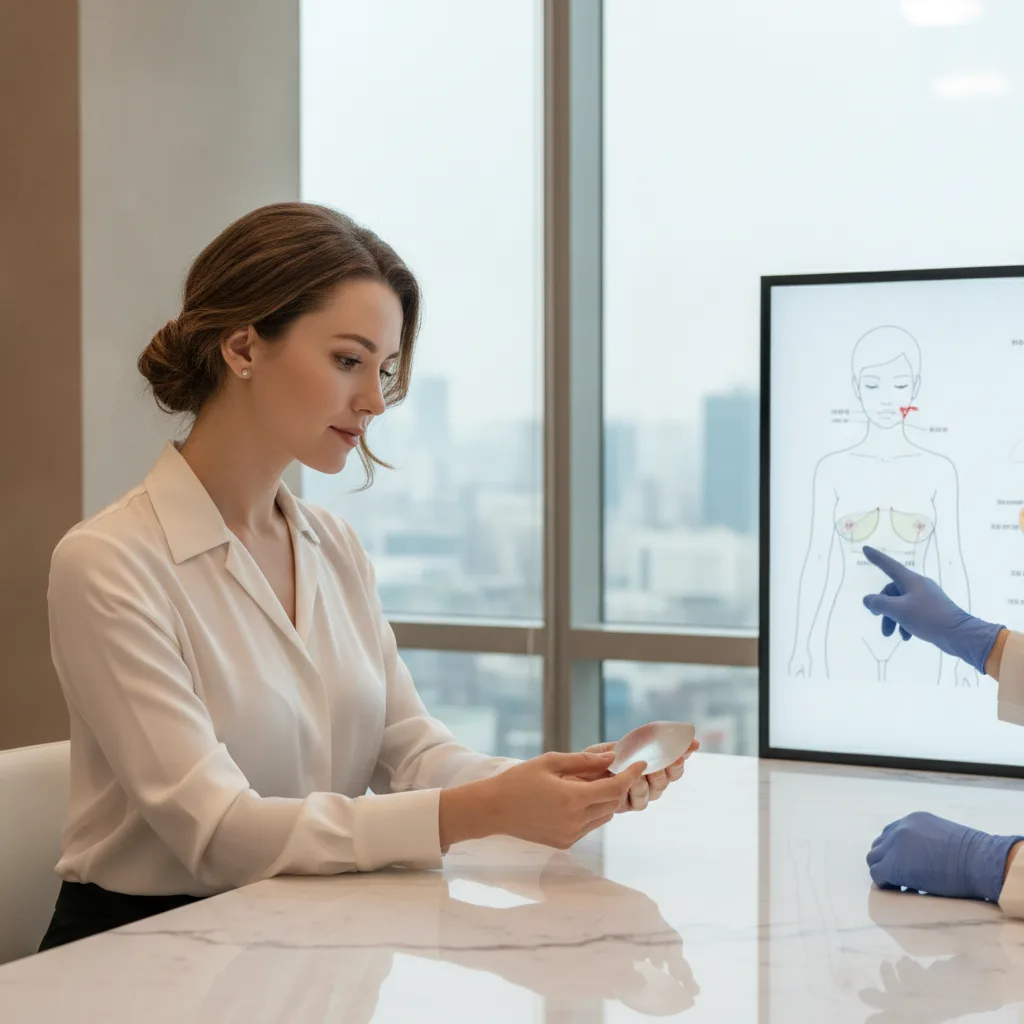
SUBGLANDULAR VS SUBMUSCULAR VS DUAL PLANE BREAST AUGMENTATION SEOUL 2026
The three pocket planes behind every Seoul boob job, how surgeons pick between them, and what each one means for recovery, feel, and ten-year results.
MINT PDO VS WONDERLIFT VS SILHOUETTE SOFT THREADS SEOUL 2026
The three thread brands Seoul clinics argue about, how surgeons actually pick between them, and what each costs for foreign patients in 2026.

FAT TRANSFER VS IMPLANTS BREAST AUGMENTATION SEOUL 2026
Head-to-head verdict on fat grafting and silicone implants in Seoul, with KRW price bands, revision rates, and the clinic types that run each procedure well.
▶▶▶ stop reading. start matching.
FIND YOURS.
We'll pull five clinics matched to your case. WhatsApp reply within 24h.