STITCH REMOVAL AFTER SEOUL PLASTIC SURGERY 2026: STAY OR FLY HOME
Who takes your sutures out, when, where, and what it costs if you stay in Seoul versus going home with stitches still in.
By Editorial
Most foreign patients lock in their flights before the surgeon mentions stitch removal, and then find out mid-recovery that the sutures are coming out on day seven while their boarding pass says day five. The decision is not purely medical. It is a mix of what procedure you had, where the incisions sit, how your skin holds, and whether a clinic at home will finish the job without charging you a new-patient consultation fee. This guide walks through who takes stitches out in Seoul, when each incision type is actually ready, what it costs to stay an extra two to four nights, and what to do if you have already booked a flight you cannot move.
WHEN SEOUL CLINICS ACTUALLY REMOVE STITCHES
Stitch removal timing depends on where the cut is, not on how good you feel. Eyelid incisions from double eyelid or canthoplasty come out at day 5 to 7, because the skin there is thin and the sutures start to leave track marks after a week. Rhinoplasty columellar stitches come out at day 7, at the same visit where the cast and splint are removed. Facial contouring incisions inside the mouth are usually dissolvable and do not need a removal visit, but external sutures on a facelift or neck lift come out at day 7 to 10, and the staples behind the ear at day 10 to 14. Breast augmentation incisions in the inframammary fold or around the areola are typically closed with buried dissolvable sutures plus skin glue, so there is often nothing to pull, but revision cases sometimes get externals that come out at day 10.
The surgeon decides the exact day at the final pre-op consult, and almost every clinic in Gangnam, Apgujeong, Cheongdam, and Sinnonhyeon will schedule the removal visit before you leave the operating room. Do not estimate from a friend's timeline. A thicker-skinned patient gets a day or two extra on nose and face work, and anyone on steroids, blood thinners, or isotretinoin can be pushed out by three or four days. If your clinic sends a KakaoTalk reminder the day before, assume that is the real appointment, not a provisional one.
WHO PHYSICALLY TAKES THE SUTURES OUT
In Seoul, suture removal is done by a nurse or a surgical coordinator, not the surgeon, except for the first rhinoplasty cast-off visit where the surgeon usually inspects the tip. The appointment itself is short. A bilateral double eyelid stitch removal takes about 5 minutes once you are on the chair. A facelift comes in two passes across 20 minutes. Most clinics do not charge for the removal visit when it is within the original package, and the big foreigner-facing clinics explicitly bundle it into the quoted price. Always confirm this in writing before surgery. Smaller clinics occasionally bill ₩30,000 to ₩80,000 for a nurse removal if the incision is a secondary one they added at consultation.
You do not need the surgeon who operated to take the stitches out. If your clinic's post-op slot is full on your target day, ask for the senior aesthetic nurse. That is the normal workflow for 90 percent of Seoul foreign-patient volume. The one exception is rhinoplasty tip refinement, where the surgeon takes the splint off personally and checks that the dorsal line is settling right. Expect that visit to run 20 to 30 minutes because the photo set and consultation are part of it.
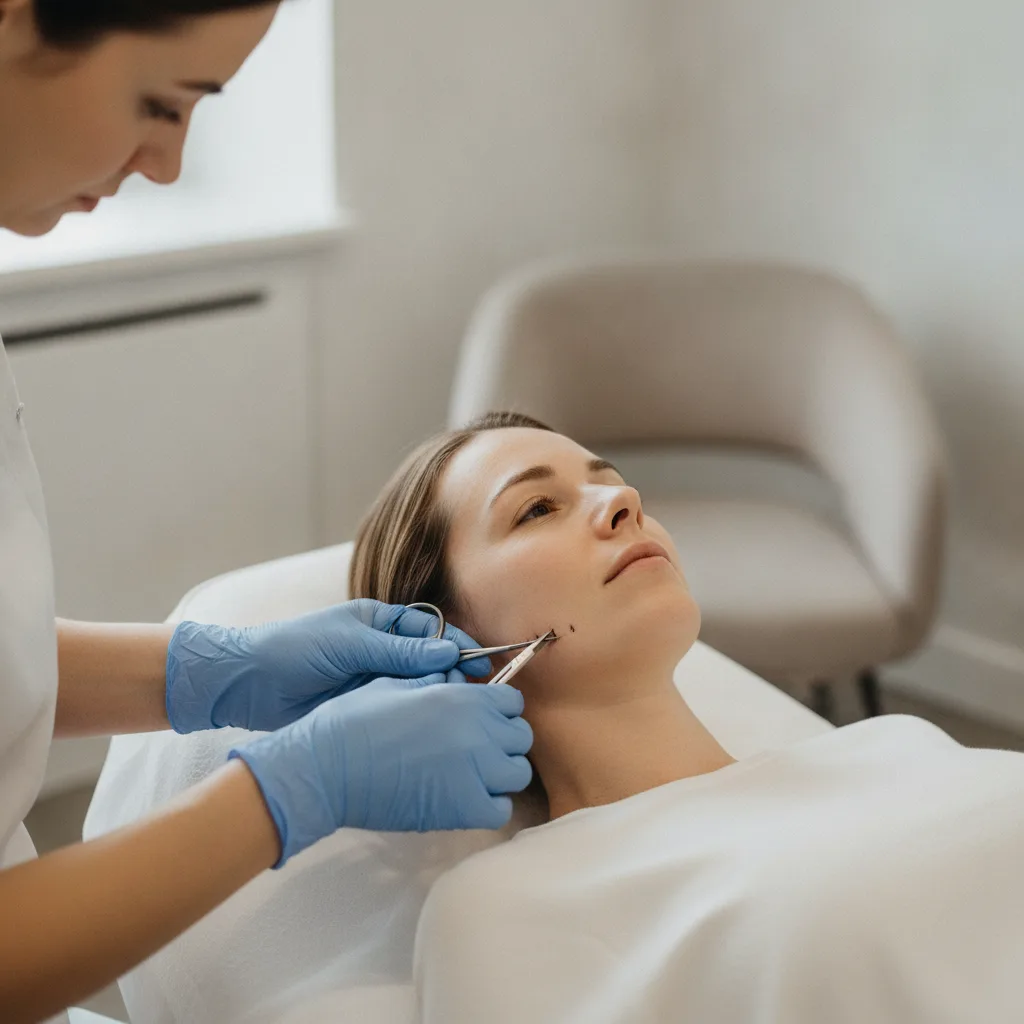
STAYING IN SEOUL VERSUS FLYING HOME WITH STITCHES IN
Staying through the removal visit is the cleaner option, and for most procedures it is also the cheaper one once you price in the home-country clinic fee. An extra 3 nights in a 3-star Gangnam hotel runs ₩240,000 to ₩420,000 total, or about $175 to $310. A recovery-focused serviced apartment is ₩90,000 to ₩150,000 a night, so ₩270,000 to ₩450,000 for the window. Compare that against a foreign plastic surgery clinic back home, which charges $150 to $400 for a one-off suture removal as a non-patient, plus whatever assessment fee they add to cover the liability. Our breakdown of recovery apartments near Seoul plastic surgery clinics shows the usable blocks in Sinsa and Sinnonhyeon for stays of 5 to 14 nights.
Flying home with stitches is viable for eyelid work and upper-face procedures once swelling has peaked, but there are two risks you cannot undo. First, cabin pressure dries the incision and the tape, which raises the odds of the suture knot catching on a mask or pillow and pulling early. Second, if you land in a country where plastic surgery aftercare for non-patients is not covered by insurance, you will walk into a GP who either refers you to another specialist or does the removal with the wrong-sized scissors. For rhinoplasty, two-jaw surgery, facial contouring, or any body procedure, flying home with external sutures still in is a bad trade and most Seoul surgeons will advise against it. See flying home after plastic surgery in Seoul for the full post-op flight window by procedure.
MINIMUM TRIP LENGTH BY PROCEDURE
- 01Double eyelid surgery: 7 to 8 days total, removal day 5 to 7, fly day 8 at earliest.
- 02Non-incisional double eyelid: 5 to 6 days total, no external stitches on most techniques.
- 03Rhinoplasty with splint: 9 to 10 days total, cast and stitches off day 7, buffer 2 days for swelling.
- 04Facial contouring (V-line, zygoma, genioplasty): 10 to 14 days, intraoral sutures dissolve, external points removed day 7.
- 05Facelift or neck lift: 12 to 14 days, stitches day 7 to 10, staples day 10 to 14.
- 06Breast augmentation: 7 to 10 days, drain and tape checks, dissolvables plus glue in most cases.
- 07Liposuction (small areas): 7 days, compression garment fitting at the removal visit.
- 08Two-jaw surgery: 14 to 21 days, intermaxillary fixation checks and swelling monitoring are the limiter, not sutures.
The trip length is almost always driven by the removal visit, not the surgery date. Our Seoul aesthetic trip length guide breaks the window down by booking pattern. If you can only take 5 to 7 days off work and you are considering rhinoplasty or facial contouring, you are either changing procedure or extending the trip. There is no safe shortcut.
WHAT TO DO IF YOU ALREADY BOOKED A FLIGHT THAT LEAVES BEFORE REMOVAL DAY
Change the flight first, before you talk to the clinic. On most carriers flying Seoul routes, a one-way domestic-to-international change in the same booking class costs ₩80,000 to ₩200,000 if done more than 72 hours out. That is lower than the composite cost of a self-pay suture removal in Singapore, Sydney, London, or Los Angeles, and it keeps the aftercare line of responsibility with the surgeon who did the work. If the flight is non-refundable and locked, call the airline and ask about a medical rebooking policy. Korean Air, Asiana, and most ASEAN flag carriers will waive the change fee on presentation of a medical certificate from a licensed Seoul clinic, which the clinic will write for you on request. Budget carriers like T'way, Jin Air, and AirAsia do not have this policy and will charge the standard change fee.
If the flight truly cannot move, email your clinic's international coordinator at least 48 hours before the removal visit and ask for a referral letter to a plastic surgeon in your destination city. The letter should list the suture material, the incision location, the date of surgery, and the recommended removal window. Most Seoul clinics will write this in English and Korean on request, often without a fee for foreign patients. Book the destination clinic yourself. Do not ask the Seoul clinic to coordinate with them, because the two-sided scheduling delays usually do not fit inside a tight flight window.
WHAT A SEOUL SUTURE REMOVAL VISIT ACTUALLY LOOKS LIKE
You check in through the foreign patient desk, hand over the KakaoTalk appointment reminder, and are called within 10 to 20 minutes depending on clinic volume. The nurse takes pre-removal photos, cleans the incision with saline, and lifts the knots with fine forceps before snipping. For eyelids, the cleanup afterwards is a quick antibiotic ointment pass and tape-off instructions. For rhinoplasty, the splint and tape come off, the nurse cleans crusts out of the nostrils, and the surgeon walks through the swelling timeline with you. Most clinics end the visit by handing you a care kit with ointment, saline ampoules, and sometimes a scar silicone sheet, and they schedule the first video follow-up for 4 to 6 weeks later.
Bring your passport. Bring a hat or hood if the incision is on the face, because there is no recovery room to wait in after and you are walking out through the lobby. Wear a button-down shirt on facial surgery days so you do not have to pull a shirt over fresh stitches. Do not plan a long dinner, a sauna, or a makeup counter visit the same day. For rhinoplasty specifically, our splint-week recovery guide covers the 72 hours on either side of the removal visit.
HOW LONG AFTER REMOVAL BEFORE YOU CAN FLY
For eyelid work, 24 hours is enough. The incisions are closed with surgical tape or steri-strips for another 3 to 5 days, and cabin pressure does not threaten them. For rhinoplasty, most Seoul surgeons will clear you to fly 24 to 48 hours after the splint and stitches come off, as long as there is no active bleeding and you can breathe through both nostrils. For facial contouring and two-jaw, give yourself 7 days after the final stitch comes out before boarding a long-haul flight, mostly because of swelling and the risk of a sudden pressure-driven nosebleed. For body procedures, the limiter is the compression garment schedule, not the stitches themselves.
How-to · 6 min · Nov 21, 2026
← all posts
KAKAOTALK VS WHATSAPP BOOKING AT SEOUL CLINICS 2026: WHICH WORKS
Seoul clinics reply fast on KakaoTalk, slower on WhatsApp, and sometimes only on their own site form. Here is which channel actually gets you a booking in 2026.
FLYING HOME AFTER RHINOPLASTY IN SEOUL 2026: DAY-BY-DAY TIMELINE
When foreign patients can safely board a flight after rhinoplasty in Seoul, what changes day by day, and what to pack for the cabin.
COMPRESSION GARMENTS FOR SEOUL PLASTIC SURGERY 2026: WHAT CLINICS GIVE YOU VS WHAT TO BUY
Exactly what Seoul clinics include with liposuction, tummy tuck, and BBL packages in 2026, what quality it is, and when to buy your own before you fly.
PRE-OP MEDICAL TESTS FOR SEOUL PLASTIC SURGERY 2026
What foreign patients need in the folder before they fly: blood panels, EKG, imaging, and the Seoul-vs-home-country tradeoff.
RHINOPLASTY SPLINT WEEK IN SEOUL 2026: DAY-BY-DAY RECOVERY FOR MEDICAL TOURISTS
The first ten days after a Seoul nose job, hour by hour: splint care, swelling, hotel vs recovery apartment, and when you can fly.
▶▶▶ stop reading. start matching.
FIND YOURS.
We'll pull five clinics matched to your case. WhatsApp reply within 24h.