COMPRESSION GARMENTS FOR SEOUL PLASTIC SURGERY 2026: WHAT CLINICS GIVE YOU VS WHAT TO BUY
Exactly what Seoul clinics include with liposuction, tummy tuck, and BBL packages in 2026, what quality it is, and when to buy your own before you fly.
By Editorial
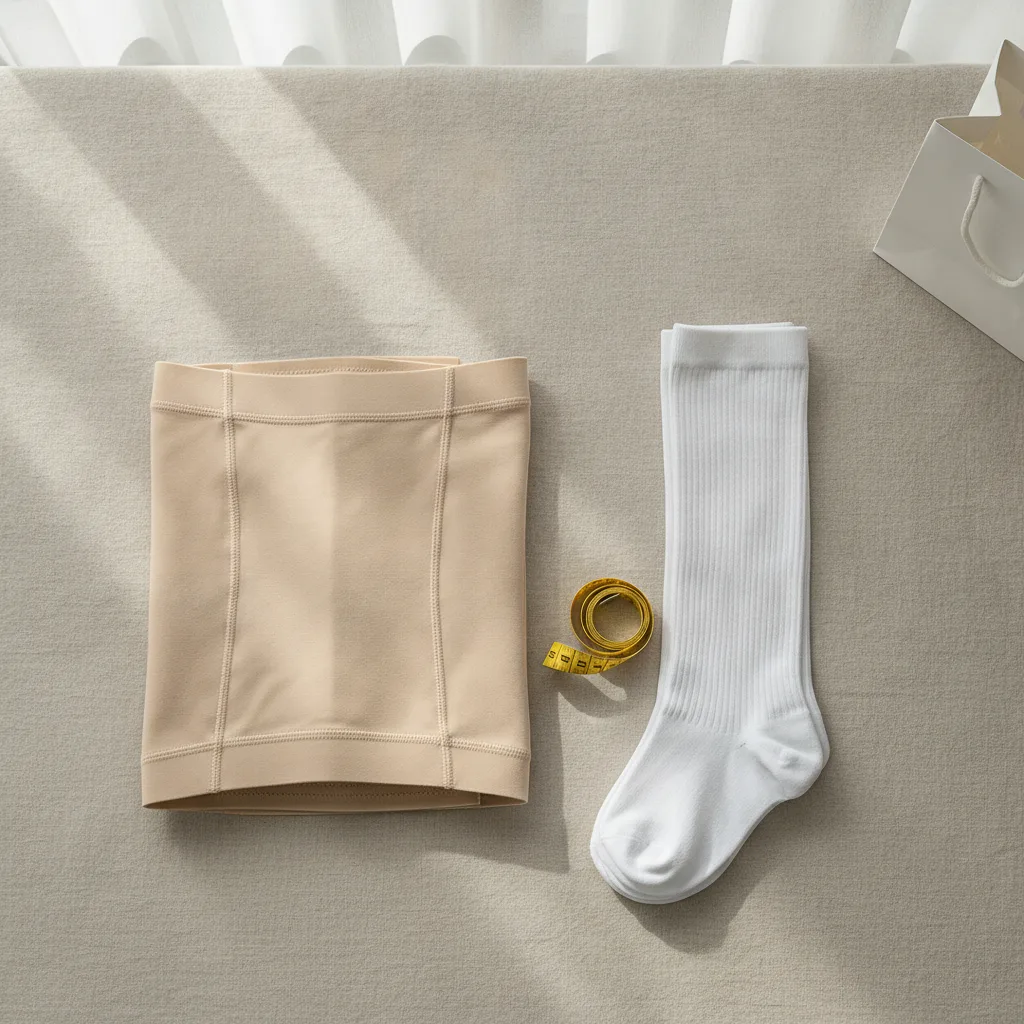
Almost every Seoul clinic hands you a compression garment at discharge, but the quality, number of pieces, and fit vary more than the booking pages suggest. For medical tourists flying in with limited time to shop, knowing exactly what shows up in the aftercare bag changes whether you land smoothly or spend day two hunting a pharmacy for a better binder. This guide pins down what is included with liposuction, tummy tuck, BBL, breast augmentation, and facial contouring packages in Seoul in 2026, what the garments cost at retail, and when to buy your own before the flight.
WHAT SEOUL CLINICS INCLUDE WITH THE SURGERY PRICE
For liposuction packages at mid-tier Gangnam clinics, the standard discharge kit is one Stage 1 full-body or zone-specific compression garment, usually a neoprene-blend pullover style for abdomen and flanks, or a bike-short cut for thighs and buttocks. Most clinics bill this as part of the quoted price. A few premium operators in Apgujeong include both a Stage 1 and a Stage 2 switch-over garment, but this is still the exception rather than the rule. If your quote mentions "all-inclusive aftercare," ask whether that means one garment or two, and whether replacements are free or charged at retail.
Tummy tuck and mommy-makeover packages typically include a high-compression abdominal binder plus an upper-torso shaper when breast work is combined. For 360 lipo with fat transfer to the buttocks, expect a BBL-style cutout garment that keeps pressure off the graft site. The weight and stitching matter more than the brand: a clinic-issued garment at Shinebeam, Ocean, or Xenia will typically be a Korean OEM product, serviceable but not high-end. Full breakdowns of the aftercare that comes bundled with the big body procedures sit in our tummy tuck cost guide and the body contouring trip budget.
Breast augmentation packages follow a different logic. Most Seoul clinics supply a surgical bra, often two in different sizes to accommodate the day-one swelling, plus a chest stabilizer strap worn across the top of the breasts for the first two to three weeks. Facial contouring (two-jaw, zygoma reduction, V-line) packages include a facial wrap or chin strap, which is more of an elastic band than a true compression garment. These are universally included and rarely need an upgrade.
STAGE 1 VS STAGE 2: WHAT THE TERMS ACTUALLY MEAN
Stage 1 garments are what you leave the operating room in. They are heavier, higher-compression, often with external closures to accommodate drains, and designed for the first one to three weeks when swelling and bruising are worst. The fabric is thicker, the seams more aggressive, and the fit deliberately tight to hold tissue planes together. You sleep in them, bathe around them, and generally hate them by day five. Seoul clinics supply Stage 1 by default.
Stage 2 garments start at week two or three, once swelling has dropped and the Stage 1 fits loose. These are thinner, more breathable, and shaped more like premium shapewear than medical gear. They provide moderate compression for the next four to eight weeks while final contour sets. The problem for medical tourists is that most Seoul clinics do not include Stage 2, and by the time you need one you are already home. The practical fix is either to buy a Stage 2 in Seoul before you fly out (around ₩80,000–₩180,000 / –0 at pharmacies in Gangnam and Apgujeong), or order one from a Korean brand online before the trip and pack it.

WHEN TO BUY YOUR OWN GARMENT BEFORE FLYING IN
Three situations justify sourcing your own compression gear before the trip rather than trusting the clinic kit. The first is body size outside typical Korean sizing. Clinic-issued garments run small, with XL often capping around a US 12 or a 100 cm waist. Patients above that range frequently find the Stage 1 too tight in the hips or too short in the torso, which creates bulge lines at the edge and worsens post-op swelling. If you are above a US size 14 or over 172 cm tall, buy a correctly sized medical compression garment from a brand like Marena, Design Veronique, or Leonisa before departure and bring it with you. Show it at consultation. Most Korean surgeons will clear it on sight.
The second is procedure-specific need. If you are doing 360 lipo, a full thigh case, or a combined lipo-and-tummy-tuck, you will want a second Stage 1 garment to rotate while the first is in the wash. Clinics rarely include a spare. Buying a second identical garment at retail in Seoul costs ₩120,000–₩250,000 and keeps you in compliant compression during the laundry cycle. The third is skin sensitivity. Latex and neoprene allergies are not rare, and clinic-issued garments default to blended synthetics. Patients with reactive skin should bring a cotton-lined medical-grade garment from home.
- 01Order from home if: above US size 14, over 172 cm tall, latex or neoprene sensitive, doing multi-zone lipo, or want a cotton lining
- 02Buy in Seoul if: standard sizing but need a Stage 2 switch, want a spare for laundry, or your clinic charges extra for a second piece
- 03Trust the clinic kit if: single-zone procedure, Asian or mid-size Western build, staying in Seoul long enough to swap at week two
WHERE TO BUY COMPRESSION GARMENTS IN SEOUL
The most reliable storefronts for foreign patients are the medical supply pharmacies clustered around Gangnam-gu Office Station (Line 7, Exit 3) and the Apgujeong Rodeo stretch running east from Apgujeong Station Exit 2. These shops stock Korean OEM compression garments from brands like Benaloh, Everylady, and clinic-white-label manufacturers that supply Shinebeam and other Gangnam operators. Expect to pay ₩80,000–₩220,000 for a Stage 2, ₩120,000–₩280,000 for a Stage 1, and ₩40,000–₩80,000 for surgical bras and chest straps. Staff English is limited but a photo of the garment style and your measurements in centimeters is enough to get a correct size.
Larger pharmacies inside Shinsegae Gangnam and Lotte Department Store Avenuel in Myeongdong stock Western-brand compression gear at roughly double the price. If you need a specific brand like Marena immediately and cannot wait for an online order, these are the fallback. For orders delivered to your recovery apartment, Coupang Rocket Delivery reliably moves medical compression within 24 hours inside Seoul. The recovery apartments post covers the neighborhoods where Coupang next-day works best, which is essentially all of Gangnam and most of Yongsan.
HOW LONG DO I ACTUALLY WEAR IT?
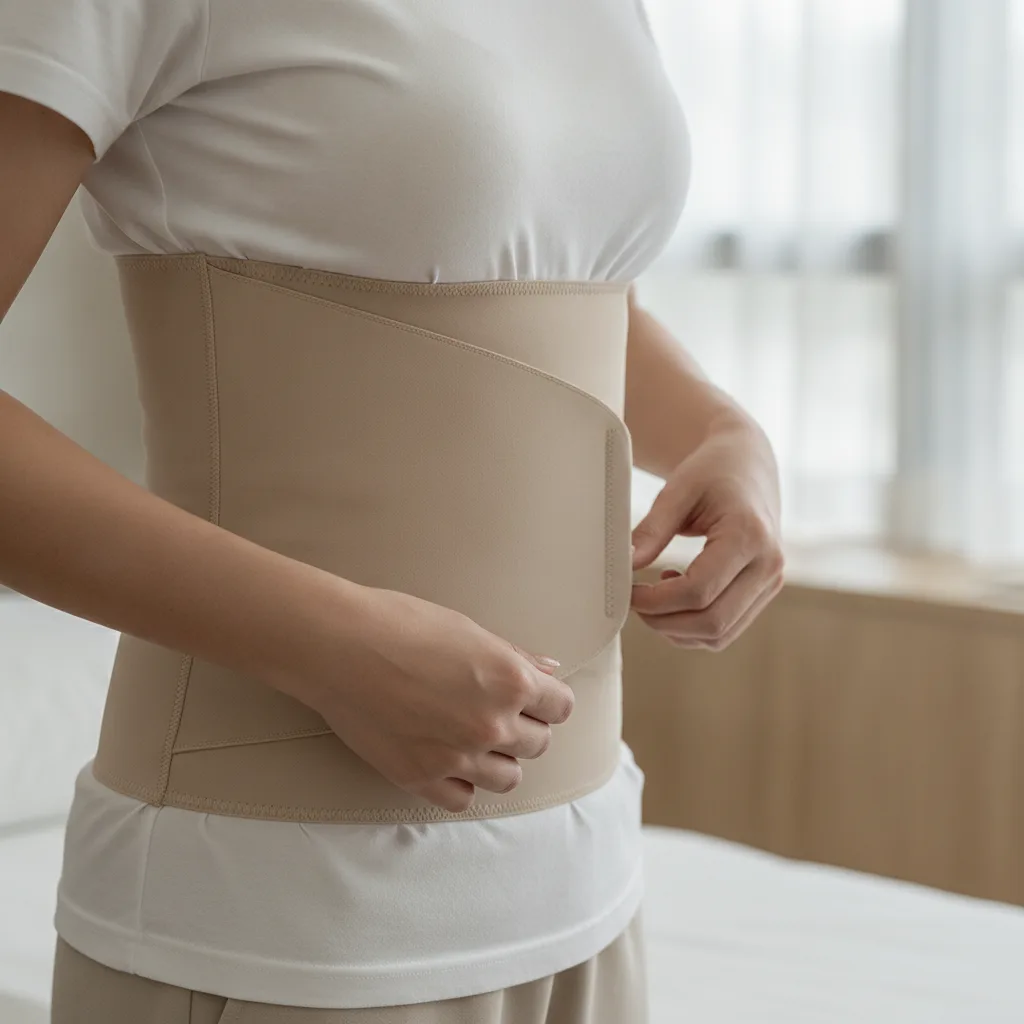
For liposuction and 360 lipo, the standard protocol is Stage 1 for the first two to three weeks worn 24 hours a day except during showering, then Stage 2 for weeks three through eight worn 12 to 16 hours a day. Some Korean surgeons extend Stage 2 through week twelve for large-volume cases. Tummy tuck patients run a similar timeline but with an abdominal binder as the primary garment, often for a full six weeks of 24-hour wear. BBL patients wear a cutout garment for six to eight weeks and are told to avoid sitting directly on the grafted area for the first three weeks regardless of garment.
Breast augmentation compression is shorter. A surgical bra runs for four to six weeks, and the chest stabilizer strap is typically removed at week two to three. Facial contouring wraps come off at the one-week post-op visit, though many surgeons recommend nighttime wear for another two weeks to control swelling. Compression for all procedures assumes you are not flying. If your flight home falls inside the compression window, keep the garment on during the flight. More on timing the trip home sits in our guide to flying home after plastic surgery in Seoul.
CAN I CLAIM COMPRESSION GARMENTS ON TRAVEL INSURANCE OR VAT REFUND?
Most travel-health policies will not reimburse compression garments purchased separately, since they are classified as recovery equipment rather than medical treatment. If your clinic itemizes the garment on the surgical invoice and codes it under the operative package, it can sometimes roll into a wider submission under the surgery claim. This is worth checking with your insurer before the trip. More detail on what travel policies actually cover is in our travel insurance guide.
VAT refund is another story. Compression garments bought at a Tax Free retailer in Korea with a passport-linked receipt of at least ₩30,000 qualify for the standard 10 percent VAT refund at the airport counter. Most of the dedicated medical supply pharmacies in Gangnam do not participate in Tax Free, so this mostly applies to department-store purchases. The VAT and tax refund guide walks through which categories actually refund and which do not.
How-to · 8 min · Nov 13, 2026
← all posts
PRE-OP MEDICAL TESTS FOR SEOUL PLASTIC SURGERY 2026
What foreign patients need in the folder before they fly: blood panels, EKG, imaging, and the Seoul-vs-home-country tradeoff.

RHINOPLASTY SPLINT WEEK IN SEOUL 2026: DAY-BY-DAY RECOVERY FOR MEDICAL TOURISTS
The first ten days after a Seoul nose job, hour by hour: splint care, swelling, hotel vs recovery apartment, and when you can fly.
FLYING HOME AFTER SURGERY IN SEOUL 2026: SAFE TIMELINES BY PROCEDURE
Rhinoplasty, facelift, breast, lipo, two-jaw: how many nights to book before the return flight, and what cabin pressure actually does to swelling.

INSURANCE LETTERS FOR SEOUL PLASTIC SURGERY: 2026 FOREIGN PATIENT GUIDE
What the letter has to contain, which Seoul surgery hospitals issue it cleanly, and how to use it for home-country reimbursement in 2026.
FLYING HOME AFTER PLASTIC SURGERY IN SEOUL 2026: DAYS BY PROCEDURE
Minimum wait before boarding a long-haul flight after rhinoplasty, double eyelid, V-line, breast augmentation, two-jaw, lipo, facelift, and FUE.
▶▶▶ stop reading. start matching.
FIND YOURS.
We'll pull five clinics matched to your case. WhatsApp reply within 24h.