TRAVEL INSURANCE FOR SEOUL PLASTIC SURGERY 2026: WHAT ACTUALLY COVERS YOU
Standard travel policies exclude elective cosmetic surgery. Here is what covers complications abroad, what pays for a stuck flight home, and which Seoul clinics include their own policy.
By Editorial
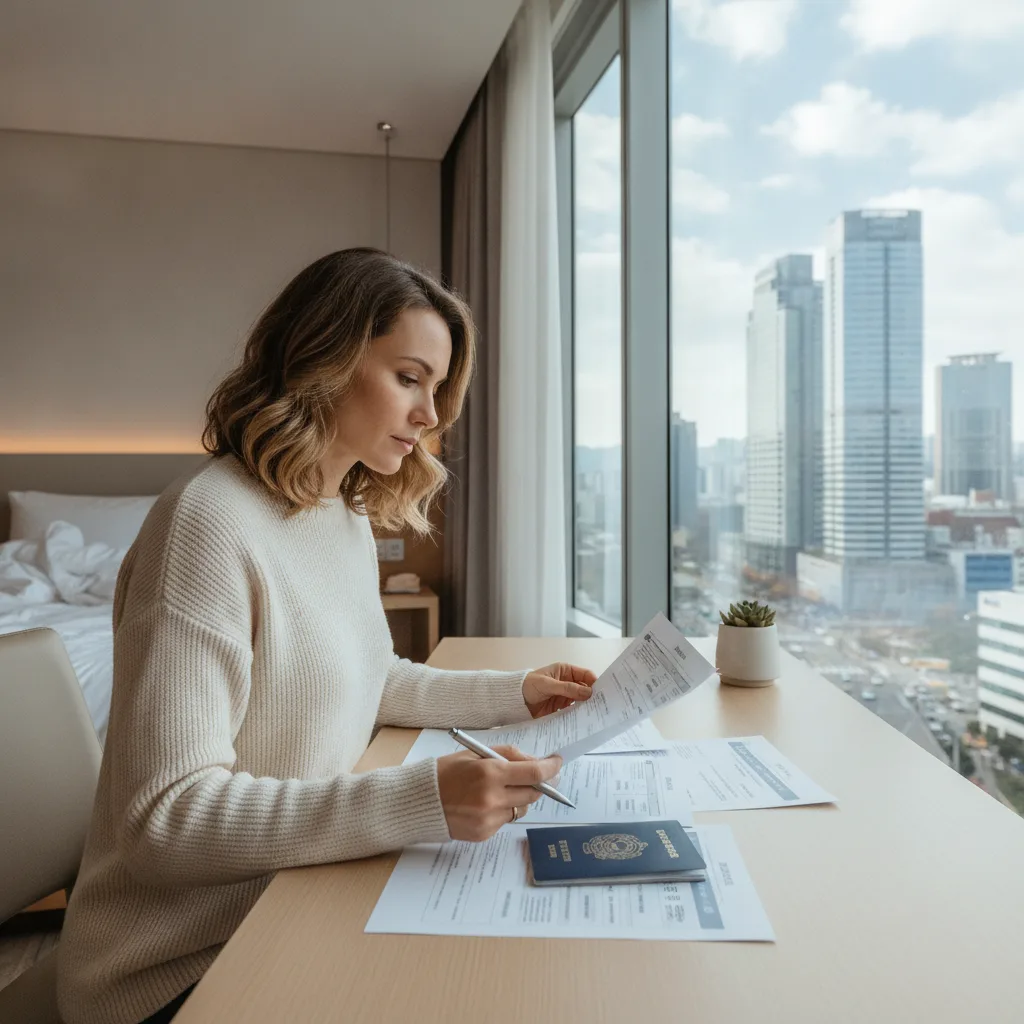
Your regular travel insurance will not pay a won toward your rhinoplasty, your facelift, or any complication that follows. Elective cosmetic surgery sits in the exclusion list of nearly every mainstream policy from Allianz, World Nomads, SafetyWing, and Chubb. The thing you actually need is a dedicated medical-tourism policy or a specialty cosmetic-surgery rider, and the gap between those two products decides whether a wound infection on day 7 costs you nothing or roughly USD 14,000 out of pocket.
WHY YOUR STANDARD TRAVEL POLICY WILL NOT PAY OUT
Every mainstream travel insurer defines an exclusion for elective or cosmetic procedures and any complications arising therefrom. The language varies, the effect does not. If you fly to Seoul for a scheduled rhinoplasty and develop septal necrosis on day 10, your Allianz policy will decline the hospitalization claim, the follow-up CT, and the revision flight. The policy will still cover unrelated events on the same trip, so a twisted ankle in Myeongdong is paid, a hematoma from your facelift is not. The dividing line is causation, and insurers test it hard.
The second trap is the stable-at-departure clause. Many policies only cover acute conditions that arise after you leave home. A procedure booked and paid for before travel disqualifies the entire medical section for anything related to that body region, even events that look unrelated on the surface. Read the policy wording, not the sales page. Search for the words cosmetic, elective, pre-arranged, and foreseeable, and read every paragraph those terms appear in.
The third trap is destination exclusions. South Korea is covered by nearly all US and EU travel insurers for general medical events, but a handful of medical-tourism-specific policies carve out certain countries where the insurer has no claims-handling partner. Confirm Korea is listed in the schedule, not just the generic region Asia.
THE THREE PRODUCTS THAT ACTUALLY COVER COSMETIC SURGERY ABROAD
The specialty market in 2026 is small but real. Three product families cover complications from cosmetic procedures in Seoul with policy limits that match a serious adverse event. The names below are the ones most commonly cited by Korean clinics when they issue an insurance letter.
- 01Global Protective Solutions MediTour: dedicated cosmetic-surgery policy, pays complications up to USD 2 million within 180 days post-op, covers revision in a US or EU clinic if the Korean clinic cannot. Premium runs roughly 7 to 9 percent of the surgery fee.
- 02Seven Corners Medical Tourism Insurance: pairs with specific partner clinics, including several in Gangnam and Apgujeong. Covers complications up to USD 250,000, flight-home upgrade for medical reasons, and USD 200 per day interruption benefit. Premium around 5 to 8 percent of the procedure fee.
- 03Custom Assurance Placement Cosmetic Surgery Rider: adds to an existing US homeowners or health policy, covers complications for 365 days post-op in the home country only (not Korea itself). Useful as a second layer, not a replacement.
Several Seoul clinics bundle a Korean-side policy at no extra charge for foreign patients. These are issued by Hyundai Marine or Samsung Fire & Marine and cover inpatient readmission at the same clinic for 30 to 90 days post-procedure. The limits are usually modest, around KRW 50 million to 100 million, which is enough for most complications but not for a true emergency transfer. Ask for the policy certificate in English before you pay the deposit, not after.

WHAT A KOREAN CLINIC INSURANCE LETTER SHOULD ACTUALLY CONTAIN
Most mid-tier Seoul clinics issue a one-page letter in English on request. The letter is a prerequisite for both a medical-tourism visa application and for any specialty policy at the pricing step. A proper letter from an Apgujeong premium clinic or Cheongdam provider names the procedure in CPT or ICD-10 coding, lists the surgeon by license number, states the date and expected recovery window, and specifies which complications the clinic itself will treat at no additional cost. A letter without a license number is a liability letter, not an insurance letter.
Push for a line that reads revision surgery within 12 months included for the following complications and have the clinic enumerate them. Common inclusions are hematoma drainage, asymmetry correction, implant malposition, and nerve-related ptosis. Common exclusions are infection past day 30, keloid scarring, and patient-reported dissatisfaction that is not clinically abnormal. If the clinic refuses to put a specific complication list in writing, treat that as a signal.
HOW MUCH DOES COSMETIC-SURGERY INSURANCE ACTUALLY COST?
On a KRW 9.5 million primary rhinoplasty (roughly USD 7,000, see rhinoplasty cost in Seoul 2026 for the full band), a Global Protective MediTour policy with USD 1 million in complications coverage runs about USD 480 to USD 630 for a 90-day coverage window. On a KRW 18 million two-jaw surgery, the same policy with a 180-day window runs USD 1,100 to USD 1,400. The premium scales with both the procedure fee and the window length, not with your age.
Seven Corners is cheaper on paper, around 5 percent of the fee for the standard 90-day window, but their covered-clinic list is shorter. If your target clinic is not on their partner schedule, the policy still issues but at a reduced limit. Call the broker before you commit, name the exact Seoul clinic, and ask them to confirm partner status in writing.
The home-country rider from Custom Assurance Placement runs 2 to 4 percent of the procedure fee but only pays out once you are home. For a tourist spending 7 to 10 days in Seoul, this rider is a complement, not a substitute, since the window where you most need coverage is the first 14 days after surgery, which you will spend inside Korea.
WHAT ABOUT FLIGHT DELAYS AND THE STANDARD TRIP-INTERRUPTION PIECE?
This is the one piece a regular travel policy will still cover. If you book a flexible flight home for day 10 and your post-operative recovery requires a 72-hour extension because of swelling, standard trip-interruption benefits usually pay for the change fee and one additional hotel night. The claim trigger is a doctor note stating the delay is medically necessary, not an airline cancellation. Any Seoul clinic will issue the note on request, in English, usually free.
The nuance is that medically-necessary extensions are only covered if they are not a foreseeable outcome of a pre-arranged procedure. Most insurers treat moderate swelling as foreseeable, severe hematoma as not. If the delay is tied to a complication the policy excludes, the trip-interruption claim can be denied even though the flight-change piece seems independent. Ask the clinic to word the medical note around the swelling, not around any procedure-specific complication, if the extension is routine.

WHAT DOES REVISION COVERAGE REALLY LOOK LIKE 6 MONTHS LATER?
Revision is the piece most tourists get wrong. A primary surgery is a single flight, a single hotel block, a single payment. A revision is a second flight six to nine months later, and that is where the Korean-clinic-issued policies run out. Most clinic-side policies cover the surgical fee for one revision but not the airfare, hotel, or lost workdays. The specialty medical-tourism policies cover the surgical fee for the revision if performed in the home country, which solves the body but not the Korean follow-up.
If you are a serious revision candidate, consider stacking: a specialty policy for home-country revision, plus the Korean clinic own policy for Seoul-side readmission, plus a flexible return ticket paid in points rather than cash. Three thin layers beat one thick one when the exclusion lists are different.
How-to · 9 min · Oct 6, 2026
← all posts
CREDIT CARD FEES AT SEOUL AESTHETIC CLINICS 2026: SURCHARGES & FX
What foreign patients actually pay in card surcharges, FX markups, and daily caps at Seoul aesthetic clinics in 2026.
RECOVERY STAYS SEOUL PLASTIC SURGERY 2026: HOTELS AND PRICES
Where foreign patients actually stay after rhinoplasty, two-jaw, breast and body surgery in Seoul, with KRW night rates by district and what to book.
TAX REFUND IN SEOUL FOR AESTHETIC TREATMENTS 2026: VAT RULES EXPLAINED
What foreign patients actually pay in 10% VAT at Seoul aesthetic clinics, which treatments qualify for the Medical Tourism Tax Refund, and how to claim your won back at Incheon.
MEDICAL VISA FOR SEOUL PLASTIC SURGERY 2026: RULES BY COUNTRY
Visa-free entry, K-ETA, and C-3-3 medical tourist visas explained for foreign patients flying to Seoul for plastic surgery in 2026.
DEPOSIT AND REFUND POLICIES AT SEOUL CLINICS 2026
How non-refundable deposits, cancellation windows, and chargeback options really work for foreign patients booking Seoul aesthetic clinics.
▶▶▶ stop reading. start matching.
FIND YOURS.
We'll pull five clinics matched to your case. WhatsApp reply within 24h.