PAYING SEOUL AESTHETIC CLINICS 2026: CASH, CARD, KRW, DEPOSITS
What foreign patients actually pay with at Seoul clinics: card limits, cash discounts, deposit refund rules, and the KRW conversion traps.
By Editorial
Nobody warns you that the last ten minutes of a Seoul clinic visit are a small financial negotiation. You picked the treatment, you survived the consultation, and then the receptionist slides a payment terminal across the desk and quietly asks whether you want to pay in won or in your home currency. The answer matters more than most patients realise, because the gap between the two prices can be 4-7% of the whole bill. This guide covers the payment side of a Seoul aesthetic trip in 2026: what clinics actually accept, when cash buys you a real discount, what deposit rules look like, and the conversion traps that quietly add a hundred dollars to a $2,000 package.
DO SEOUL CLINICS TAKE FOREIGN CREDIT CARDS?
Almost every aesthetic clinic in Gangnam, Apgujeong, Cheongdam, and Sinnonhyeon takes Visa and Mastercard without issue. American Express is accepted at roughly half, mostly the premium Apgujeong tier. JCB works at the Japanese-leaning clinics in Myeongdong. Discover and UnionPay are hit-and-miss and worth confirming by email before you fly. The terminal is usually a KICC or BC Card unit, and the swipe or tap flow is identical to what you know. Foreign-issued cards work on the Korean rails because the acquiring bank treats them as cross-border transactions, which is why your bank, not the clinic, is the one deciding whether the charge clears.
The one failure mode that catches first-timers is bank fraud blocks. A $3,400 charge from Seoul on a US-issued card you have not used abroad in a year often triggers an automatic hold. Call your bank before the trip, log the travel dates, and keep a backup card in your wallet. If your card does decline at the clinic, the receptionist can usually re-run it as a split charge across two cards, or in two separate transactions one hour apart, which seems to clear the fraud filter about 80% of the time. For the full foreign-booking workflow before you even land, see how to book a Seoul aesthetic clinic from abroad.
CASH VS CARD: IS THE DISCOUNT REAL?
Yes, and it is bigger than Western patients expect. Korean clinics pay 2.5-3.5% in card processing fees, and most will share a chunk of that with a cash-paying patient if you ask directly. The typical cash discount in 2026 sits at 5-10% off the quoted price, higher for larger packages. On a ₩2,000,000 Ulthera session you are looking at a ₩100,000 to ₩200,000 cash discount, which is roughly $75 to $150. On a ₩8,000,000 breast augmentation package the discount pushes closer to 10% because the absolute card fee is enough that the clinic genuinely feels it.
Three rules make the cash discount actually appear. First, ask once at the start of consultation, not after they have already written up a card quote, because once the number is in their system they tend to defend it. Second, use the phrase "hyeongeum halin" (cash discount) or write it on your phone in Hangul if the coordinator is a translator rather than native English staff. Third, bring the cash in large notes. A clinic charging ₩2,500,000 wants fifty 50,000 won notes, not a bag of 10,000s. For context on how the quoted number is built in the first place, how to read a Korean clinic price menu breaks down the line items. On whether the quote also hides VAT, the short answer is that most Gangnam injectables quotes include VAT but a lot of surgery packages don't, and the clinic will tell you only if you ask.
HOW MUCH KRW CASH SHOULD YOU BRING?
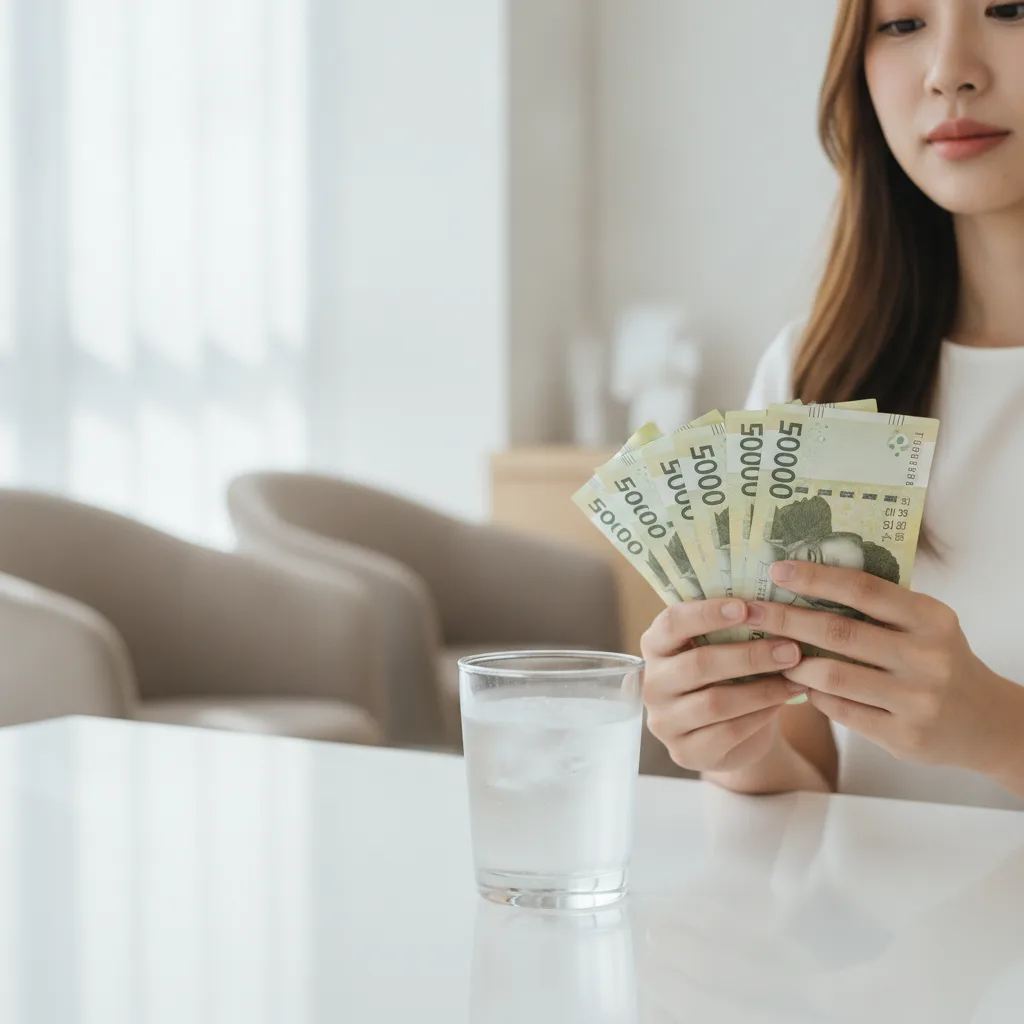
The right cash target is not the full treatment cost. ATMs in Gangnam dispense a maximum of ₩1,000,000 per transaction and ₩3,000,000 per day on foreign cards, and the big clinics are rarely willing to wait an afternoon while you make three trips to a KB Kookmin branch. Bring enough cash to cover the deposit, the add-ons, and a cash-discount injectables session, and run the big surgery bill on card. For a 7-day aesthetic trip the realistic cash target looks like this:
- 01Injectables-only trip (Botox, filler, boosters, Rejuran): ₩500,000 to ₩1,500,000 total
- 02Energy-based trip (Ulthera, Shurink, Thermage, laser toning): ₩800,000 to ₩2,500,000
- 03Mid-surgery trip (double eyelid, non-incisional ptosis, thread lift): ₩1,500,000 to ₩3,000,000 cash plus card for the main package
- 04Major surgery trip (rhinoplasty, breast aug, two-jaw, V-line): ₩2,000,000 cash for extras, card for the main bill
Pull KRW at the airport counter inside the arrivals hall at Incheon Terminal 1 or 2 before you clear customs, because the airport Hana Bank booths run close to interbank rate with a flat ₩3,000 commission. The hotel exchange rate is 2-3% worse. The subway-station ATMs around Gangnam, Sinnonhyeon, and Apgujeong accept foreign Visa and Mastercard cleanly, with a ₩3,500-₩4,000 ATM fee per withdrawal plus whatever your home bank layers on top. Avoid any ATM branded "Travelex" or "Global ATM" because they offer dynamic currency conversion by default and shave another 3-4% off the rate.
DEPOSIT RULES: HOW REFUNDABLE IS "REFUNDABLE"?
Most Seoul clinics now charge a booking deposit for foreign patients. The deposit protects the clinic against the no-show rate on international bookings, which runs 15-25% depending on the clinic. For injectables and energy-based treatments the deposit is usually ₩100,000-₩300,000 and is deducted from the final bill on the day. For surgery it is usually 10% of the quoted package, meaning ₩300,000-₩1,000,000, and it is sometimes split as a non-refundable consultation fee plus a refundable surgery hold.
The refund rules are where patients get burned, because "refundable" in a Korean contract typically means refundable minus a time-based penalty. The common structure in 2026 looks like a full refund if you cancel more than 14 days out, 50% between 14 and 7 days, 30% between 7 and 48 hours, and zero inside 48 hours. Read the Korean-language contract line, not just the English summary, because the English page sometimes rounds the terms generously while the Korean binds you. If the coordinator refuses to send the contract before you pay, treat that as a soft red flag and ask again, in writing, by email. More on the broader red-flag pattern lives in how to avoid consultation upsell.
THE 3% DYNAMIC CURRENCY CONVERSION TRAP
When the receptionist asks whether you want to pay in Korean won or in your home currency, say Korean won every single time. The home-currency option is called dynamic currency conversion, DCC, and it layers a 3-6% markup over the interbank rate before your bank even sees the charge. On a ₩4,000,000 charge that is $90 to $180 of pure margin going to the terminal provider, not the clinic. The Korean-won option sends the raw KRW amount to your bank, which converts it at its own rate, usually within 1% of the interbank rate for a mainstream Visa or Mastercard. The clinic receives the same money either way, so there is no social cost to refusing DCC.
If your card has a foreign-transaction fee, which most US cards do at 1-3%, you cannot avoid that layer. But stacking a 3% foreign-transaction fee on top of a 4% DCC markup is where $300 vanishes from a package without you ever seeing it on an invoice. A no-foreign-transaction-fee card (Chase Sapphire, Capital One Venture, Wise, Revolut) run in KRW is the cleanest combination and typically beats cash on anything above ₩3,000,000 once you account for the airport exchange spread.
WIRE TRANSFERS, DEPOSITS FROM ABROAD, AND THE 2026 WISE OPTION
Pre-flight deposits used to mean a $50 bank wire fee for a $300 deposit, which was its own small insult. In 2026, most Seoul clinics with a foreign-patient desk accept Wise, Revolut, or Western Union transfers to a KB Kookmin or Shinhan corporate account. The Wise route lands the deposit at the clinic in under 24 hours with a fee of ₩8,000-₩15,000 on a ₩500,000 transfer, which is roughly a 2% all-in cost. Keep the Wise receipt and the clinic's confirmation email in one folder, because occasionally the deposit is credited to the wrong patient file and you need to prove the trace.
Avoid PayPal to the clinic. PayPal cross-border fees run 4.4% plus a fixed charge, and the chargeback protection most patients assume they have does not apply to medical services across jurisdictions. Credit card chargebacks for aesthetic treatment "not as described" are nearly impossible to win because the clinic can show you signed the consent form. If something goes wrong, your path is the clinic's internal grievance process and, as a backup, the Korea Health Industry Development Institute medical dispute mediation line, not Visa dispute resolution. For a sanity check on what tier of care your money is actually buying, when premium pricing is worth it walks through the price-quality trade.
How-to · 7 min · Oct 1, 2026
← all posts
CREDIT CARD FEES AT SEOUL AESTHETIC CLINICS 2026: SURCHARGES & FX
What foreign patients actually pay in card surcharges, FX markups, and daily caps at Seoul aesthetic clinics in 2026.
RECOVERY STAYS SEOUL PLASTIC SURGERY 2026: HOTELS AND PRICES
Where foreign patients actually stay after rhinoplasty, two-jaw, breast and body surgery in Seoul, with KRW night rates by district and what to book.
TRAVEL INSURANCE FOR SEOUL PLASTIC SURGERY 2026: WHAT ACTUALLY COVERS YOU
Standard travel policies exclude elective cosmetic surgery. Here is what covers complications abroad, what pays for a stuck flight home, and which Seoul clinics include their own policy.
TAX REFUND IN SEOUL FOR AESTHETIC TREATMENTS 2026: VAT RULES EXPLAINED
What foreign patients actually pay in 10% VAT at Seoul aesthetic clinics, which treatments qualify for the Medical Tourism Tax Refund, and how to claim your won back at Incheon.
MEDICAL VISA FOR SEOUL PLASTIC SURGERY 2026: RULES BY COUNTRY
Visa-free entry, K-ETA, and C-3-3 medical tourist visas explained for foreign patients flying to Seoul for plastic surgery in 2026.
▶▶▶ stop reading. start matching.
FIND YOURS.
We'll pull five clinics matched to your case. WhatsApp reply within 24h.