TWO-JAW SURGERY RECOVERY TIMELINE IN SEOUL 2026: WEEK BY WEEK
A realistic week-by-week recovery map for orthognathic surgery in Seoul, from the ICU-adjacent first night to bone consolidation at month six.
By Editorial
Two-jaw surgery is the most invasive procedure most medical tourists in Seoul will ever schedule, and the recovery is not a smooth downhill glide. It is a stepped process with a hard first week, a fragile first month, and a slow bone-healing tail that runs six to twelve months. Knowing what week you are in, what should be improving, and what is a red flag makes the difference between a controlled recovery and a panicked call to a coordinator at 2 a.m.
WHAT SURGERY YOU ARE ACTUALLY RECOVERING FROM
Bimaxillary osteotomy cuts the maxilla at a Le Fort I level and splits the mandible with bilateral sagittal split osteotomies. Both bones are repositioned in three dimensions, then locked with titanium plates and screws, usually 4 to 8 plates depending on the movement. Your bite is fixed with elastics rather than wired shut, which is the standard in Seoul as of 2026. That means you can open your mouth, but you should not, for weeks.
Because the incisions are intra-oral, there is no visible scar. What there is: swelling in three planes, temporary numbness of the lower lip and chin from inferior alveolar nerve stretch, an altered bite, and a jaw that feels foreign for months. Roughly a third of patients report some patch of numbness at six months, and about 5 to 10 percent retain a permanent minor sensory deficit. Every reputable Seoul surgeon covers this in consult. If yours skips it, that is a signal.
For the surgical fundamentals of the procedure itself, our two-jaw surgery guide walks through movement types, plate systems, and the CT-based planning phase. This post assumes surgery is behind you and focuses on the calendar from day 0.
DAY 0 TO DAY 3: HOSPITAL STAY
Most Seoul clinics keep two-jaw patients in-house for 2 to 3 nights. Braun Plastic Surgery in Seocho, which runs a CCTV-monitored OR and an in-house anesthesiologist, follows a standard 3-night inpatient protocol with vital-sign monitoring, IV antibiotics, and steroid tapering. Girin Plastic Surgery, also Seocho, is government foreigner-designated and includes room-and-board for the inpatient stretch in its package. You will not be walking around Gangnam on day 2. Assume you are horizontal, on ice, and only sipping water through a syringe.
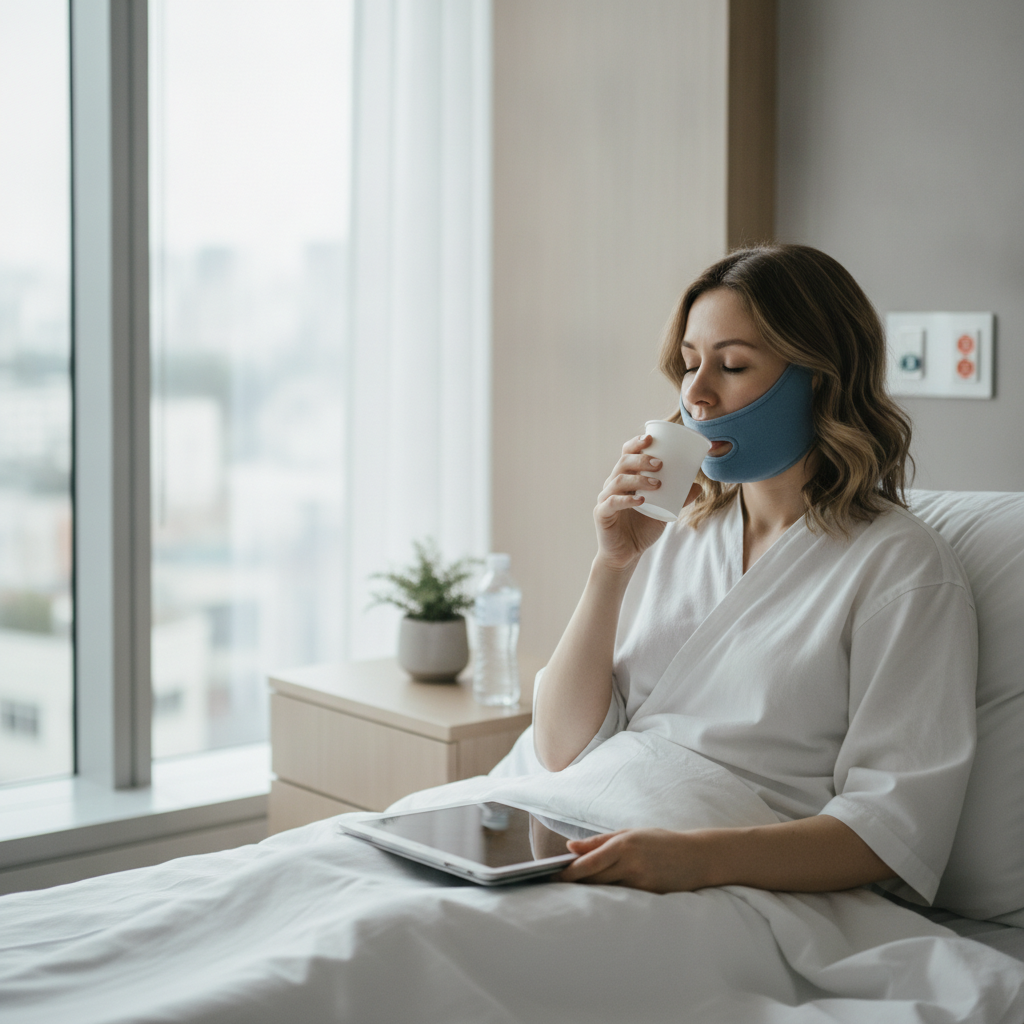
Swelling peaks around 48 to 72 hours, not day 1. That means day 3 is when your face looks worst. Coordinators warn foreign patients about this because most people expect a straight-line improvement and panic when it gets worse before it gets better. Ice packs on 20-minute cycles for the first 48 hours, then a switch to warm compresses at day 4, is the protocol most Seoul clinics use.
- 01Bleeding: mild oozing from the mouth is normal for 24 to 48 hours. Bright red flow is not.
- 02Pain: managed with tramadol and NSAIDs. Most patients rate day-1 pain 3 to 5 out of 10, less than expected.
- 03Diet: cold water and clear broth through a 60 mL syringe. No solids, no straws (suction risks bleeding).
- 04Sleep: head elevated 30 to 45 degrees on 2 pillows or a wedge, for the full first month.
WEEK 1: DISCHARGE AND THE SWELLING PEAK
You are discharged around day 3 or 4 to a nearby serviced apartment. Most foreign patients stay in Sinsa, Apgujeong, or Nonhyeon within a 10-minute cab of the clinic, because you will be back for daily or every-other-day dressings and elastic checks in week 1. UE Plastic Surgery in Apgujeong runs a coordinator system that schedules these visits in English and handles the taxi arrangement, which sounds trivial until you are five days post-op and cannot open your mouth to ask a driver anything.
Diet moves from clear liquids to cold blended soups by day 5. No hot food. Heat dilates vessels and worsens swelling. Sleeping remains elevated. Talking is discouraged, and most patients use a phone-based text app with their coordinator or a small whiteboard. Elastics are worn 24 hours a day except during rinsing, and they will feel tight. That is intentional. Removing them for comfort is the single most common mistake foreign patients make in week 1.
Bruising migrates down the neck and into the upper chest by day 7. This looks alarming and is expected. The classic yellow-green mottling means bruising is resolving. What is not expected: fever above 38.5 C, a sudden increase in swelling on one side, or new numbness of the tongue. Any of those goes to the clinic that day.
WEEK 2 TO 4: THE FRAGILE PHASE
By day 10 to 14, most of the visible swelling in your cheeks is down 40 to 50 percent, and stitches are removed if you had extra-oral micro-anchor sutures. Intra-oral sutures dissolve on their own by week 3. Elastics may loosen to a night-only schedule around day 21, depending on your surgeon's protocol. Saero Plastic Surgery in Gangnam, which has native English support and an ISAPS-credentialed team, typically flips elastics to night-only at week 3 for patients with a stable occlusion.
Diet expands to soft foods you do not have to chew: mashed potato, silken tofu, congee, protein shakes, well-cooked pasta cut small. Most Seoul patients lose 4 to 7 kg by week 4. That is expected. Aggressively force-feeding calories through a syringe is fine, and coordinators will sometimes recommend a Korean rice-porridge chain called Bonjuk for calorie-dense soft meals that do not require chewing.
This is also when you fly home if you scheduled a 4-week trip. Airline pressure is safe by week 3 in almost all cases, but the risk you carry home is a delayed infection or a plate loosening from a bad chew. Bring your surgeon's mobile line, your CT and X-ray images on a USB, and an antibiotic prescription in case you need to fill it locally. Our flying home after Seoul aesthetic recovery covers cabin pressure, medication timing, and airport logistics in detail.
MONTH 2 TO 3: THE PLATEAU NOBODY WARNS YOU ABOUT
Roughly 70 percent of visible swelling clears by week 6. The last 30 percent does not. It sits in your lower face, along the jawline and under the chin, and it will not shift on your timeline. Bone remodels around the plates, and edema clears through the lymphatic system slowly. Most patients describe month 2 as the psychologically hardest phase because the face looks different, the swelling is not obviously going down day to day, and social life resumes before the result is visible.
Numbness of the lower lip and chin is usually still present, most patients report a tingling pins-and-needles sensation as nerves reawaken. That paresthesia is a good sign. It means the inferior alveolar nerve is recovering. Around week 8, most surgeons clear patients for gentle jaw stretching exercises to restore mouth opening. Normal aperture is 40 to 55 mm between the incisors, and a healthy two-jaw recovery is back to 35 mm by week 8 and 40+ by week 12.
Physiotherapy is not routine in Seoul the way it is in Europe, but the Foreigner Coordinator Center at THE PLUS Plastic Surgery in Gangnam does refer week-8 patients to a small network of oral-myofunctional therapists in Sinnonhyeon. If your surgeon does not offer this, ask specifically about myofunctional therapy for TMJ range.
MONTH 4 TO 6: BONE CONSOLIDATION
Bone healing around osteotomy sites takes 4 to 6 months to reach roughly 80 percent of final strength. During this window you can chew progressively firmer foods, but hard nuts, tough steak, and dense breads are off the menu until month 6 in most protocols. Panoramic X-rays at month 3 and month 6 confirm plate position and bone bridging. Foreign patients usually do these at a local oral surgery clinic and email the images to the Seoul team for review.
Sensation continues to return in patches. By month 6, most patients recover 80 to 95 percent of chin and lip sensation, with a small area of residual numbness that may or may not fully resolve. If you had a genioplasty at the same time, our genioplasty in Seoul guide covers the chin-specific nerve timeline that stacks on top of the bimaxillary work.
This is when your face starts to look like the final result. The lower two-thirds tighten, the jawline sharpens, and the profile you saw in your simulation begins to match reality. Patients who move too fast in this window, chewing hard food or getting hit in the face at the gym, are the ones who come back for revision hardware removal or a second procedure. The two-jaw crowd on Korean recovery forums has a saying: the surgery is one day, the recovery is one year. Believe it.
HOW DO I KNOW IF MY RECOVERY IS GOING WRONG?
Most red flags cluster in specific weeks. Any of the following warrants a same-day message to your Seoul surgeon and, if severe, a visit to a local ER with a note translated to English. Coordinators at Braun and Girin will call ahead to a foreign hospital on your behalf if needed.
- 01Fever above 38.5 C after week 1: possible plate-site infection.
- 02Asymmetric swelling that worsens after week 2: possible hematoma or seroma.
- 03Sharp pain at a plate site with pressure, months in: possible plate loosening or exposure.
- 04Complete numbness of the tongue: nerve compression, not the typical lip/chin paresthesia.
- 05Bite that shifts noticeably at week 4 or later: occlusion instability, may need elastic re-adjustment.
- 06Sudden bleeding from the nose at any point after week 2: possible maxillary plate or sinus complication.
HOW LONG BEFORE I CAN WORK OUT AGAIN?
Walking on flat ground at low pace is fine from week 2. Light stationary cycling and low-heart-rate treadmill work from week 4. Full cardio from week 6. Weight training from week 8, avoiding anything that Valsalvas hard on the jaw or brings a barbell near the face. Contact sports, martial arts, and any activity with a face-impact risk stay off until month 6 minimum. Divers wait until month 4 for the sinus to settle after the Le Fort I cut.
HOW LONG UNTIL I LOOK LIKE MY SIMULATION?
The bones are in their final position from day 1, but the soft tissue takes 6 to 12 months to settle over them. Most patients look 80 percent finished at month 3, 90 percent at month 6, and 100 percent at month 12. Photos taken before month 4 will still show residual swelling that mutes the definition. Save the before-and-after photo shoot for month 6 or later.
CAN I GET REVISION OR HARDWARE REMOVAL IN SEOUL?
Plate removal is optional in most cases and is scheduled at month 12 or later if the patient requests it, usually for MRI compatibility or a foreign-body sensation. Removal is a shorter procedure than the original and requires 2 to 3 days in Seoul. Revision osteotomy for a poor outcome is technically possible but rare, and most Seoul surgeons will refer complex revisions to a small group of specialists such as the KAPRS members listed at Girin Plastic Surgery. Cost for revision runs 60 to 100 percent of the original fee.
REALISTIC SEOUL COST, BUDGET, AND HIDDEN LINE ITEMS
Two-jaw surgery in Seoul in 2026 runs 22 to 45 million KRW (roughly $16,000 to $33,000 USD) surgeon-dependent, with the top-tier Apgujeong and Gangnam names sitting at the upper end. Our two-jaw surgery cost guide breaks down the package versus a-la-carte pricing. The recovery-specific costs that patients forget: a serviced apartment near the clinic for 4 weeks at around 3 to 5 million KRW total, daily blended-food delivery from around 20,000 KRW a day, and follow-up X-rays back home at 100 to 300 USD each visit.
How-to · 10 min · Sep 15, 2026
← all posts
LIPOSUCTION RECOVERY TIMELINE SEOUL: WEEK BY WEEK (2026)
Realistic week-by-week liposuction recovery in Seoul, from compression garment days through swelling peaks to the earliest safe flight home.
RHINOPLASTY RECOVERY IN SEOUL 2026: WEEK-BY-WEEK TIMELINE
A day-by-day, week-by-week recovery map for rhinoplasty in Seoul, from splint removal to final tip refinement at month twelve.
BREAST AUGMENTATION RECOVERY IN SEOUL: WEEK-BY-WEEK TIMELINE 2026
A day-by-day and week-by-week recovery map for international patients getting breast implants in Gangnam, from surgery day through the six-week clearance.
FACELIFT RECOVERY TIMELINE IN SEOUL: WEEK BY WEEK (2026)
A realistic day-by-day and week-by-week facelift recovery timeline for medical tourists in Seoul, from compression day 1 to fully settled month six.
HOW TO AVOID CONSULTATION UPSELL AT SEOUL CLINICS (2026)
A practical script for foreigners: how Seoul aesthetic clinics upsell, and the exact lines that keep your quote honest.
▶▶▶ stop reading. start matching.
FIND YOURS.
We'll pull five clinics matched to your case. WhatsApp reply within 24h.